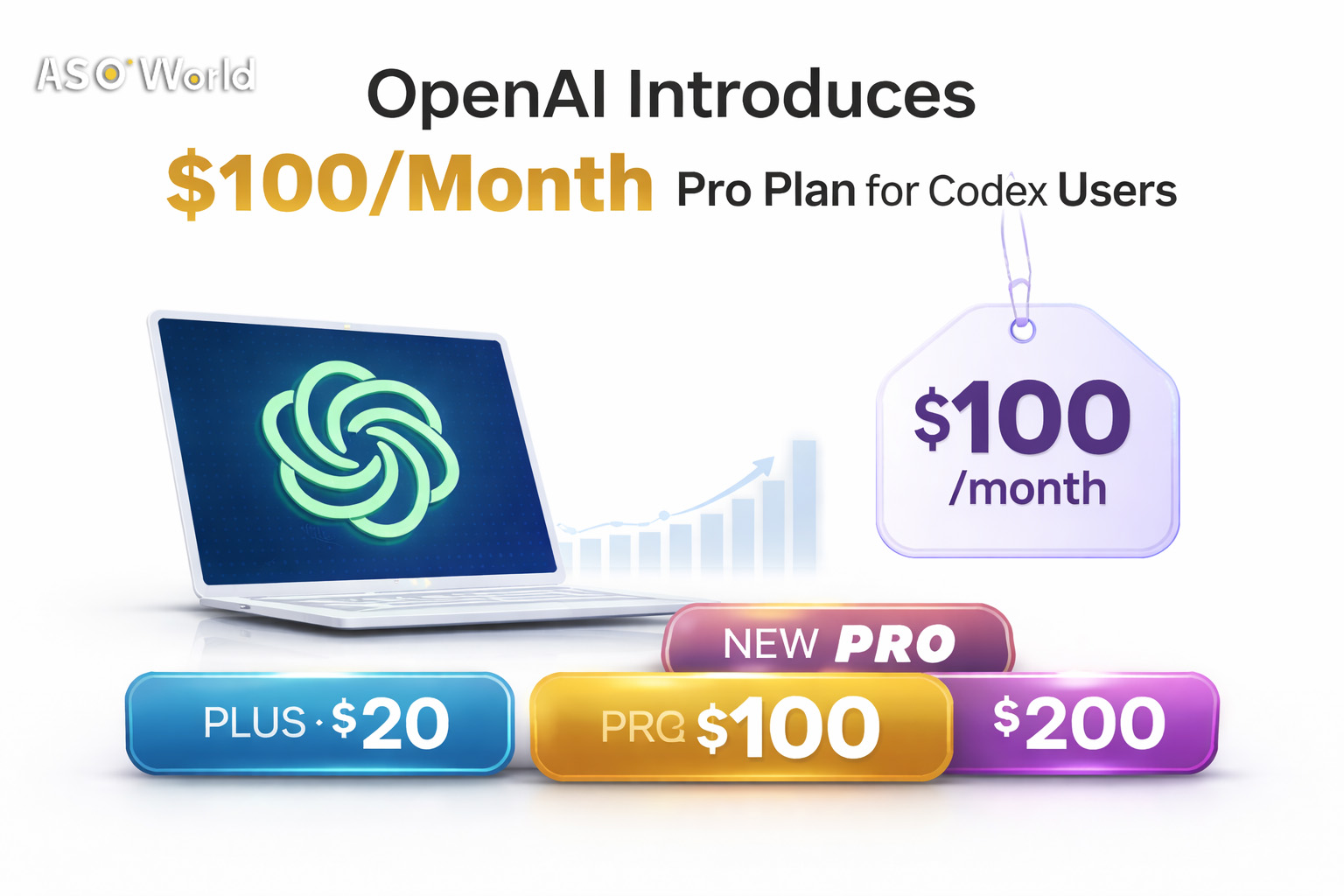

OpenAI has introduced a new $100-per-month ChatGPT Pro subscription tier aimed at users of its Codex coding agent. The move expands the company’s pricing structure and targets developers who have outgrown the $20 Plus plan but do not require the full capacity of the $200 Pro tier.
The launch comes amid rapid growth in Codex adoption, which now exceeds 3 million weekly active users, with usage increasing roughly 70% month over month, reflecting strong demand for AI-powered coding tools.
New $100 Tier Bridges the Gap in OpenAI’s Subscription Model
OpenAI’s updated pricing structure now includes Free, Go ($8), Plus ($20), Pro ($100), and Pro ($200) tiers. The new $100 plan is designed as a mid-point offering for high-usage developers.
Key features of the $100 Pro tier include:
- Around 5x usage limits compared to Plus
- Access to exclusive Pro-level models
- Unlimited access to Instant and Thinking model variants
- Temporary promotion offering up to 10x Codex usage through May 31
The $200 tier remains available for users requiring maximum throughput and parallel workload support. Both Pro tiers share the same core capabilities, with differences primarily in usage limits rather than features.
Codex Growth Drives Demand for Mid-Tier Monetization
The introduction of the new plan is closely tied to Codex’s rapid adoption. The coding agent has become a central driver of OpenAI’s developer ecosystem, with usage expanding significantly in a short period.
This surge has created a clear pricing gap:
- $20 plan users frequently hit usage limits
- $200 plan is too expensive for many mid-level developers
- A mid-tier option fills this monetization “sweet spot”
As a result, usage-based constraints are becoming a key trigger for upgrades, rather than feature differentiation.
Competitive Pressure from Anthropic Shapes Pricing Strategy
The $100 tier also positions OpenAI directly against Anthropic’s Claude Max 5x plan, which is similarly priced and targets high-frequency AI coding users.
Both companies are now competing on:
- Usage capacity per dollar
- Developer workflow efficiency
- Retention of power users
This reflects a broader shift in the AI coding market, where competition is no longer defined purely by model capability but by pricing architecture and usage economics.
Subscription Layering Becomes Core Growth Infrastructure
OpenAI’s expanded pricing structure highlights a broader industry trend toward segmented monetization strategies.
The current model creates a structured funnel:
- Entry tiers drive acquisition
- Mid tiers drive conversion and revenue
- High tiers anchor perceived value and serve heavy users
This structure makes usage limits a primary growth lever, turning product engagement directly into subscription upgrades.
Comments
The introduction of a mid-tier $100 plan signals a maturing AI SaaS market where pricing design is becoming as important as model performance. Subscription architecture is now a central growth strategy, not just a monetization detail.
Sign up and stay tuned to our AI Tech News section for the latest updates!
FAQ
1. Why did OpenAI introduce a $100 Pro tier?
To bridge the gap between $20 Plus and $200 Pro plans and better serve mid-level and high-usage developers.
2. What are the main differences between $100 and $200 plans?
Both share core features, but differ mainly in usage limits and capacity.
3. How does Codex growth influence pricing strategy?
Rapid growth in usage creates demand for higher tiers and more flexible capacity options.
4. How does this affect AI developers and app builders?
It signals that usage limits and subscription design are now key growth and monetization levers in AI products.

 Follow Us on Facebook