
Google is pushing AI Search more aggressively than ever before. But the market reaction may not be what the company expected.
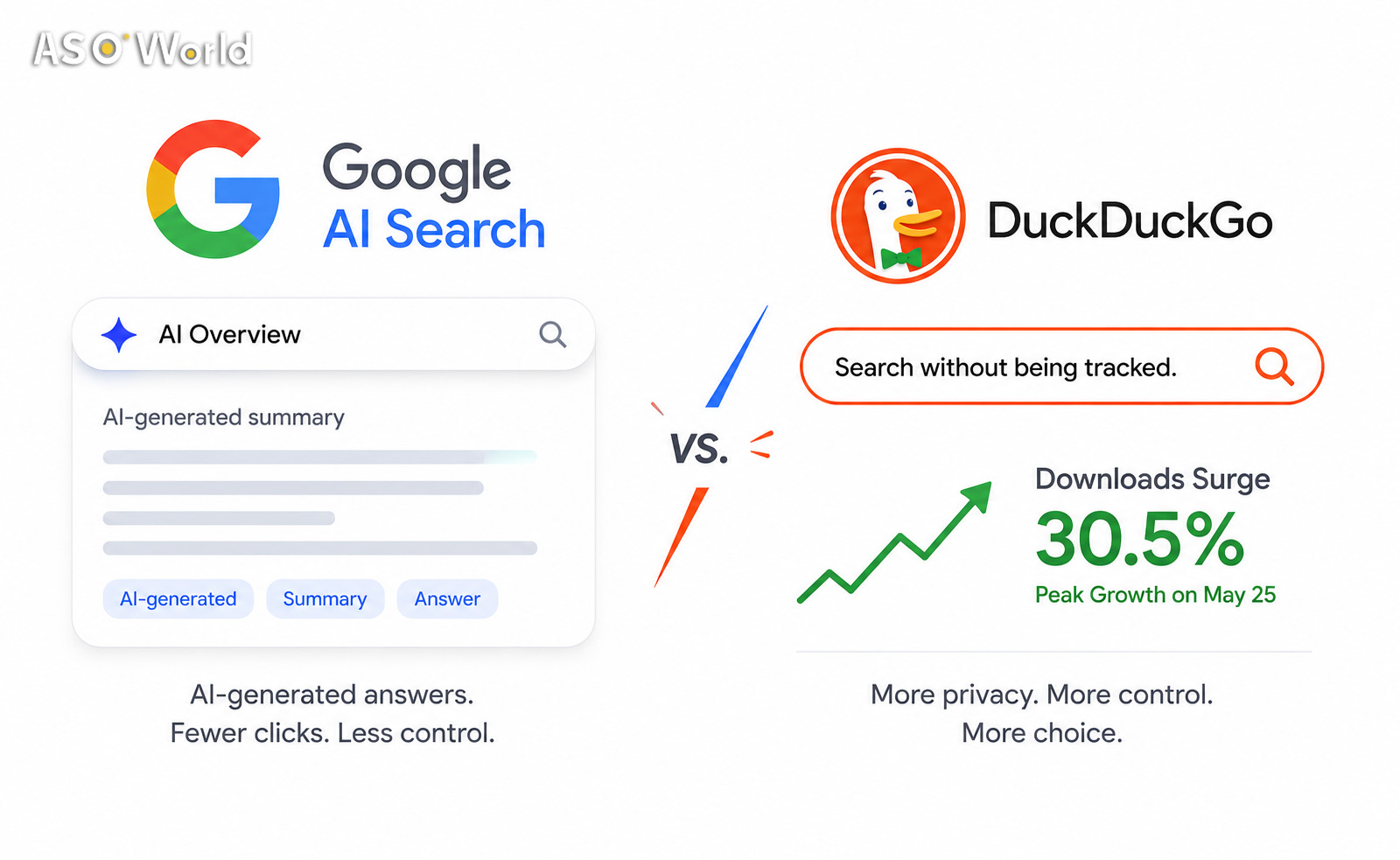
Shortly after Google I/O 2026 introduced Google’s large-scale AI Search rollout, privacy-focused search engine DuckDuckGo saw downloads surge across the U.S.
According to reports from TechCrunch, DuckDuckGo app installs increased an average of 18.1% week-over-week between May 20 and May 25, with growth continuing for six consecutive days. On May 25, downloads peaked at 30.5%, while iOS installs reportedly reached nearly 70% daily growth at their highest point.
Google’s AI Search Rollout Is Changing User Behavior
At first glance, this may look like a temporary reaction to Google’s latest AI announcements. But the underlying signal is much more important: users are beginning to push back against overly AI-controlled search experiences.
Google’s new AI Search model increasingly places AI-generated summaries and interpretations ahead of traditional search results. Instead of comparing multiple websites themselves, users are now being guided toward a single AI-generated answer layer first.
While this creates a faster experience, it also changes how users interact with information online. For many users, search is no longer about discovering information independently. It is gradually becoming an AI-mediated experience where interpretation happens before exploration. That shift may improve convenience, but it also reduces transparency and user control — two things many internet users still value heavily.
Why This Matters for Developers
For developers, this shift is bigger than a search UI redesign. For years, app discovery and web traffic depended heavily on SEO visibility, keyword relevance, and ranking positions. But AI Search changes the distribution layer itself. If users receive answers directly from AI summaries, fewer people may click through to original websites, apps, or platforms.
AI Search Could Reduce Traditional Organic Traffic
Products that rely heavily on Google-driven discovery may face increasing pressure as AI-generated answers absorb more informational queries directly inside search results.
This is especially important for:
- utility apps
- content platforms
- AI tools
- educational products
- comparison services
- media websites
As AI summaries become more comprehensive, users may consume information without ever visiting the original source. That means developers can no longer rely solely on traditional SEO strategies for sustainable acquisition.
The competition is no longer just about ranking first on Google. It is increasingly about whether users still need to leave Google at all.
User Trust Is Becoming a Competitive Advantage
DuckDuckGo’s growth is significant because it reveals something deeper about current user sentiment. Users are not necessarily rejecting AI itself. Instead, many users are reacting against experiences that feel overly automated, filtered, or controlled by AI systems.
That distinction matters. The next generation of successful AI products may not be the ones that automate everything. Instead, they may be the products that balance AI convenience with transparency, customization, and user choice.
This trend is already appearing across multiple product categories, where users increasingly prefer:
- AI tools with editable outputs
- recommendation systems with visible logic
- products that cite original sources
- search experiences with higher controllability
- productivity tools that assist rather than replace decision-making
AI Fatigue May Become a New Market Opportunity
The AI product market is rapidly becoming saturated with experiences designed around maximum automation. But as more platforms aggressively insert AI into core workflows, user fatigue is starting to emerge.
That creates a positioning opportunity for developers. Products that make users feel more in control may become increasingly differentiated in the next phase of the AI market. Features like source visibility, adjustable AI behavior, manual modes, and transparent recommendations could become important retention advantages rather than secondary UX features.
In many ways, the recent DuckDuckGo surge may be less about search engines specifically and more about changing expectations around AI products overall.
The Bigger Shift Behind Google’s AI Strategy
Google’s AI Search rollout may ultimately accelerate a much larger industry transition. For the past two years, most technology companies have operated under the assumption that adding more AI automatically improves user experience. But user behavior is now suggesting a more nuanced reality.
People want AI assistance. But they do not always want AI control. For developers building AI-powered apps in 2026, that difference may become one of the most important product strategy questions moving forward.
Comment
Google’s AI Search rollout may end up creating an unexpected market shift: users realizing they don’t actually want every digital experience filtered through AI first.
DuckDuckGo’s growth isn’t just about privacy anymore. It reflects a growing demand for products that feel more transparent, controllable, and less algorithmically overwhelming.
For developers, this is probably the bigger takeaway. The next wave of successful AI products may not be the ones with the most automation, but the ones that give users the best balance between AI assistance and user control.

 Follow Us on Facebook