
Keypoint:
- Google’s latest CodeMender expansion highlights how AI competition is shifting from code generation toward operational automation infrastructure.
- Autonomous remediation systems could significantly reshape DevSecOps workflows and enterprise security operations over the next several years.
- The broader AI platform race increasingly centers on workflow integration, governance, and operational control rather than model performance alone.
Introduction
Over the past several years, most AI development tools have focused on improving developer productivity. Large language models became increasingly capable of generating code, debugging functions, summarizing documentation, and accelerating software delivery workflows. Products like GitHub Copilot helped normalize AI-assisted development across both startups and enterprise engineering teams.
Google’s latest CodeMender expansion suggests the industry is now moving into a different phase of AI adoption. Instead of limiting AI systems to coding assistance, Google is positioning AI agents inside operational security workflows tied to vulnerability remediation, validation, and enterprise governance.
This shift matters because software security has traditionally been one of the most difficult areas to automate reliably. Security remediation requires contextual understanding, dependency analysis, testing validation, and deployment oversight, all of which historically depended heavily on human engineers and DevSecOps teams.
As AI systems become more deeply integrated into operational infrastructure, the role of AI inside software environments is beginning to expand from productivity support into autonomous workflow participation. That transition could have significant implications for enterprise security, SaaS operations, developer workflows, and the broader AI platform ecosystem.
What Google Actually Announced
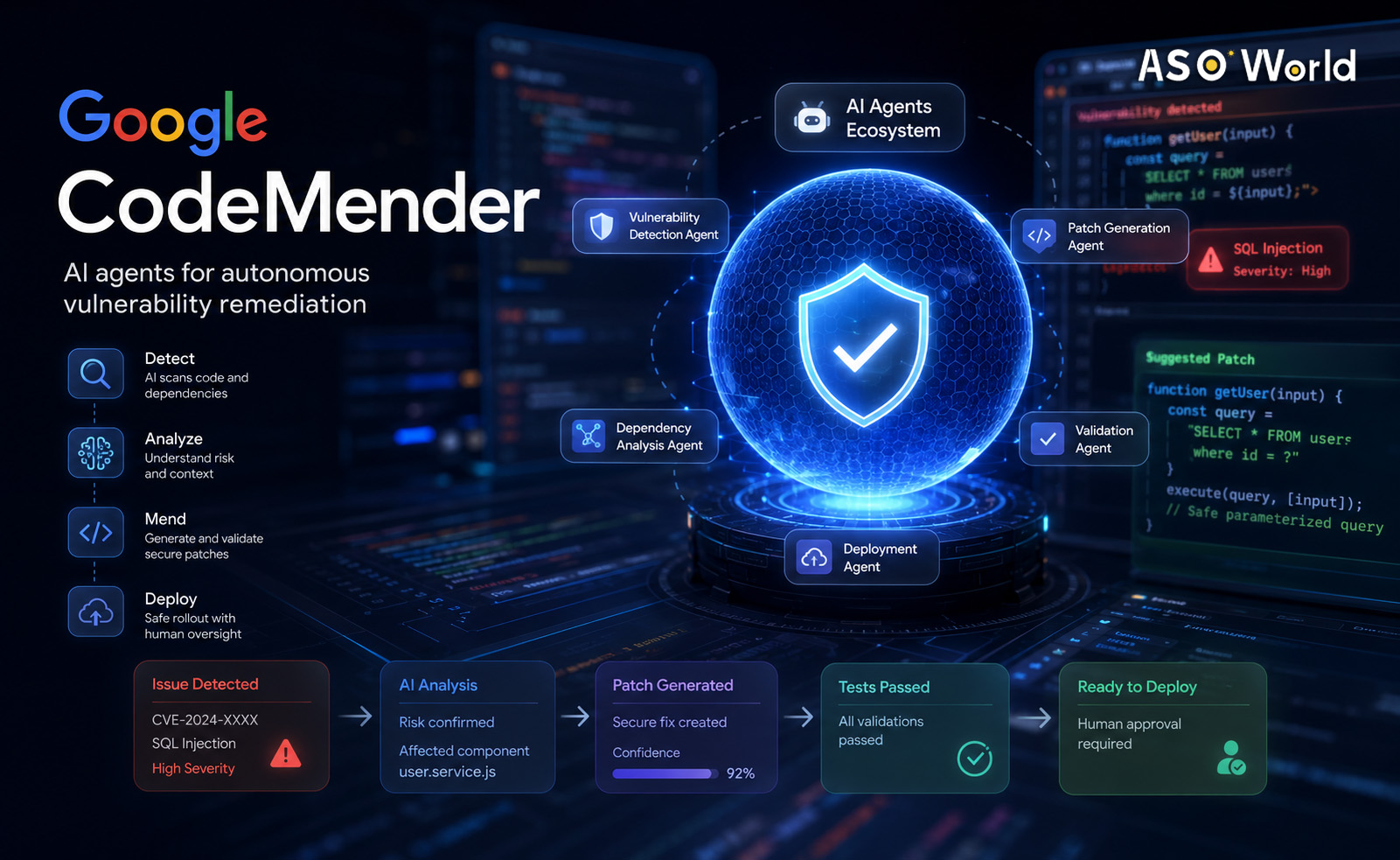
Google announced a deeper integration of CodeMender into its broader AI agent ecosystem as part of its push toward AI-led application security and enterprise workflow automation. The company is positioning the system as more than a standalone coding assistant, instead connecting it to larger remediation and operational pipelines used inside enterprise software environments.
At a functional level, CodeMender is designed to help analyze vulnerabilities, generate patches, and support remediation workflows. While earlier AI coding systems primarily focused on autocomplete and developer assistance, Google’s newer approach expands AI participation into post-development operational processes associated with software security and infrastructure management.
The announcement also reflects Google’s broader investment in AI agents. Rather than treating generative AI as an isolated interface layer, the company is increasingly integrating AI systems into workflows connected to governance, validation, and deployment processes. This creates the foundation for multi-agent environments where different AI systems may eventually coordinate vulnerability detection, remediation generation, regression analysis, dependency validation, and deployment preparation.
This architectural direction represents a meaningful shift from earlier generations of AI coding tools. Traditional coding copilots operated primarily inside developer interfaces and required humans to maintain full operational control over production systems. Google’s latest strategy increasingly connects AI systems to enterprise infrastructure itself, allowing them to participate more directly in operational workflows.
Although Google’s current implementation still relies heavily on human oversight, the broader direction suggests the company is preparing for a future where AI systems manage increasingly large portions of software maintenance and security operations.
The Shift From Coding Assistance to Operational AI
The most important aspect of Google’s announcement is not the patch-generation capability itself, but the changing role AI systems are beginning to play inside enterprise software environments. Earlier generations of generative AI tools largely functioned as recommendation systems. AI models could generate code suggestions or accelerate development tasks, but operational authority still remained firmly under human control. Developers wrote the code, validated fixes, and managed deployment decisions manually.
Google’s latest approach moves AI beyond the developer interface and into operational remediation workflows tied to production infrastructure. Instead of simply assisting developers during coding tasks, AI systems are increasingly being designed to participate in vulnerability analysis, remediation preparation, and workflow orchestration across enterprise environments.
This shift becomes especially important in software security because remediation workflows are often constrained by operational complexity. Large enterprises manage enormous dependency chains, cloud-native infrastructure, distributed services, and continuous deployment environments that generate massive volumes of security alerts and patch requirements. Human-led remediation cycles frequently struggle to keep pace with the scale and speed of modern software ecosystems. AI agents are increasingly being positioned as a solution to this operational bottleneck. In practice, this could eventually allow enterprise environments to automate portions of vulnerability management workflows, including issue detection, patch generation, validation analysis, and deployment preparation.
The long-term significance is that AI systems are gradually evolving from productivity tools into operational infrastructure layers. That transition could become one of the defining shifts of the current AI platform race.
Why Autonomous Security Matters
The broader importance of autonomous remediation extends well beyond cybersecurity itself. As software ecosystems continue growing more complex, enterprises are under increasing pressure to reduce operational overhead while improving deployment speed, reliability, and security responsiveness.
Modern SaaS infrastructure depends heavily on third-party APIs, open-source libraries, cloud-native services, and continuously updated software components. Security vulnerabilities can emerge across multiple layers of the stack simultaneously, making manual remediation workflows increasingly expensive and difficult to scale.
AI-driven remediation systems offer a potential solution by compressing the time required to identify, analyze, and respond to vulnerabilities. If AI systems can reliably support remediation preparation and validation workflows, enterprises may be able to reduce operational friction across DevSecOps pipelines while improving response speed.
This could also reshape how engineering productivity is measured. Instead of focusing primarily on code output and deployment velocity, organizations may increasingly prioritize workflow governance, remediation efficiency, and operational oversight inside AI-assisted environments. The emergence of autonomous remediation may also accelerate the development of what many companies are beginning to describe as “self-healing software.” In this model, applications continuously monitor operational conditions, identify potential failures or vulnerabilities, and initiate corrective actions with minimal human intervention.
While fully autonomous remediation remains technically and operationally challenging, Google’s latest strategy suggests the industry is actively moving in that direction.
What This Means for Developers
For developers, the biggest change is not that AI can now generate patches. The bigger shift is that AI systems are gradually becoming embedded inside the software lifecycle itself. In traditional workflows, developers were responsible for nearly every stage of remediation, including identifying issues, validating dependencies, writing fixes, testing regressions, and coordinating deployment timelines. AI coding assistants improved speed, but developers still remained the central operators inside the workflow.
That structure is starting to evolve. As AI agents move deeper into remediation pipelines, developers may increasingly focus on supervising workflows rather than manually executing every operational step themselves. Security validation, governance review, deployment oversight, and AI orchestration could become more important parts of modern engineering roles.
This transition may be especially significant for SaaS teams operating with small engineering resources. AI-assisted remediation systems could reduce the operational burden associated with patch management, dependency maintenance, and infrastructure monitoring, allowing smaller teams to handle increasingly complex environments without proportionally increasing headcount. For mobile developers and app teams, the implications could also extend into release management and app stability workflows. Faster vulnerability remediation and automated validation systems may shorten update cycles while improving operational reliability across continuously deployed applications.
The shift also creates new strategic pressure around tooling adoption. Developers may increasingly favor platforms capable of integrating directly into AI-native workflows, especially as enterprise ecosystems become more automated. Over time, operational compatibility with AI agents may become just as important as traditional productivity features when evaluating developer tools and infrastructure providers. At the same time, developers who understand governance, observability, and AI-assisted operations may gain a significant advantage as enterprises expand autonomous workflow adoption. The next generation of engineering workflows is likely to depend not only on writing software efficiently, but also on managing how AI systems interact with production environments safely and reliably.
Comments on Competitive Landscape and Industry Direction
Google’s CodeMender strategy reflects a broader shift happening across the AI ecosystem. The market is increasingly moving beyond standalone chatbots and code assistants toward AI-native operational infrastructure integrated directly into enterprise workflows. This transition is reshaping competitive dynamics across the industry. Microsoft continues integrating AI deeply across GitHub, Azure, and enterprise development environments. OpenAI is expanding enterprise automation capabilities and operator-style workflows. Anthropic has focused heavily on reasoning-oriented enterprise use cases tied to governance-sensitive environments.
Google appears to be positioning Gemini, AI agents, cloud infrastructure, and remediation workflows as part of a unified operational ecosystem designed for enterprise-scale automation. At the same time, entirely new software categories are beginning to emerge around AI operations, autonomous remediation, workflow orchestration, AI observability, and governance infrastructure. These segments may become increasingly important as enterprises search for ways to safely operationalize AI systems across production environments.
The long-term industry trend is becoming clearer: AI systems are gradually evolving from passive productivity tools into active participants inside software operations. As this transition accelerates, the companies controlling operational AI infrastructure may gain substantial influence over the next generation of enterprise software ecosystems.
 Follow Us on Facebook