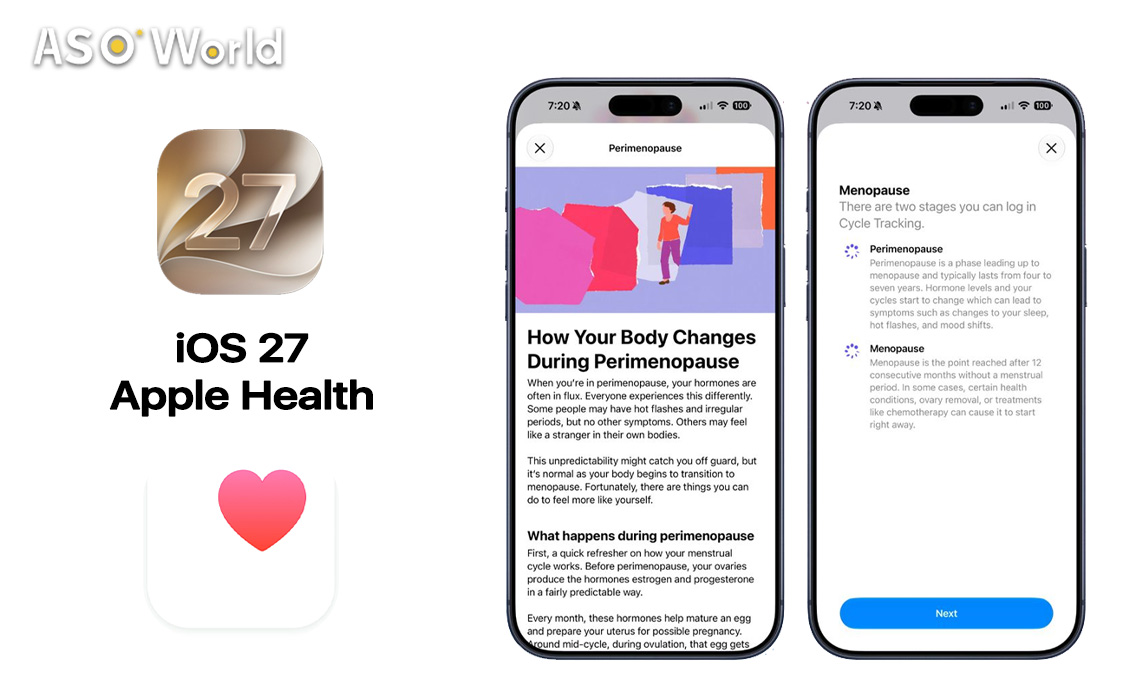

At WWDC 2026, Apple dropped one of its most significant health updates in years — and it wasn't another heart-rate algorithm or sleep-stage classifier. It was perimenopause and menopause tracking, built directly into the Health app's Cycle Tracking feature in iOS 27. For the roughly half of the world's population who will experience this life transition, it's a long-overdue acknowledgment from the world's most valuable tech company.
The announcement, made on June 8, has already sparked a wave of coverage from TechCrunch, CNET, Women's Health, and beyond — but the real story goes deeper than feature bullet points. In an exclusive interview with Tom's Guide, Apple Health Director Dr. Lauren Cheung and Fitness Director Julz Arney pulled back the curtain on the clinical thinking, the research methodology, and the very deliberate decision to address a health gap that mainstream medicine has historically "underresearched, misunderstood, and very often stigmatized."
The Clinical Gap Apple Is Targeting
Perimenopause — the hormonal transition that can begin a decade or more before menopause — remains one of the most underdiagnosed stages in women's health. Standard clinical criteria have long focused on bleeding patterns alone, but research increasingly shows that neurological symptoms like anxiety, brain fog, and sleep disruption can surface years before menstrual cycles become irregular.
Dr. Cheung explained Apple's approach bluntly: "From the beginning of our journey in health, we've designed the health ecosystem to meet people where they are throughout every stage of life." She pointed to the company's track record of targeting underserved areas — fall risk detection, hearing health, heart rhythm notifications — as the context for why menopause tracking is not an outlier but the natural next step.
The feature works by analyzing a six-month rolling window of logged cycle data. When more than one irregularity is detected within that window, and the user is aged 40 or above, the Health app surfaces a notification suggesting the patterns may be indicative of perimenopause. The threshold is deliberately conservative: "It's not abnormal for folks to have one or two cycles that might be off, for a variety of reasons," Dr. Cheung told Tom's Guide. "We wanted to make sure we are being responsible about when it is something a user actually needs to pay attention to."
The FIGO Guidelines and the Age-40 Threshold
One of the more debated design decisions is the age-40 gate. Some research suggests perimenopause can begin in the late 30s. Dr. Cheung clarified that Apple is using the FIGO (Federation of International Obstetrician-Gynecologists) definitions for irregular and infrequent menses. Anyone at any age can receive a deviation alert — but the perimenopause-specific interpretation only triggers at 40 and above.
"For anyone under the age of 40, we think it's really important that they still treat this as something they need to go and talk to their physician about to confirm that it isn't something else that might be causing it," she said.
The system is powered entirely by manual logging — not wrist temperature or heart-rate sensors. However, Apple Watch's temperature sensor does improve the accuracy of retrospective ovulation detection, which in turn sharpens period and fertile-window predictions. Night sweats and hot flashes remain manually logged for now; the temperature sensor provides one aggregated overnight reading rather than granular enough data to auto-detect these events.
Fitness+: Strong Through Menopause
Apple isn't stopping at tracking. Fitness+ is launching Strong Through Menopause, a progressive three-week program built around yoga and strength training. It targets all seven clinical priorities for fitness during menopause — pelvic floor health, muscle strength, cardiovascular conditioning, balance, mobility, stress reduction, and sleep improvement — in just three 20-minute sessions per week.
Julz Arney, Apple's Director of Fitness, emphasized that the program's philosophy departs from the usual metrics-driven approach: "It isn't about performance metrics necessarily in this stage of life. It's about resilience and finding ways to protect your health and feel strong and really feel more like yourself through the journey."
The trainers themselves are women in this life stage, and the sessions address real-world concerns — including incontinence, which Arney called "a big blocker for people doing any kind of movement" — without being preachy about it. "You just feel this real sense of like we're all in this together," she said.
Beyond Menopause: The Full iOS 27 Health Upgrade
While the perimenopause features have grabbed headlines, iOS 27 brings a broader refresh to the Health ecosystem:
| Feature | What's New |
|---|---|
| Health App Redesign | Card-style Browse interface replaces the old list view; unified bottom navigation bar merges search and browse. |
| Visual Intelligence – Nutrition | Point your iPhone camera at food to get a nutritional-value rating (very low to very high) with flags for processing, protein, sugar, and more. No calorie counting, but a fast way to understand what you're eating. Requires iPhone 15 Pro or later. |
| Faster Data Syncing | Performance improvements mean health data updates reach the app noticeably faster. |
| Route & Distance Accuracy | Post-workout route maps are more precise; treadmill distance tracking is significantly improved. |
| GymKit on iPhone | GymKit expands from Apple Watch to iPhone — pair directly with treadmills, indoor bikes, and other gym equipment to sync calories, distance, speed, incline, and pace. No watch required. |
| Step Count Sync | Step counts now sync consistently between the Health and Fitness apps. |
| Child Safety | New parental controls with expert health research-backed guidance for managing child accounts. |
What This Means for Health & Fitness App Developers
For developers building in the health-tech space, iOS 27's women's health push signals a clear market direction. Apple is investing — with clinical rigor — in a category that has been underserved by both medicine and technology. The perimenopause tracking feature integrates with HealthKit, meaning third-party apps can read and contribute to the same cycle data that powers the new alerts. Fitness+ programs like Strong Through Menopause also set a benchmark for content strategy: age-specific, clinically grounded, and community-driven. If you're building or optimizing a health, wellness, or fitness app, now is the time to audit your women's health feature set — because Apple just raised the bar, and the 40+ demographic is paying attention.
For app marketers, the implication is equally clear: ASO keyword strategies around "perimenopause tracker," "menopause symptoms," and "cycle tracking" are about to see a surge in search volume as iOS 27 rolls out this fall. Early optimization means capturing the wave before it crests.
What Comes Next
iOS 27 is already in developer beta, with a public beta expected in July and a full public launch this fall. The perimenopause data collected through these features will also feed into Apple's ongoing Women's Health Study, conducted in partnership with the Harvard T.H. Chan School of Public Health — meaning this isn't just a consumer feature, but a living research platform.
Dr. Cheung put it simply: "We have a track record of focusing on health needs that have often been overlooked… Cycle tracking is a feature we designed to grow with you — from logging a first period to family building, to pregnancy, to ongoing health awareness. With our newest updates, we're extending that continuity into a life stage that affects roughly half the world's population."
For the millions of women who have spent years navigating perimenopause with little more than guesswork and Google searches, iOS 27's Health app might just be the most meaningful software update Apple ships this year.

 Follow Us on Facebook