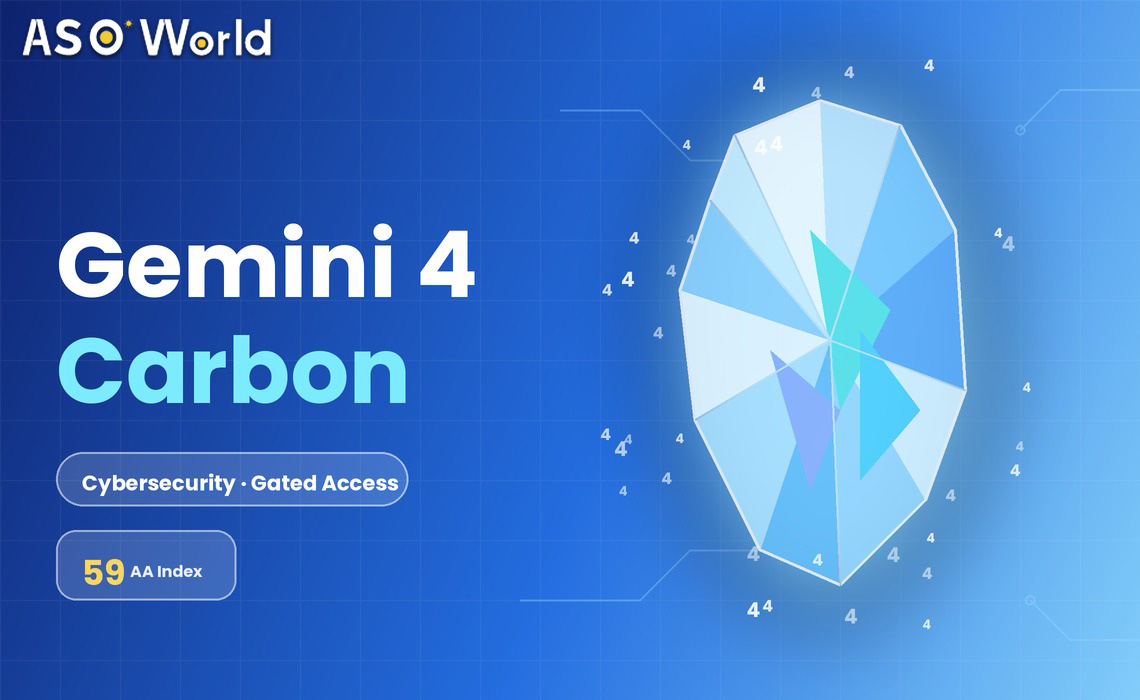

Google has released its second frontier model in a matter of weeks. On October 28, 2026, the company announced Gemini 4 Carbon, which it describes as its strongest model yet, with state-of-the-art cybersecurity and long-horizon capabilities. It arrives two weeks after Gemini 4 Argon became broadly available, and it is already ranked first on a widely followed independent AI index.
Unlike Argon, Carbon is not yet open to the public. Access begins with a small group of cyber defenders, and wider availability is planned once safeguards are refined. Here is what has been announced, how the numbers stack up against rivals, and what the staged release means for developers and businesses.
Key Takeaways
- Release status: Announced October 28, 2026. Available only to a subset of cyber defenders at first, then to more trusted partners through Google's Fairwind Program.
- Ranking: First on version 5.0 of the Artificial Analysis Intelligence Index, with a score of 59.
- Cybersecurity focus: 88.2% on SEC-bench Pro (finding vulnerabilities), 54.8% on ExploitGym (exploitation) and 71.0% on CWE-bench (patching).
- Pricing: Introductory rates of $2 per million input tokens and $10 per million output tokens, the same as Argon.
- Caveat: The lead over rival models is narrow overall, and rivals are ahead on some tests.
Gemini 4 Carbon at a Glance
| Detail | Info |
|---|---|
| Announced | October 28, 2026 |
| Position in the lineup | Above Gemini 4 Argon |
| Focus | Long-horizon agentic work, coding and cybersecurity defence |
| Current access | A subset of cyber defenders, expanding through the Fairwind Program |
| Wider access | Developers, businesses and consumers "as soon as possible," with no date given |
| Introductory price | $2 input / $10 output per million tokens; cached input 95% cheaper |
| Price after introductory period | $4 input / $20 output per million tokens |
Carbon vs. Argon
| Feature | Gemini 4 Argon | Gemini 4 Carbon |
|---|---|---|
| Announced | September 30, 2026 | October 28, 2026 |
| General availability | October 13, 2026 | Not yet |
| Intelligence Index v5.0 score | 50 | 59 |
| Introductory price (input / output per million tokens) | $2 / $10 | $2 / $10 |
| Secure code generation | Baseline | More than 2x success rate, per Google's internal tests |
Google says Carbon beats Argon on all 17 benchmarks in its published comparison. Argon's introductory pricing is reported to end on November 30.
What's New: Long-Horizon Agentic Work
Carbon is designed for sustained, multi-step tasks rather than single prompts. Google says its internal teams have watched the model run for days, persisting through dead ends to root-cause and patch subtle bugs across large codebases and low-level systems.
The company also points to improvements in coding, agentic tasks, scientific work, full-stack web development and multimodal understanding. On WebDev Arena, a web-development leaderboard, Carbon gained 89 Elo points to land fourth, at about 1,768.
The Cybersecurity Headline
Cybersecurity is the centrepiece of the launch. Google frames it around the full defensive lifecycle, and reports leading scores at each stage:
| Stage | Benchmark | Carbon score |
|---|---|---|
| Finding vulnerabilities | SEC-bench Pro | 88.2% |
| Validating exploitability | ExploitGym | 54.8% |
| Patching the root cause | CWE-bench | 71.0% |
Google also reports that its Chrome team found Carbon more than 10 times better at generating high-quality patches than another lab's large frontier model, which it did not name. Cloud security firm Wiz says Carbon leads on its web penetration testing benchmarks.
These strengths cut both ways. A model that can find and exploit vulnerabilities efficiently is valuable to defenders and attackers alike, which helps explain Google's cautious rollout. The company says it is taking part in the U.S. government's voluntary pre-release testing process while it refines guardrails.
Safety and Alignment Claims
Google says Carbon uses the same multi-layered safety stack as Argon, covering model training, real-time misuse defences, prompt-injection resilience and chain-of-thought monitoring. Its reported improvements over Argon include:
| Area | Google's reported result |
|---|---|
| Benchmark cheating | Successful cheating on Terminal-Bench 4.0 reduced to 0.0%, with attempts at 0.4% |
| Misalignment alerts | High-severity alerts in live internal coding down by almost 80% |
| Unsupported claims | Roughly halved |
| Scope control | Overreach down 26% and under-service down 29% |
| Prompt injection | 0.0% attack success on an indirect injection benchmark (Argon: 0.7%) |
These are Google's own test results. Independent measurements can differ, as the next section shows.
How Carbon Compares With Rivals
Independent benchmarking data supports Google's headline claim, but with nuance:
| Measure | Result |
|---|---|
| Intelligence Index v5.0 | Carbon 59, Claude Opus 5.5 58, GPT-6 Astra 57, Argon 50 |
| Coding agent index | Carbon (via Antigravity CLI) 59, up from Argon's 53, but behind Claude Code with Opus 5.5 at 62 |
| Knowledge-work Elo | 1,609, up 126 points on Argon, but behind Grok 4.7, Muse Wonder and Kimi K3.1 Pro |
| Factual knowledge | First place, with 58% of questions answered correctly (Argon: 48%) |
| Hallucination rate (same test) | Rose from 4% to 11% |
In Google's own comparison, Carbon leads on 15 of 17 benchmarks. The exceptions are a software-engineering test where GPT-6 Astra and Claude Opus 5.5 both come out ahead, and an offline computer-use test where Claude Opus 5.5 leads. Carbon's clearest advantage is long-context reasoning.
It is worth noting how the comparison was built. Google's evaluation notes say rival-model results are mostly taken from each provider's self-reported figures, and several of Carbon's own scores were self-computed. The first-place margin on the independent index is a single point.
Pricing and Access
Carbon launches at the same introductory price as Argon: $2 per million input tokens and $10 per million output tokens, with cached input tokens 95% cheaper. Google has not said when the introductory period ends. After it, prices rise to $4 and $20 per million tokens. As an example, a workload of 10 million input tokens and 1 million output tokens would cost about $30 at introductory rates and about $60 afterwards.
Google has not yet published a technical report, architecture details or API specifications, so context window and output limits for Carbon remain unconfirmed.
- Now: A subset of cyber defenders.
- Next: More trusted partners, gradually, through the Fairwind Program.
- Later: Developers, businesses and consumers through Google's product surfaces.
Why It Matters for AI App Developers and Marketers
This section is ASOWorld's editorial analysis, not a statement from Google.
The release pattern matters as much as the model:
- Faster model cycles. Two top-tier releases in two weeks means app teams should expect frequent model changes. Building so that a model can be swapped without rewriting the product reduces risk.
- No clear single winner. The top models trade leads across coding, computer use and knowledge work. Teams are better served testing on their own tasks than relying on a single index.
- Gated launches are becoming normal. When capability is tied to security risk, access may arrive in stages, so product roadmaps should not assume same-day availability.
- Marketing claims need care. AI app listings often cite benchmark rankings. Because results vary by test and self-reported numbers differ from independent ones, claims are safest when they are specific and sourced.
For more coverage of AI platforms and their impact on app businesses, browse the AI Tech section on Marketing Trending.
📱 App Marketing Angle
New model launches reshape what users expect from AI apps and boost search interest in AI assistants and coding tools. Apps that build on these models can use the moment to refresh store listings, screenshots and keywords around concrete capabilities, such as agents, coding help and security features. See how ASOWorld's AI app marketing solutions help AI apps turn model-launch attention into rankings, installs and revenue.
What to Watch Next
- General availability. A date for developer and consumer access has not been announced.
- API specifications. Context window, output limits and supported inputs will determine how Carbon fits into existing products.
- Independent evaluations. Broader testing will show whether Google's lead holds outside its own benchmarks.
- Rival responses. With the top of the index separated by only a few points, other labs may answer quickly.
- End of introductory pricing. Pricing changes will matter for teams budgeting for large workloads.
Quick Answers: Gemini 4 Carbon
What is Gemini 4 Carbon?
Google's strongest model to date, announced October 28, 2026, with a focus on long-horizon agentic tasks, coding and cybersecurity defence.
Can I use it now?
Not yet for most people. It is available to a subset of cyber defenders and will expand gradually to trusted partners through the Fairwind Program.
How much does it cost?
$2 per million input tokens and $10 per million output tokens during the introductory period, then $4 and $20.
Is it better than Claude Opus 5.5 and GPT-6 Astra?
On the independent Intelligence Index v5.0 it leads narrowly, 59 against 58 and 57, but rivals are ahead on some coding and computer-use tests.
How does it differ from Gemini 4 Argon?
Carbon scores 59 against Argon's 50 on the index, claims more than double the secure-code success rate, and is gated, while Argon is generally available at the same introductory price.
Why is access limited?
Its cybersecurity strengths could be misused, so Google is rolling it out gradually while refining guardrails and taking part in U.S. government pre-release testing.
 Follow Us on Facebook