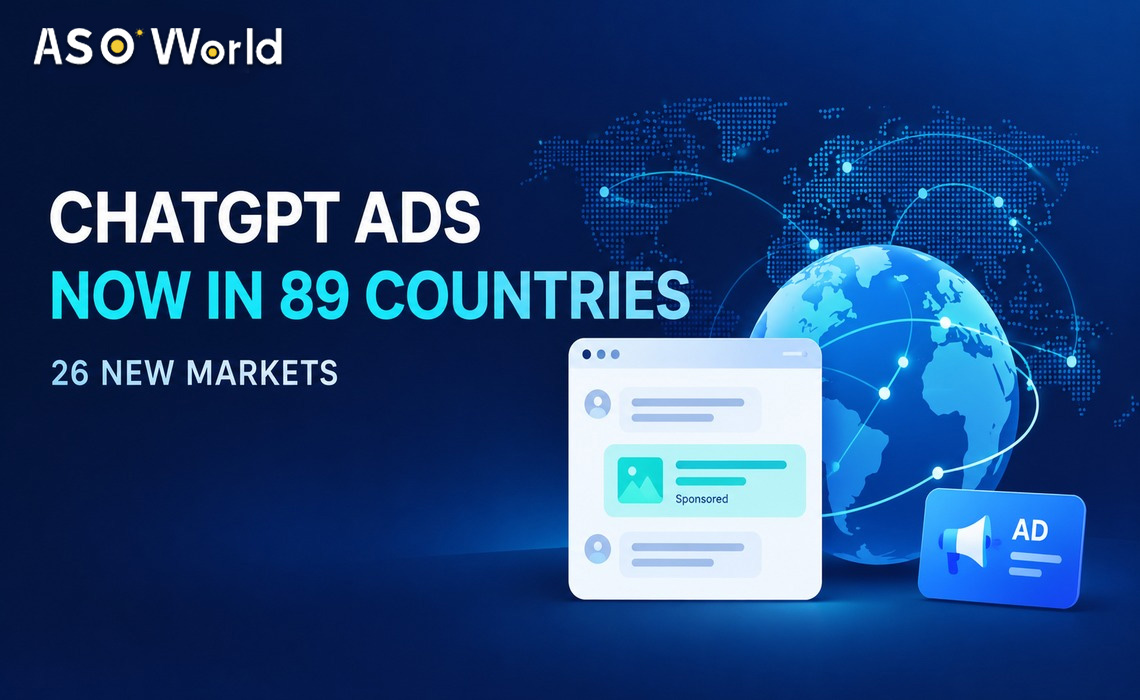

OpenAI is taking its youngest revenue line global. On October 21, 2026, the company expanded ChatGPT Ads to 26 additional countries, bringing availability to 89 countries worldwide, just over eight months after advertising first appeared in the chatbot. OpenAI says more than 100,000 advertisers have now run campaigns on the platform, and that ChatGPT is used by more than 1.2 billion people each week.
The expansion is the clearest sign yet that conversational advertising is becoming a core part of OpenAI's business model. Below is what was announced, how the ads work, which numbers need context, and what the shift means for marketers.
Key Takeaways
- Scale: ChatGPT Ads now cover 89 countries, up from 63 before this expansion.
- New regions: 14 more Latin American countries, plus markets across Europe, the Middle East, Africa and Asia.
- Who sees ads: Only users on the Free and Go plans. Plus, Pro and Enterprise subscribers remain ad-free.
- How to buy: Through technology partners or self-service in OpenAI's Ads Manager.
- What's next: New ad formats, campaign objectives, buying options and measurement tools, though no timelines have been given.
How ChatGPT Ads Have Rolled Out
| Phase | Timing | Coverage |
|---|---|---|
| Initial launch | Early 2026 | United States, for Free and Go users |
| Latin America, first markets | Before October | Mexico and Brazil |
| Europe expansion | August 18, 2026 | Multiple European markets |
| Southeast Asia and Taiwan | September 23, 2026 | Southeast Asian markets and Taiwan |
| Latest expansion | October 21, 2026 | 26 more countries, for a total of 89 |
Where the New Markets Are
The latest wave leans heavily on Latin America and emerging markets:
- Latin America: 14 more countries, including Argentina, Chile, Colombia and Peru, following the earlier launches in Mexico and Brazil.
- Europe: Additional markets including Serbia and Ukraine.
- Africa: Nigeria and South Africa.
- Asia: Cambodia, Bangladesh and Pakistan.
OpenAI has not itemised all 26 markets in its announcement, so the list above covers only the countries named publicly.
How ChatGPT Ads Work
OpenAI describes ads as a way for people to discover products and services during moments of consideration. Because users can describe what they want, ask follow-up questions and refine their options in conversation, ads can respond to the context of that exchange rather than to a single search query.
The company's own example involves someone training for a first marathon who asks about race-week meals. As the conversation narrows toward dietary needs and cooking time, a relevant ad might introduce a grocery delivery service they had not considered.
Trust and privacy commitments
- Ads are clearly labelled and kept separate from ChatGPT's answers.
- Advertising does not influence the answers ChatGPT gives.
- Conversations are kept private from advertisers, and customer data is not sold.
- Ads appear only on the Free and Go plans.
How advertisers buy
In the new markets, advertisers can access ChatGPT Ads through technology partners or through self-service access in Ads Manager. OpenAI also cited early testing by global brands, with L'Oréal's digital leadership describing a focus on journeys that run from discovery to evaluation to agentic commerce.
The Numbers, in Context
The headline figures are large, but each carries a caveat worth keeping in mind.
| Figure | What was reported | Context |
|---|---|---|
| 89 countries | Total ChatGPT Ads availability after the expansion | Availability is not the same as ad volume. Ad demand will vary widely by market. |
| 100,000+ advertisers | Businesses that have run campaigns since launch | A cumulative total. One analyst estimate put active advertisers at roughly 60,000 in early October, which suggests some have paused or stopped spending. |
| 1.2 billion weekly users | People using ChatGPT each week | Ads reach only Free and Go users, not paid subscribers. |
| $1 billion run rate | Annualised ad revenue reached in August | A run rate projects a single period forward. It is not actual annual revenue. |
Reports also link the push to OpenAI's wider commercial plans, including a potential IPO. Advertising gives the company a revenue stream beyond subscriptions and enterprise contracts.
What OpenAI Plans Next
OpenAI says its next phase will focus on additional ad formats, campaign objectives, buying options and measurement capabilities, as well as more native ways for businesses to interact with consumers inside ChatGPT. No dates were given.
Recent steps hint at the direction:
- AI-powered advertiser tools introduced in September to help build and manage campaigns.
- Business-sponsored agents being tested with a limited group of U.S. advertisers.
- A more visual ad format with larger images, initially tested among U.S. users of ChatGPT's image-generation features.
- Partner integrations, with ad-tech and attribution companies adding support for ChatGPT campaigns and Amazon's ad platform opening a U.S. pilot.
Open Questions for Advertisers
- Measurement. Advertisers have asked for stronger attribution than the platform offers today, compared with established search and social channels.
- Retention. OpenAI has not published advertiser retention rates or average campaign spend.
- Relevance. Conversational placements depend on how well an ad matches the user's evolving intent, which is harder to judge than a single keyword.
- Regional readiness. Ad budgets, buying partners and local regulation differ across 89 markets, so results will not be uniform.
Why It Matters for App Marketers
This section is ASOWorld's editorial analysis, not a statement from OpenAI.
For app publishers, the expansion matters less as a new ad slot than as a signal about how people find products:
- Discovery is moving into conversation. When users compare options inside a chatbot, the consideration stage can happen before they ever open an app store. Clear positioning, strong ratings and consistent messaging across the web help brands show up in those answers.
- Emerging markets are in scope. The inclusion of countries across Latin America, Africa and South and Southeast Asia overlaps with fast-growing mobile audiences.
- Measurement is still maturing. Teams considering a test should plan how they will attribute installs and revenue, and keep budgets modest until reporting improves.
📱 App Marketing Angle
As AI assistants become a place where users research and compare apps, store listings still anchor the decision. Keep your title, keywords, screenshots and ratings aligned with how people describe their needs in conversation. See how ASOWorld's app marketing solutions help apps turn new discovery channels into rankings, installs and revenue.
What to Watch Next
- New formats and objectives. Any announcement of app-install or performance-focused objectives would matter to mobile advertisers.
- Measurement partnerships. Wider third-party attribution support would make ChatGPT campaigns easier to evaluate.
- Active advertiser counts. Updated figures would show whether advertiser interest is converting into sustained spending.
- Further country launches. Markets not yet covered remain candidates for later rollouts.
Quick Answers: ChatGPT Ads Expansion
How many countries have ChatGPT Ads now?
89 countries, after OpenAI added 26 more on October 21, 2026.
Who sees ads in ChatGPT?
Only users on the Free and Go plans. Plus, Pro and Enterprise subscriptions are ad-free.
Do ads change ChatGPT's answers?
According to OpenAI, no. Ads are labelled and kept separate from answers, and advertising does not influence what ChatGPT responds with.
Can advertisers see my conversations?
OpenAI says conversations are kept private from advertisers and that it does not sell customer data.
How can a business advertise on ChatGPT?
Through technology partners or through self-service access in Ads Manager, depending on the market.
Is the $1 billion figure annual revenue?
No. It is an annualised run rate reached in August, which projects one period forward rather than reporting actual yearly revenue.

 Follow Us on Facebook