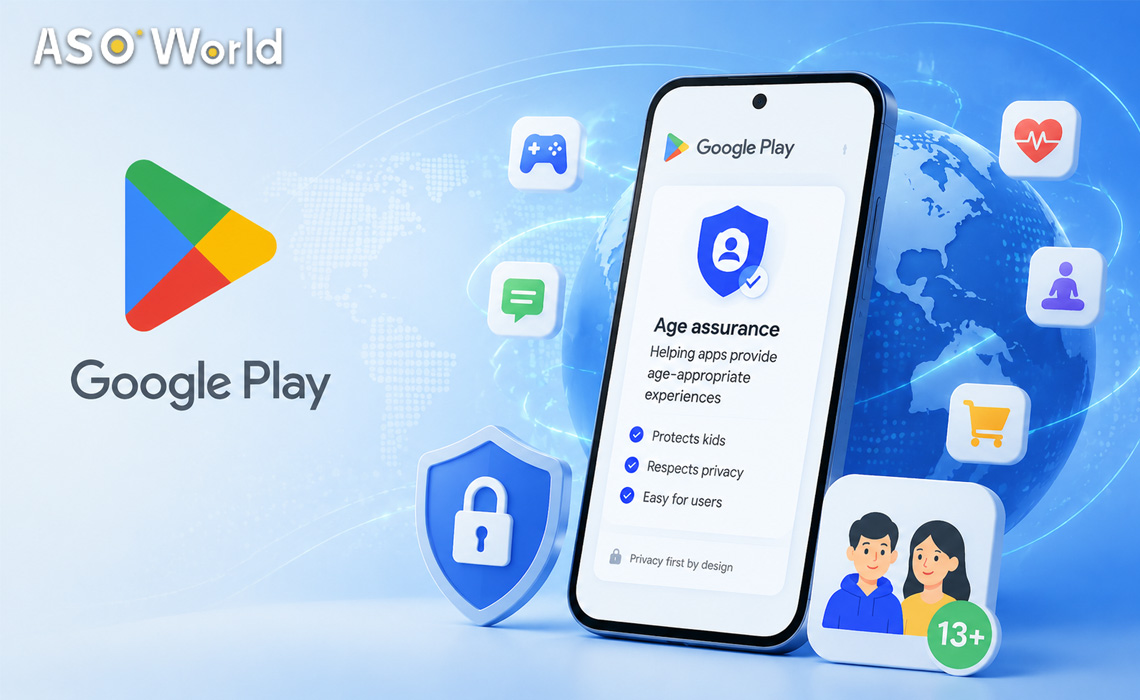

Google confirmed this week that its Play Age Signals API will reach Android developers in every market by the end of 2026. The headline is regulatory compliance — but the real story, for anyone shipping or promoting an app, is a quiet reshaping of how audiences are segmented on the App Store and Google Play.
What Google Actually Announced
On July 29, 2026, Google outlined a worldwide rollout of its Play Age Signals API, a privacy-preserving mechanism that returns a user's age range — not a birthday, not a document scan, not a raw identifier — to participating Android apps. Developers get enough signal to tailor an experience for a minor versus an adult, without absorbing the liability of storing sensitive personal data. The rollout wraps by year-end and covers every region where Google Play operates.
The move follows tightening age-appropriate design rules in the UK, the EU, Australia, and a growing patchwork of US states. Rather than let each developer bolt on a custom age gate, Google is standardizing the plumbing.
Why This Is an ASO and UA Story, Not Just a Compliance Story
Most coverage frames age assurance as a legal checkbox. For app marketers, the second-order effects are more interesting:
- Content ratings will matter more in ranking. Once age signals flow reliably, the stores have a stronger basis for filtering search results, Top Charts, and Featured placements by audience. Apps rated 4+ / Everyone are likely to gain visibility in youth-heavy sessions; anything rated Teen or Mature may quietly disappear from those same impressions.
- Creative approvals get stricter. Expect Google Play and, by competitive pressure, Apple's App Store to re-scrutinize screenshots, videos, and custom store listings that skew mature but target broad audiences. The gray-area creatives that squeaked through in 2024–2025 will convert worse — or get pulled.
- Attribution windows shift for minors. With age-range signals available at runtime, ad networks and MMPs will start segmenting cohorts by declared age band. Post-install events tied to under-18 users will likely default to non-personalized modeling, which changes CPI, ROAS, and LTV math for kids and family categories.
- The "family" category is about to get crowded. Publishers who previously stayed neutral will re-classify to capture protected inventory where competition is thinner and payout structures are becoming more predictable.
The Metadata Audit Nobody Is Talking About
If your app's IARC questionnaire was filled out in 2020 and never revisited, you have work to do before the API becomes ambient. Age Signals only functions as well as the content rating attached to your listing. A miscategorized rating in a world where the store actively filters by age will directly cost impressions.
Three things to check this quarter:
- Re-run your content rating questionnaires on both Google Play Console and App Store Connect. Flag any UGC, in-app chat, or gambling-adjacent mechanics honestly — algorithmic downranking for mismatch is worse than a stricter rating.
- Audit your keyword field and subtitle for terms that pull in mixed-age intent (e.g., "dress up," "shooter," "chat"). In an age-filtered search index, keyword efficiency drops when your term matches a query but your rating filters you out.
- Localize compliance copy. Privacy labels, data safety forms, and age disclosures now need to be accurate per region, because Google's global rollout does not mean uniform enforcement — the UK's Children's Code and the EU DSA still impose stricter interpretations.
Regional Nuance: Where Age Signals Bite Hardest
Google's rollout is global, but the marketing consequences are not evenly distributed. The UK and Australia have already signaled aggressive enforcement of age-appropriate design. The EU is layering DSA obligations on top of GDPR-K. In the US, Utah, Texas, and California are running parallel state-level laws that Google's API can help satisfy — but only if developers wire it in correctly. Southeast Asia and LATAM, historically laxer, are the next frontiers regulators are watching.
For growth teams running multi-market campaigns, this means paid UA creative and store listings should be built with an assumption of divergent enforcement, not a single global asset set.
What to Do Before Year-End
- Segment your funnel by age band now, even if you have to model it. When the API lights up, you want the reporting scaffolding already in place.
- Prepare two creative sets — one that assumes an adult viewer, one that survives a Teen or younger filter — and test which one is being served in each market.
- Rework your onboarding. Age-appropriate defaults (private accounts, restricted messaging, reduced ad load) will become de facto ranking signals, not just legal shields.
- Talk to your ad-network reps about how they plan to consume Play Age Signals — some will pass it into bid requests, some will use it purely for suppression. That difference changes your CPM curve.
The Bigger Picture
Age Signals is one visible piece of a broader shift: the app stores are moving from being catalog operators to being audience gatekeepers. Every additional signal Google or Apple standardizes — age, sensitive-content flags, data-safety attestations — becomes a new axis on which your app is ranked, surfaced, or quietly buried. The winners in 2026 will be the teams that treat store metadata as a living growth surface, not a one-time launch task.
For deeper breakdowns of App Store and Google Play ranking shifts, creative benchmarks by category, and market-by-market ASO strategy, keep tracking the Marketing Trending — App Store feed.

 Follow Us on Facebook