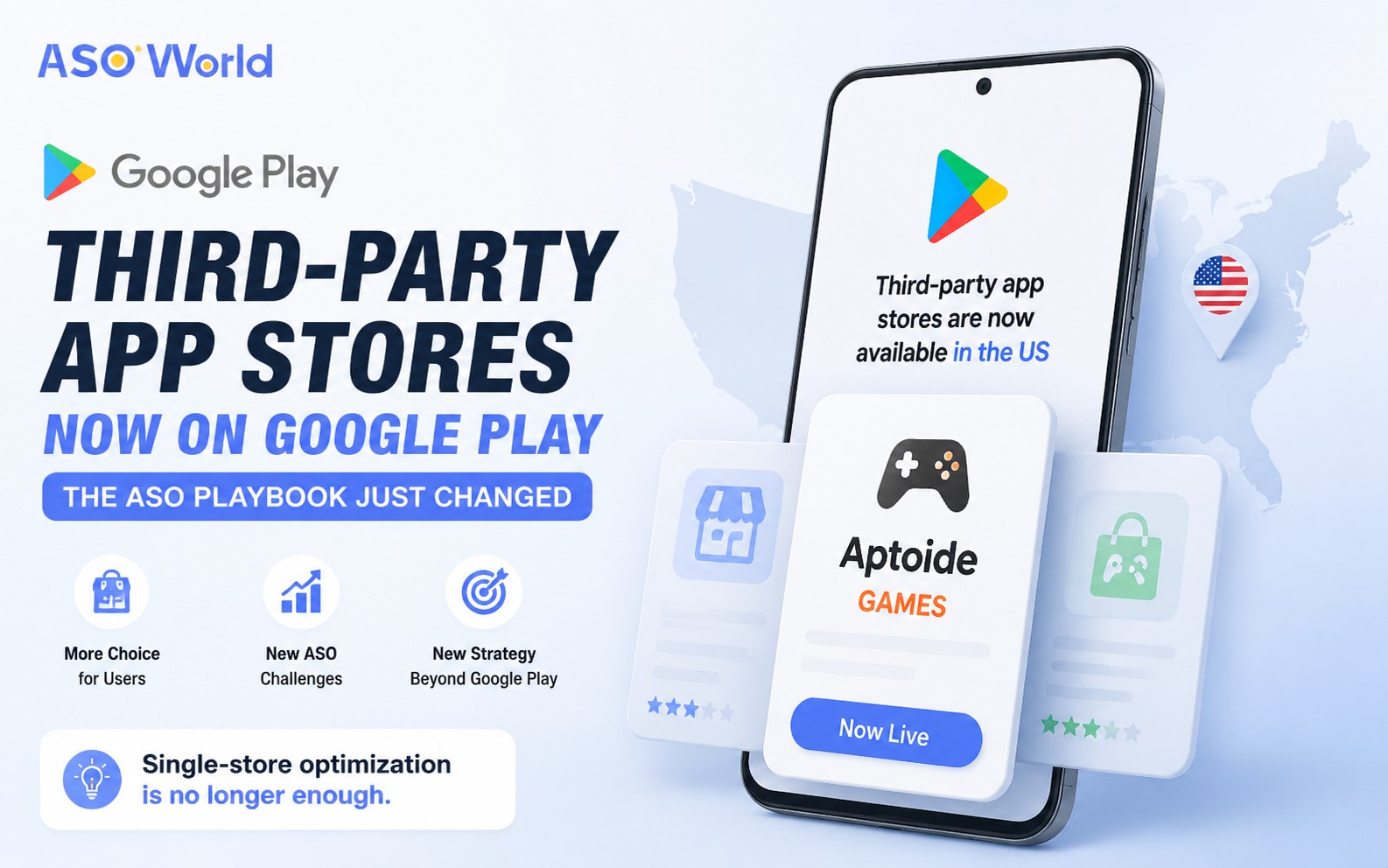

The walled garden has a new gate. After years of courtroom battles with Epic Games, Google has begun hosting third-party Android app stores directly inside the Google Play Store in the United States. Aptoide Games is already live, with more stores onboarding through dedicated landing pages accessible via search, deep links, and category browsing. For ASO professionals, this is not a minor policy update—it is a structural shift that redefines app discovery on Android.
Here is what changed and how to adapt before competitors do.
What Changed—and How It Works
Under a court-approved settlement taking effect July 2026, Google Play must allow approved third-party US Android app distribution platforms to list their stores inside Google Play itself. Users discover these stores through a dedicated Play Store landing page, deep links, account menus, or direct search queries such as “app store” or a specific store name. Once installed, users can download apps from third-party stores with no additional security friction beyond the standard Android install prompt.
Google enforces its own policies on these stores but does not review every individual app or manage updates and payments within them. Third-party stores pay an annual fee of roughly $5,000, while developers are automatically opted into having their listings shared unless they manually opt out.
At the same time, Google lifted another major restriction: developers are no longer required to use Google Play Billing and may link users to external payment options without penalty. Open distribution plus open payments marks the most significant loosening of Google’s ecosystem control since Android launched.
Why This Disrupts Traditional ASO Thinking
For more than a decade, Android ASO strategy has revolved around one dominant surface: ranking well inside Google Play search and browse. Keywords, metadata, screenshots, ratings velocity, and conversion optimization were all tuned to a single algorithm. That monopoly is ending.
When users can discover alternative stores from within Google Play itself, the customer journey fragments. Each additional store introduces its own ranking logic, editorial curation, and audience segmentation. Organic visibility on Google Play alone is no longer sufficient. If your competitor appears in three storefronts and you appear in one, you are fighting for share of voice with one hand tied behind your back—even if your Play Store keyword rankings are perfect.
Five ASO Takeaways for the Multi-Store Era
1. Treat Brand Search as a Defensive Asset
Third-party stores will compete for generic queries like “game store” and “app market” inside Google Play search. Your brand name, however, remains uniquely yours. Invest in branded keyword defense across every store where your app appears. If users search your exact brand inside Aptoide or any future store, ensure you own that result. Brand search volume is about to become your most reliable funnel.
2. Optimize Conversion, Not Just Discovery
With payment flexibility unlocked, your store listing must do more than attract clicks—it must close transactions. Screenshots and videos should communicate pricing transparency, free-trial availability, and premium tier value. Since external billing links are now permitted, consider using Google Play as a discovery layer while routing high-intent users to your own checkout flow for better margins. That hybrid model turns ASO from a pure acquisition channel into a revenue-optimized front door.
3. Diversify Metadata for Different Storefronts
Each third-party store will have its own metadata fields, character limits, and indexing behavior. Do not copy-paste your Google Play description into Aptoide or future stores. Tailor titles, subtitles, and feature graphics to each platform’s audience and search patterns. Early movers who localize their presence across multiple Android storefronts will capture compounding visibility before standardized best practices emerge.
4. Monitor Opt-Out Deadlines Carefully
Google’s default-opt-in approach means your app listing is likely already eligible for syndication to third-party stores unless you actively declined. Review your Google Play Console notifications and understand where your intellectual property is being displayed. For some developers, wider distribution is welcome free marketing. For others—especially premium brands with strict pricing policies—it creates channel conflict. Make the choice deliberately rather than by default.
5. Compare Platform Philosophies When Allocating Budget
While Android opens up, Apple’s App Store remains tightly controlled. In 2026, iOS still captures roughly 70% of combined consumer spending across both platforms despite representing only about 21% of total downloads. The strategic implication is clear: Android ASO is becoming a multi-channel acquisition game, whereas iOS ASO remains a precision game fought inside a single, highly monetizable arena. Allocate creative and testing resources accordingly. Android demands breadth; iOS demands depth.
The Larger Shift: From Gatekeeper to Host
Google’s move signals a deeper identity change from absolute gatekeeper to regulated host—a role closer to a traditional retailer leasing shelf space than to a closed ecosystem operator. For ASO professionals, the skill set must expand accordingly. Keyword research, A/B testing, and rating management remain essential, but they must now be multiplied across storefronts. Competitive intelligence must track positioning inside emerging third-party catalogs, and attribution modeling must account for users who discover on one store, compare on another, and convert on a third.
Conclusion
The Google Play Store remains the largest single addressable audience on Android, but it is no longer the only one that matters. Third-party store integration, combined with payment flexibility, transforms Android into a genuinely open distribution landscape. The ASO teams that treat this shift as an opportunity rather than a threat will build resilient, multi-store presences while competitors cling to a single-point-of-failure strategy.
If your 2026 growth plan assumes one storefront per platform, it is already outdated.
About the Author: This analysis draws on official Google developer policy updates, Epic v. Google settlement filings, and hands-on ASO benchmarking data. For ongoing coverage of App Store and Google Play dynamics, follow our updates at Marketing Trending.
 Follow Us on Facebook