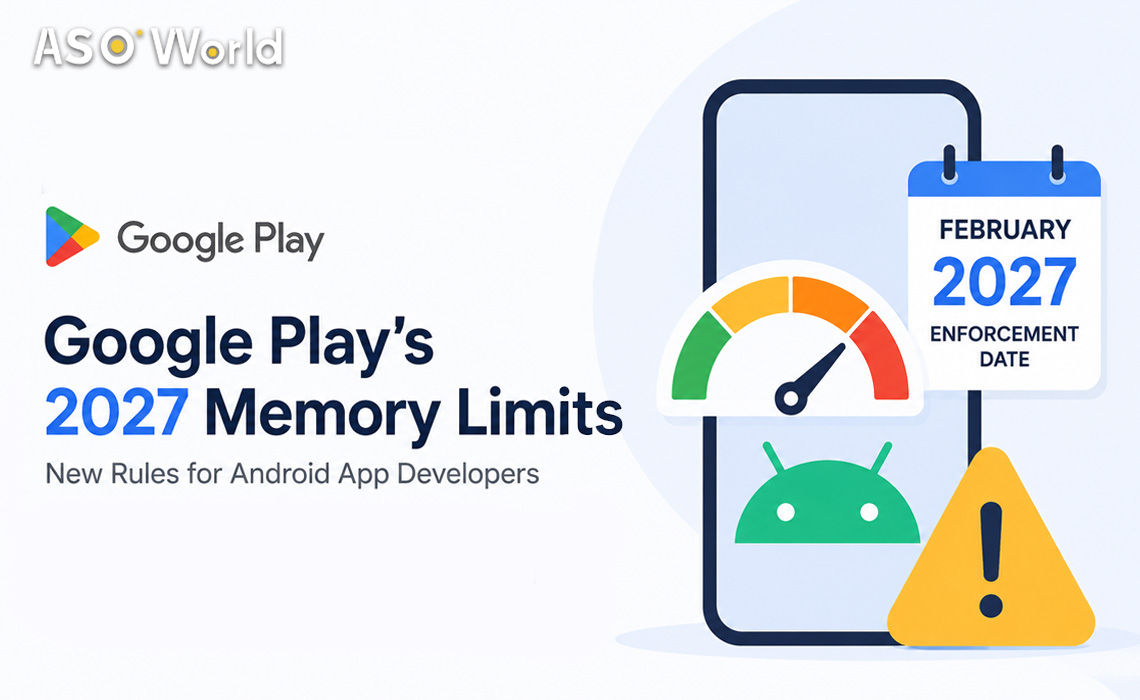

Google Play is turning app performance into a policy requirement. Starting in February 2027, Android apps and games will face enforceable thresholds for memory usage, bitmap consumption, and code optimization — with a separate Zero-Tap Sign-In mandate following two months later in April 2027. For developers, the message is blunt: apps that keep hogging device memory could lose visibility and, in some cases, the ability to publish updates on the Play Store.
The shift, announced by Google Play's Developer & Monetization team, is framed as a response to what the company calls "significant hardware supply constraints" reshaping device memory availability. It extends protections already introduced in Android 17, where per-app memory limits first landed on Pixel phones and are now spreading across a wider range of Android manufacturers — from budget 4GB handsets to 16GB-plus flagships.
Why Google Is Tightening Memory Rules Now
The core problem is straightforward. When an app consumes too much memory, it doesn't just hurt itself — it slows the entire device, drains background apps, and triggers system-level terminations that users rarely blame on the hardware. Google's own guidance warns that applications exceeding Android's limits "will be slowed down and may be terminated," which translates directly into poor ratings, higher uninstall rates, and weaker retention.
Android 17 introduced the technical groundwork with per-app memory limits, but those protections only matter if developers actually stay within them. By moving enforcement to Google Play, the company is linking technical quality to commercial consequences — making memory discipline a ranking and publishing factor rather than a best practice.
The Three Thresholds Developers Must Hit
Google Play's February 2027 enforcement targets three distinct areas. The first is dynamic memory usage, measured using Anonymous RSS + Swap. This tracks the private memory an app uses for active and compressed data, while excluding on-device files such as code and assets. Google evaluates consumption across different app states and device RAM tiers.
The second area is bitmap memory usage. Bitmaps are a common source of hidden bloat because they can remain in memory long after an app is no longer visible. Under the new rules, Google expects bitmaps to be released promptly in background and cached states.
The third requirement is DEX code optimization. Android App Bundles published through Google Play must reach at least 25% coverage across optimization, shrinking, and obfuscation — typically using R8 or another shrinking tool. Google says optimized DEX code reduces an app's memory footprint while improving startup, rendering, and runtime performance, and reducing application-not-responding (ANR) events.
The actual limits vary depending on whether the software is an app or a game, how much RAM the device has, and whether the process is running in the foreground, providing a user-perceived service, or sitting in the background. Games receive higher ceilings in several categories because of their naturally heavier memory requirements.
| Device RAM tier | App foreground limit (Anonymous RSS + Swap) | Game foreground limit |
|---|---|---|
| 4GB | 2GB | 2.25GB |
| 8GB | 2.25GB | 3.5GB |
| 16GB+ | 4.25GB | 5GB |
Bitmap consumption gets its own set of 90th-percentile thresholds. Apps and games must stay at or under 200MB for user-perceived services, 200MB in the background, and 400MB when cached. For image-heavy apps, that means aggressive downsampling, bitmap recycling, and lifecycle-aware memory management become mandatory rather than optional.
What Happens If Your App Exceeds the Limits
This is the part developers can't afford to ignore. From February 2027, compliance is no longer advisory. Google states that apps and games failing to meet the memory, bitmap, and DEX optimization thresholds "may see reduced app visibility and publishing capabilities on Google Play." That's a direct threat to discoverability — and, by extension, to organic installs.
To soften the transition, Google has already started rolling out tools in Play Console. Android vitals now surfaces dynamic and bitmap memory metrics that can be drilled down by percentile and RAM bucket. A new Crashes and ANRs filter identifies instances where the OS killed an app due to severe memory pressure. Play Console is also adding DEX optimization insights for newly uploaded bundles and proactive warnings when an app or game approaches the upcoming thresholds.
More diagnostics are promised later this year, including deeper visibility into how long an app spends in each state and additional insight into Android's Memory Limiter. For developers, the practical takeaway is to start measuring now — waiting until late 2026 means fixing performance debt under deadline pressure.
Zero-Tap Sign-In: The April 2027 Onboarding Deadline
The second requirement targets a different kind of friction: device migration. Starting in April 2027, any app that supports user accounts — whether sign-in is optional or mandatory — must support Google's Zero-Tap Sign-In standard. The mechanism uses the Android Restore Credentials API to restore a user's authenticated state during device-to-device transfer or cloud backup, so a restored app recognizes and signs in the user without requiring credentials again.
Games are currently exempt from this requirement, though Google plans to deliver dedicated guidance for complex gaming authentication scenarios in 2027. Games that already use a single-account sign-in system are still being encouraged to adopt the Restore Credentials API early. The stakes are the same as the memory rules: apps that don't comply could lose full publishing capabilities and optimal Play Store visibility.
What This Means for App Developers
These changes pull Google Play further into technical-quality enforcement, which means developers now have two product surfaces to optimize: the store listing and the app itself. A well-optimized APK that keeps memory low, loads quickly, and restores sign-in seamlessly is becoming a ranking signal in its own right — not just a technical nicety. If you're already investing in ASO, pair it with an understanding of how Google Play's ranking algorithm evaluates apps so your optimization efforts cover both listing performance and on-device quality.
How to Prepare Before the Deadlines
The two enforcement windows give developers separate compliance paths. The memory, bitmap, and code optimization requirements arrive first in February 2027, followed by mandatory account restoration in April 2027 for applicable apps. Teams should treat these as roadmaps rather than distant future events.
| Requirement | Enforcement start |
|---|---|
| Memory usage (Anonymous RSS + Swap) | February 2027 |
| Bitmap memory usage | February 2027 |
| DEX code optimization (25% minimum) | February 2027 |
| Zero-Tap Sign-In (Restore Credentials API) | April 2027 |
On the memory side, start by reviewing Android vitals in Play Console to identify which app states and RAM tiers are pushing you toward the thresholds. Profile bitmap usage with lifecycle-aware strategies so images don't linger in memory after an app loses visibility. Run R8 or an equivalent shrinking tool on your App Bundle and confirm your DEX coverage clears the 25% floor. For sign-in, evaluate whether your account flow can adopt the Android Restore Credentials API well before April 2027 — especially if you already use a single-account model.
The Bigger Picture for Android's Ecosystem
Google is effectively shifting the cost of the RAM shortage from hardware makers to software developers. By enforcing memory discipline at the store level, it hopes to keep budget Android devices feeling responsive even as apps grow more demanding — and as on-device AI workloads continue to compete for the same limited memory. That's a reasonable goal for users, but it places a new compliance burden on every team shipping to Google Play.
For developers, the smart response is to treat performance as a growth strategy rather than a compliance chore. Apps that start faster, crash less, use less memory, and sign users in seamlessly will not only stay visible in the Play Store — they'll also retain more of the users they worked hard to acquire. The 2027 deadlines are a warning, but they're also a competitive opportunity for teams that act early.

 Follow Us on Facebook