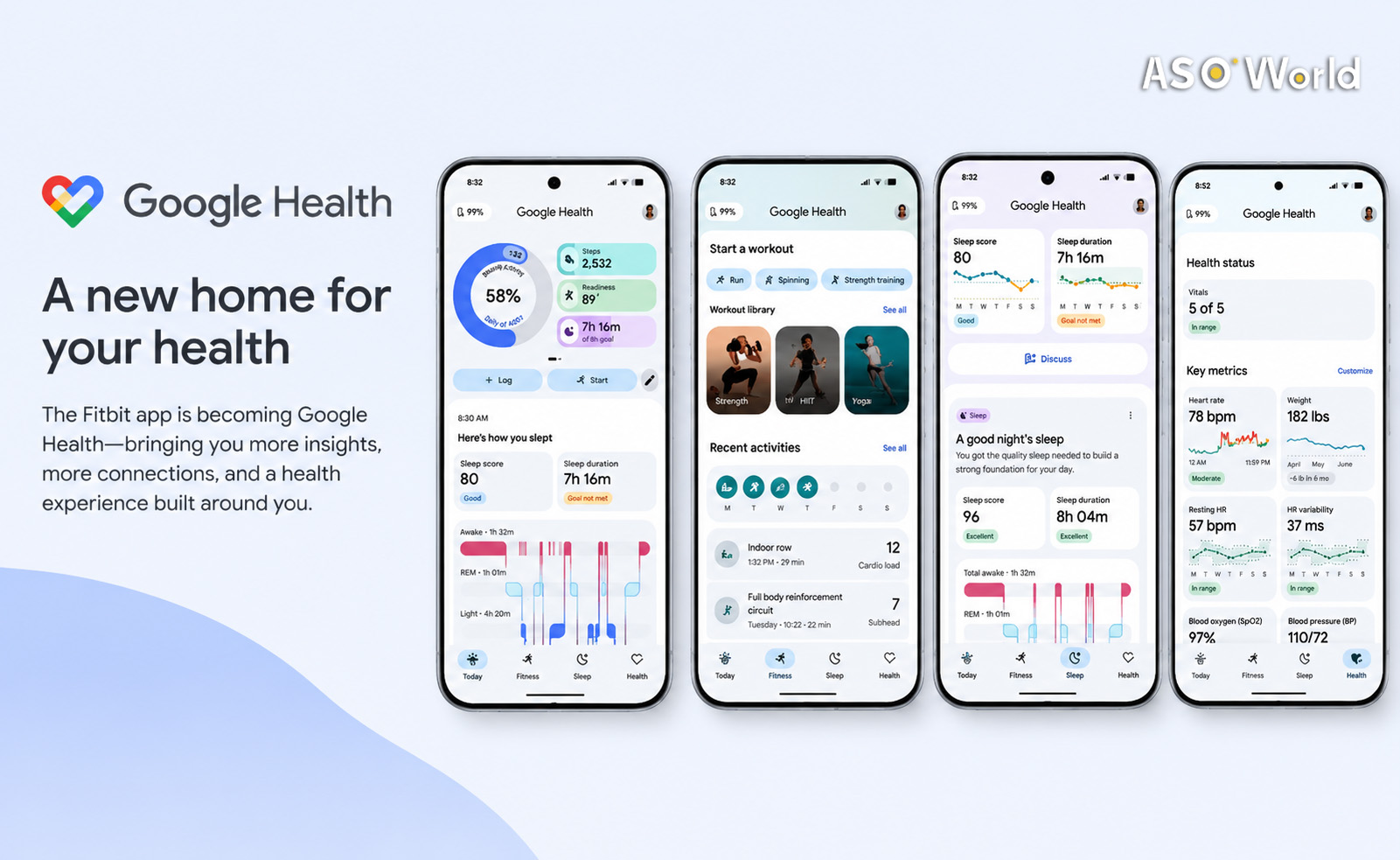

Google officially replaces the Fitbit app with Google Health, marking a major shift in wearable and health software strategy. Beyond a brand change, Google Health centralizes health tracking, integrates AI coaching, consolidates Google Fit, and supports hundreds of third-party devices and services. Teams looking to optimize health and fitness apps can explore practical strategies in our Health & Fitness App Marketing Guide.
For AI product managers and developers, this is a clear signal: the industry is moving from device-centric apps to AI-driven intelligence platforms, where predictive insights and ecosystem integration matter more than standalone functionality.
Fitbit Moves From Product to Intelligence Layer
Fitbit’s role is transitioning from a consumer-facing app to a foundational data layer within Google Health. Users will gradually experience less of the standalone Fitbit interface, while AI systems leverage their activity, sleep, and biometric data to generate contextual insights.
Strategic implication:
- Product visibility is secondary to ecosystem value.
- Developers must adapt to Google Health APIs instead of Fitbit-specific endpoints.
- SaaS competitors must integrate into AI layers or risk commoditization.
This structural change emphasizes that in AI-driven health platforms, data utility outweighs interface design.
AI Turns Health Data Into Actionable Intelligence
Health metrics are no longer just recorded—they are interpreted to guide behavior. Sleep data predicts recovery states, step counts analyze movement efficiency, and heart-rate variability informs stress and resilience models. AI transforms raw data into actionable insights, enabling automated recommendations across personal, workplace, and enterprise workflows.Learn how Google Health integration affects ASO and ecosystem positioning in our Health App Market Analysis.
Impact for AI professionals:
- Tools become integrated modules rather than dashboards.
- Workflows can leverage predictive health signals for scheduling, workload optimization, and personalized interventions.
- Platform operators controlling interpretation layers gain a sustainable competitive edge.
Implications for Users and Developers
The integration impacts multiple stakeholders:
- End users: receive proactive insights but lose a standalone product identity.
- Developers: face migration to Google Health’s unified ecosystem.
This highlights a broader lesson for AI product strategy: standalone functionality is increasingly less valuable than the ability to interpret and act on continuous data streams.
Strategic and Competitive Implications
The wearable market is now a competition over AI interpretation rather than hardware.
- Google leverages Fitbit to centralize health intelligence.
- Apple continues optimizing its hardware-software integration loop.
- Startups focus on predictive personalization and contextual recommendations.
Key insight: controlling the data-to-insight layer is now more strategic than device innovation. Platforms that dominate this layer are poised to set industry standards for user engagement, AI-driven productivity, and long-term market control.
Industry Trend: From SaaS Apps to AI Platforms
Fitbit’s integration exemplifies a broader trend: AI platforms absorb standalone SaaS functionality, merging data, workflows, and automation into unified intelligence layers.
For AI industry professionals, the takeaway is clear:
- Future SaaS products must act within intelligence ecosystems, not as isolated tools.
- Productivity gains come from systems that interpret and act on data continuously.
- Competitive advantage shifts from features to the predictive power of AI models.
Comments
Google’s strategy illustrates the evolution from product-first to intelligence-first platforms. Users gain predictive, actionable insights, developers navigate new ecosystem constraints, and SaaS operators face pressure to integrate or risk marginalization. The industry is pivoting from isolated dashboards to AI-driven decision engines.
FAQ
1. How does Google’s Fitbit strategy affect users?
Users gain predictive, actionable insights, though the standalone Fitbit app experience diminishes.
2. What does this mean for AI productivity and workflow optimization?
Health data can feed automated recommendations for scheduling, workload, and wellness interventions.
3. What does this mean for developers and SaaS operators?
Google Health offers APIs for integration, making ecosystem participation a key strategic advantage.
4. Why is this important for AI industry strategy?
Controlling the AI interpretation layer creates sustainable competitive advantages beyond hardware or basic app features.

 Follow Us on Facebook