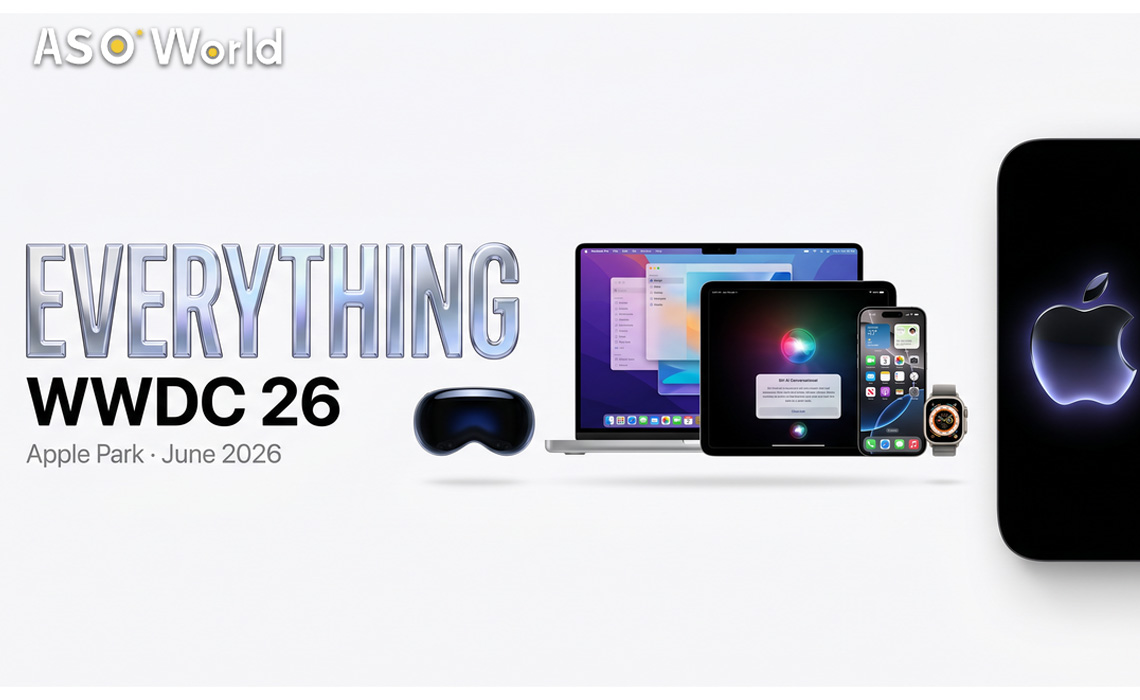

Apple's 2026 Worldwide Developers Conference opened with the loudest "we finally shipped it" moment in years. After two delays and a public re-pitch, the long-promised personalized Siri arrived as Siri AI, powered in part by Google's Gemini models and stitched across iOS 27, iPadOS 27, macOS 27 ("Golden Gate"), watchOS 27, visionOS 27, CarPlay and AirPods. It is also Tim Cook's last WWDC keynote as CEO before he hands the role to hardware chief John Ternus on September 1, giving the entire event a quiet "end of an era" undertone.
For iOS developers and app marketers, the real story is not just Siri. It's a coordinated push that re-prioritizes discovery, performance and on-device intent — three things that will reshape App Store visibility, retention curves and creative testing for the next 12 months. Here is the full breakdown, organized for builders and growth teams, not just keynote watchers.
1. Siri AI: From Voice Assistant to System-Level Intent Layer
Siri AI is the headline. It keeps the "Hey Siri" wake word and side-button press, but adds a new gesture: swipe down from the middle of the iPhone home screen to summon a conversational interface. Responses render in cards that you can keep talking to, more like a chatbot than a one-shot assistant. On Dynamic Island iPhones, the Siri animation now lives at the top of the screen during active requests.
What's actually new under the hood:
- Onscreen awareness. Siri AI can act on what is currently displayed — e.g., looking at a photo of your shed and asking how to convert it into a maker space, or pulling festival lineup items from a screenshot directly into Calendar.
- App Intents at scale. Siri AI can chain actions across first- and third-party apps: "add this photo to the family album," "remind me when the ticket lottery opens," "suggest recipes for World Cup countries."
- Dedicated Siri chatbot app. A standalone surface for text generation, image generation, file analysis and document feedback — Apple's clearest signal yet that Siri is becoming a one-stop information layer.
- Spotlight integration on macOS Golden Gate. Siri AI is baked directly into Spotlight, turning the Mac's launcher into a generative command bar.
- Voice customization. Users can adjust Siri AI's expressiveness and speech rate; dictation quality gets a major upgrade.
- Visual Intelligence on Vision Pro. Point-and-ask features extend to the headset for the first time.
Availability is gated: Siri AI launches in English first on iPhone 16 (all), iPhone 15 Pro/Pro Max, iPad mini (A17 Pro), M1+ iPads and Macs, Vision Pro, Apple Watch Series 10+, Watch Ultra 2+ and the new Watch SE 3 when paired with a supported iPhone. And — notably — Siri AI is delayed indefinitely in the EU on iOS 27 and iPadOS 27, with Apple citing the Digital Markets Act. EU users will still get it on macOS, visionOS and watchOS.
For deeper context on the conversational redesign and the new auto-deleting chat history, see our earlier write-up on Siri's AI rebirth in iOS 27.
2. Apple Intelligence Spreads Across Default Apps
Apple Intelligence — the on-device + Private Cloud Compute stack that powers Siri AI — is the year's most app-marketer-relevant story, because it lands inside the surfaces where users already spend their attention.
- Safari: auto-organizes open tabs by topic, sends notifications when a page changes (price drops, restocks, ToS edits), and lets users generate custom Safari extensions by describing what they want.
- Passwords: one-tap strengthening of weak/compromised credentials, with the Passwords app updating logins on the relevant site automatically.
- Messages & Mail: smart replies that mimic the user's own writing style.
- Calendar: create or edit events by describing them; contacts and locations are added automatically.
- Shortcuts & Home: Apple Intelligence is now first-class inside both, expanding what natural-language automations can do — a direct extension of the trend we covered in Apple's iOS 27 AI Shortcuts: the end of app silos.
- Photos & Image Playground: photorealistic generation, lock screen wallpapers, virtual reframing and an Extend tool that expands an image's canvas. Every output carries a SynthID watermark.
- Writing Tools: proofreading and rewrite suggestions are exposed to third-party apps via the system text engine.
- Accessibility: VoiceOver gets richer image descriptions; the Action Button can answer questions about whatever the camera sees; Accessibility Reader supports summaries and translations.
For a forward-looking checklist on which of these features matter most for store listings and feature parity, our team published 7 Apple Intelligence features rumored for iOS 27 just before the keynote — most of those predictions landed.
3. Liquid Glass, Year Two: Calmer, More Customizable
Last year's Liquid Glass redesign was Apple's most polarizing visual move in a decade. WWDC 2026 quietly walks it back. The default look is less translucent, and Apple has added an opacity slider so users can dial transparency up or down. On macOS, toolbars are more uniform across apps, sidebars stretch fully to screen edges, window corners are tighter, and the app icon set has been refreshed.
Why this matters for ASO and creative teams: icons and screenshot frames need to be retested. Apple's first-party icon refresh shifts the baseline visual context on the home screen and in the App Store, so contrast, edge treatment and gradient stops that performed well in 2025 may fade against the new system aesthetic. We dug into the exact icon-language shift in iOS 27 Liquid Glass: what the icon refresh means.
4. A Real Performance Reset
The least-hyped part of the keynote is arguably the most consequential. Apple is promising:
- Up to 80% faster AirDrop transfers, Mail message loads and Apple Music playback starts.
- Up to 30% faster app launches.
- Up to 70% faster appearance of new photos in the camera roll.
- Faster Wi-Fi-to-cellular handoff.
- A rewritten CPU scheduler that benefits older devices — iOS 27 supports every iPhone that ran iOS 26, meaning iPhone 11 and later get the speed boost.
- A rebuilt search foundation under Spotlight, Mail and Photos that indexes new files "almost immediately."
- Full-resolution iCloud shared albums, including on Android and Windows.
Faster app launches and faster Spotlight indexing change the math on first-impression retention and on Spotlight-driven re-engagement — two surfaces that quietly drive a meaningful share of organic opens for utility, productivity and content apps.
5. Parental Controls and Child Accounts Get Teeth
Apple is rolling out mandatory Child Accounts for under-13 users, which parents can keep in place until age 18. The account triggers system-wide safeguards tailored to age: contact controls across Phone/FaceTime/Messages, app and website permission requests, granular Screen Time limits, and a new flow to set up an Apple Watch for a kid who does not own an iPhone. Automatic image filtering is on by default.
For social, dating, gaming and UGC apps, expect tighter age-gating signals from the OS, more permission-prompt friction on first launch for younger accounts, and a higher bar for ratings disputes. Plan onboarding accordingly.
6. The Rest of the Keynote, in One Pass
- watchOS 27 gets the Siri upgrade and adds perimenopause-tracking features alongside an evolved health stack.
- visionOS 27 brings the new Siri to Vision Pro and extends Visual Intelligence to spatial computing.
- macOS 27 "Golden Gate" centers on Spotlight + Siri AI, the design cleanup and the performance work.
- AirPods gain a customizable EQ in iOS 27 — a small but long-requested addition.
- Developer betas for iOS, iPadOS, macOS, watchOS and visionOS 27 are live today; public release is this fall.
- No new hardware on stage. This was a software-first WWDC, as the pre-event WWDC 2026 expectations rundown predicted. The foldable iPhone Ultra and Apple's AI Glasses — both heavily leaked — were not on stage; see our coverage of the iPhone Ultra foldable leaks and the Apple AI Glasses delay to late 2027.
What This Means for iOS Developers
Three immediate to-dos:
- Adopt App Intents aggressively. Siri AI's value comes from chaining actions across apps. If your app does not expose intents — or exposes shallow ones — it will be invisible to the new assistant surface.
- Audit screenshots and icons against the new Liquid Glass baseline. Apple's first-party icon refresh will shift the visual reference point on the home screen and in App Store search results.
- Plan for the EU split. Siri AI is unavailable in the EU on iOS/iPadOS 27 at launch. Build feature gates and onboarding copy that gracefully degrade rather than dead-end EU users.
For categories vulnerable to system-level replacement — note-taking, translation, basic image editing, voice memos, simple automation — re-read our analysis on the five app categories iOS 27 could replace. Differentiation and positioning matter more than ever.
What This Means for App Marketers
Three shifts to watch:
- Discovery is moving up the stack. Spotlight + Siri AI now act as a generative command bar. Branded queries and direct intents will rise; long-tail keyword traffic patterns will mutate. Treat App Intents metadata with the same care you treat keyword fields.
- Creative testing has a new baseline. Liquid Glass v2, refreshed first-party icons and the new screenshot context all reset the visual environment your assets compete in.
- Performance becomes a story you can tell. A 30% faster launch and 70% faster photo handling are not just OS gains — they raise user expectations of every app. "Fast" is no longer a feature; it is table stakes that should be reflected in your screenshots, subtitle and reviews-handling.
FAQ
When can users install iOS 27?
Developer betas are available today. A public beta is expected in July, with a general release in fall 2026 alongside iPadOS 27, macOS 27 "Golden Gate," watchOS 27 and visionOS 27.
Which devices support Siri AI?
iPhone 16 (all), iPhone 15 Pro and Pro Max, iPad mini (A17 Pro), M1 or later iPads and Macs, Apple Vision Pro, Apple Watch Series 10 or later, Watch Ultra 2 or later, and Watch SE 3 when paired with a supported iPhone. English first, more languages later.
Why is Siri AI unavailable in the EU?
Apple cites the Digital Markets Act as the reason for the indefinite delay on iOS 27 and iPadOS 27. EU users will still get Siri AI on macOS 27, visionOS 27 and watchOS 27.
Did Apple announce any hardware?
No new hardware was unveiled during the keynote. WWDC 2026 was software-first. The rumored foldable iPhone Ultra and Apple AI Glasses were not shown.
What should iOS developers prioritize first?
Expose rich App Intents, adopt the updated Apple Intelligence Writing Tools APIs, retest your icons and screenshots against the new Liquid Glass defaults, and design a graceful EU fallback for Siri AI-dependent flows.
What should app marketers prioritize first?
Refresh creatives against the new system aesthetic, expand App Intents metadata for Spotlight + Siri AI discovery, and build a launch-week ASO plan timed to the iOS 27 public release. A specialized partner such as ASO World can accelerate keyword ranking and review velocity through the upgrade window.

 Follow Us on Facebook