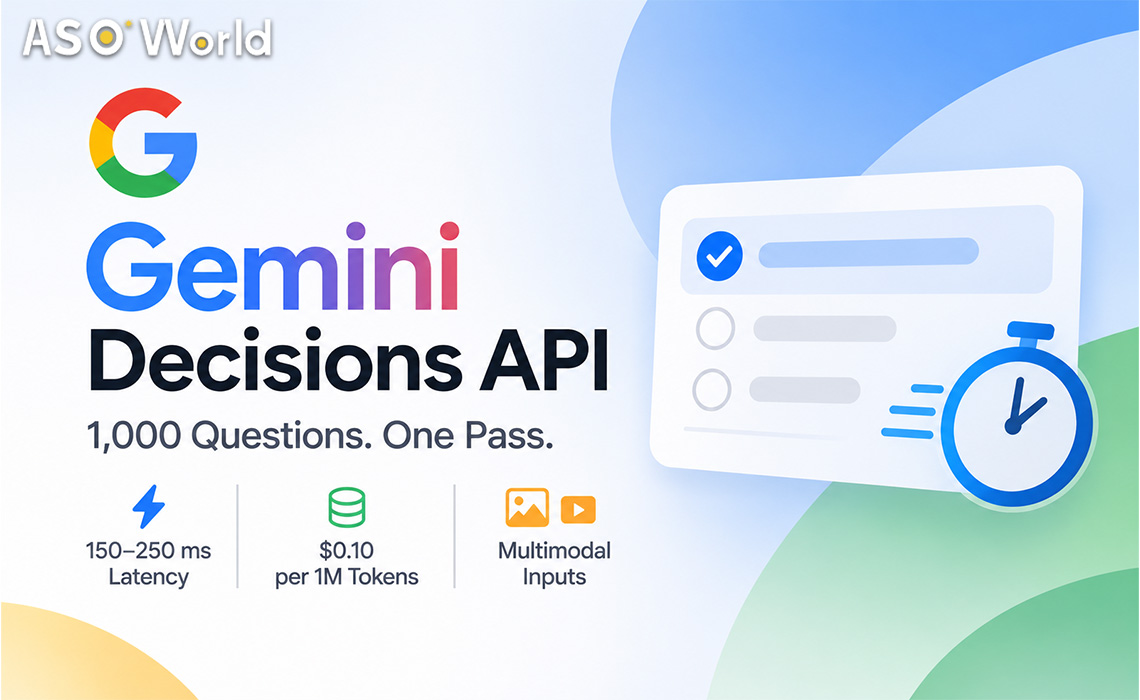

Google has joined a fast-growing corner of AI that does not write text at all. On November 11, 2026, Google DeepMind introduced the Gemini Decisions API, powered by a new model called Gemini Decision 1, built to make fast choices rather than generate answers. Instead of producing words one token at a time, it scores a set of options in a single pass and returns probabilities and confidence values in roughly 150 to 250 milliseconds.
The API can evaluate up to 1,000 independent questions in one request, across text, images, audio, video and PDFs, and costs $0.10 per million input tokens with no charge for output. Here is a clear breakdown of how it works, what it costs, where Google already uses it and how it compares with other "decision models" that have appeared in recent weeks.
Key Takeaways
- What it is: A new endpoint for closed-set decisions such as yes/no checks, multiple choice and rubric scoring.
- Scale: Up to 1,000 independent questions per request, on one shared multimodal input of up to 256K tokens.
- Speed: 150 to 250 ms end to end, with 50 to 100 ms of model compute.
- Price: $0.10 per million input tokens and zero output tokens billed. Google says that is nearly 5 times cheaper than Gemini 3.5 Flash-Lite on its benchmark suite.
- Availability: Live now in the Gemini API and Google AI Studio, with a no-cost tier for prototyping.
Gemini Decisions API at a Glance
| Detail | Info |
|---|---|
| Announced | November 11, 2026 |
| Model | Gemini Decision 1 (gemini-decision-1) |
| Input types | Text, images, audio, video and PDFs, up to 256K tokens |
| Questions per request | Up to 1,000 independent questions |
| Output | Probabilities and confidence scores from 0 to 1 |
| Latency | 150–250 ms end to end |
| Price | $0.10 per 1M input tokens; $0 for output |
| Where to try it | Google AI Studio, with Python, JavaScript and REST guides |
What Is a Decision Model?
Most AI models generate text. A decision model is built for a narrower job: given an input and a list of possible answers, pick the best one, and say how confident it is. Because the model scores options directly and does not decode an answer token by token, it can respond far faster and more cheaply than a general chat model. It suits the many small judgments that sit inside larger systems, such as routing a request, checking a rule or grading content.
How It Works: Three Question Types in One Request
Developers send one shared input and a set of questions. Each question can be one of three types, and a single request can mix them:
| Type | What it does | What comes back |
|---|---|---|
| Yes/No (named "noul") | Estimates whether a condition is true, with optional descriptions of what counts as true or false | A probability |
| Choice | Selects from 2 to 255 options | The winner and normalised probabilities for every option |
| Score | Grades the input on an ordered rubric starting at zero | A continuous weighted score plus per-level probabilities |
Google's example checks a photo of a breakroom counter before a meeting. One request asks whether there is an uncleaned spill, which cleanup action fits and how severe the mess is, and gets back a probability, a ranked choice and a severity score together. Every answer carries a confidence value, so an application can send low-confidence cases to a fallback model or a human reviewer.
Inputs can combine formats, for example a call recording with account metadata, or a scanned PDF claim with photos of damage. Developers can adjust image and video resolution to control detail and token cost.
Pricing and Cost Model
| Item | How it is billed |
|---|---|
| Input tokens | $0.10 per million |
| Output tokens | Not billed |
| Shared input | Billed once per request, however many questions are asked |
| Each question | Adds only its own instruction and criteria tokens |
| Other charges | No thinking-token bills and no separate audio transcription or OCR costs |
| Prototyping | No-cost API tier in Google AI Studio |
The structure rewards asking many questions about the same input. Because the file or recording is billed once, adding a second, tenth or hundredth question costs only the extra instruction text.
Speed and Performance Claims
- Latency: 150 to 250 ms end to end, with median model compute of 50 to 100 ms. Google says latency stays nearly flat from 1 to 100 questions per request.
- Cost: Nearly 5 times cheaper than Gemini 3.5 Flash-Lite used through the Interactions API, across a shared benchmark suite.
- Accuracy: Google says Gemini Decision 1 leads a suite covering agent routing, reasoning, ranking and multimodal understanding, and has the lowest calibration error, meaning its confidence scores match real accuracy more closely.
These figures are from Google's own testing, and the benchmark scores were published as charts rather than detailed tables. Independent evaluations will be needed to confirm them.
How Google Is Already Using It
| Product | Use |
|---|---|
| Gemini Notebook | A real-time router that sends each query to the right model tier and thinking level, serving everyday queries with up to 40% lower latency |
| Stitch (rapid canvas experiment) | Generates playable wireframes of a product flow in seconds and applies voice or tap edits almost instantly |
| CC from Google Labs | Picks an emoji reaction from a palette of more than 200 in a fraction of a second |
| Google Search | A safety layer for tools connected through the Model Context Protocol, detecting adversarial behaviour and content |
The pattern is that a small, fast model handles control decisions, while larger models stay reserved for work that needs generation or deep reasoning.
A New Category: Decision Models
Google is not alone. In recent weeks, a startup founded by a former OpenAI researcher, then OpenAI, Cloudflare and Microsoft have all introduced decision-style models or interfaces. A hands-on comparison of three of them shows how they differ:
| Feature | Jev (startup) | OpenAI | Google Gemini Decision 1 |
|---|---|---|---|
| Introduced | September 21, 2026 | October 6, 2026 | November 11, 2026 |
| Question types | Yes/no, choice, rubric score | Similar decision interface | Yes/no, choice, rubric score |
| Input types | Text and JSON only | Text and images | Text, images, audio, video and PDFs |
| Input price | $0.042 per 1M tokens | $0.10 per 1M tokens | $0.10 per 1M tokens |
| Output price | Free | Free | Free |
In a test with a video clip, one developer found a practical difference: the other two models returned a flat 1.0 or 0.0 for yes/no questions, while Gemini returned graded probabilities such as 0.92 and 0.05. That is consistent with Google's emphasis on calibration, though a single test is not proof of better accuracy.
Where to Find It
Besides Google AI Studio, integrations are rolling out across OpenRouter, LangChain, Vercel, LiteLLM, Pydantic AI, Pipecat, LiveKit and OpenCode, along with the Google GenAI software development kits. Support in Gemini on Google Cloud is listed as coming soon. Google also offers demo apps in AI Studio for trying the API without writing code.
Why It Matters for App Developers and Marketers
This section is ASOWorld's editorial analysis, not a statement from Google.
For anyone building AI features into apps, decision models change what is cheap to do:
- Cheap guardrails. Content checks, policy screening and moderation can run on every request instead of a sample, since each check costs a tiny fraction of a generative call.
- Smarter model routing. Sending easy queries to cheaper models and hard ones to powerful models is one of the main ways to cut AI costs, and a decision model makes the routing step fast enough to be invisible.
- Better review workflows. Confidence scores let apps automate clear cases and send only uncertain ones to people, which suits support, moderation and listing-quality checks.
- Multimodal inputs. Scoring video, audio and documents directly opens up features such as automated screenshot or video review, call quality checks and content tagging.
- Pick on total cost. Input price, supported formats and calibration all differ between providers, so teams should test candidates on their own data.
For more coverage of AI platforms and their impact on app businesses, browse the AI Tech section on Marketing Trending.
📱 App Marketing Angle
Fast, cheap decision layers make it easier to add AI features that feel instant, from smart routing to automated quality checks. Apps that ship these features can use the moment to refresh store listings, screenshots and keywords around concrete capabilities. See how ASOWorld's AI app marketing solutions help AI apps turn new capabilities into rankings, installs and revenue.
What to Watch Next
- Independent benchmarks. Third-party tests of accuracy and calibration across the competing decision models.
- Google Cloud availability. The listed "coming soon" support for enterprise customers.
- Price competition. Whether providers cut prices toward the cheapest option on the market.
- Wider adoption in Google products. More features using the API as a control layer, beyond Notebook, Stitch, CC and Search.
Quick Answers: Gemini Decisions API
What is the Gemini Decisions API?
A Google endpoint, powered by the Gemini Decision 1 model, that scores yes/no, multiple-choice and rubric questions in a single fast pass instead of generating text.
How much does it cost?
$0.10 per million input tokens, with no charge for output tokens and a no-cost tier in Google AI Studio for prototyping.
How fast is it?
Google says 150 to 250 milliseconds end to end.
What can it process?
Text, images, audio, video and PDFs, up to 256K tokens, with up to 1,000 independent questions per request.
What are decision models used for?
Routing requests between models, checking policy rules, grading content, selecting tools and flagging uncertain cases for review.
How does it compare with other decision models?
It matches OpenAI on input price at $0.10 per million tokens and handles more input types, while a startup rival is cheaper at $0.042 per million but supports only text and JSON.

 Follow Us on Facebook