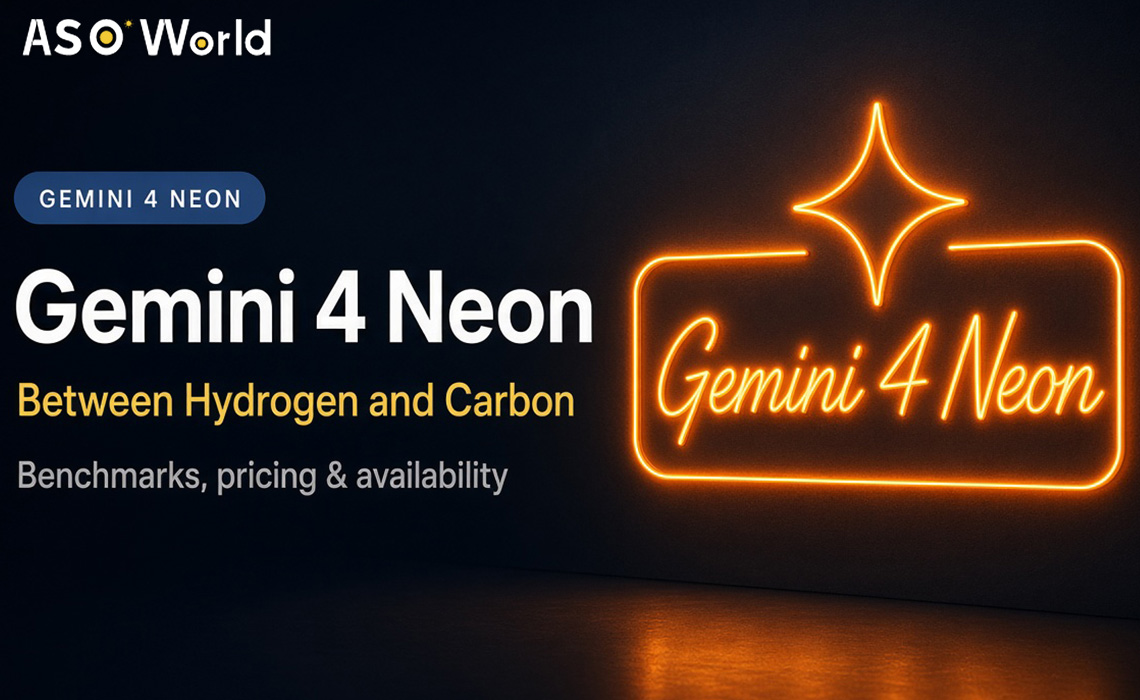

Google has released Gemini 4 Neon, a mid-tier model that it says delivers frontier-level reasoning at Flash speeds and a fraction of the cost per task. Announced on November 18, 2026, Neon sits between Gemini 4 Hydrogen and Gemini 4 Carbon in Google's lineup, replaces Argon, and ships with a one-million-token context window and four thinking levels. It is available to paid AI Pro and Ultra subscribers, developers and enterprises, but not on the free tier.
Key Takeaways
- Positioning: Neon slots between Hydrogen and Carbon, built for coding, analysis and production workflows rather than chat.
- Price: $3 per million input tokens, $0.15 per million cached input and $15 per million output tokens.
- Efficiency claim: Google says Neon costs 32% less per task than Carbon at the same default thinking level.
- Benchmarks: first on the Artificial Analysis Coding Agent Index, third overall on its Intelligence Index.
- Lineup churn: Neon replaces Argon, Gemini 3.1 Pro leaves the app, and 3.5 Flash-Lite becomes the "Auto" option for paid users.
What Neon Is, and Why the Middle Tier Matters
Google's fourth Gemini 4 variant in a month is not a flagship. It is an attempt to collapse the gap between the fast model and the smart one. Neon is built for long-running agent workflows, multi-file refactoring, spreadsheet and document analysis, and scientific reasoning — the workloads that previously forced teams to choose between Hydrogen's speed and Carbon's judgment.
The model supports four thinking levels: low, medium, high and extra high. At xhigh it posts its highest intelligence score while still undercutting competing models on cost per task; at the default high setting it is tuned for volume. It also acts as an orchestrator in Google Antigravity, directing parallel Hydrogen subagents while keeping track of progress and compacting context in long sessions.
| Tier | Model | Designed for |
|---|---|---|
| Fast | Gemini 4 Hydrogen | Everyday execution and high-volume tasks |
| Balanced | Gemini 4 Neon | Agentic coding, analysis and production workflows |
| Frontier | Gemini 4 Carbon | Long-horizon, high-difficulty reasoning |
The reshuffle is as notable as the model. Argon, until now one of Google's two frontier systems, is being replaced by Neon in the product lineup. In the Gemini app, Gemini 3.1 Pro has been removed entirely, and 3.5 Flash-Lite now appears as "Auto" for paid users. Anyone tracking which model they are actually talking to will need a new mental map.
Benchmarks: First on Agents, Third on Raw Intelligence
The results are strong but uneven, and they point to where Google aimed. Neon is not the most intelligent model available; it is one of the most capable per dollar.
| Benchmark | Result |
|---|---|
| Artificial Analysis Intelligence Index | 61, third overall at xhigh |
| Artificial Analysis Coding Agent Index | First, 58.6 |
| Vals Index | Second, on the Pareto frontier |
| Agent Arena | Second globally, 1336 across 4,200+ sessions |
| Zapier AutomationBench | First, 56.3% ($16,843 simulation) |
| FrontierCode 2.0 | 46.2% at default high |
| Chartography | 73.5% on dense professional charts |
Third place overall is the honest headline. Neon trails larger, slower models on general intelligence, which is expected for a cheaper system. What matters is the shape of the results: first on coding agents, second on steerability, first on Zapier's long-horizon business simulation, and top-ranked across finance, accounting and spreadsheet modelling tasks.
Google also reports the lowest fabrication rate of any Gemini 4 model in internal testing, a 0.09% misaligned action rate on its agentic safety suite, and a 99.2% pass rate on agent honesty. Those are company figures, but they address the failure mode that matters most for agents left running unattended.
The Price Is the Argument
Neon costs $3 per million input tokens and $15 per million output tokens, with cached input at $0.15 — a 95% discount that rewards repeated context such as a codebase.
| Model | Input | Output |
|---|---|---|
| Gemini 4 Hydrogen | $1.50 | $7.50 |
| Gemini 4 Neon | $3.00 | $15.00 |
| Carbon / Argon (promotional, to Nov 30) | $2.00 | $10.00 |
| Carbon / Argon (standard) | $4.00 | $20.00 |
The promotional pricing on Carbon and Argon ends on November 30, after which they revert to $4 and $20. At that point Neon is 25% cheaper than the flagship on list price, and Google claims a 32% lower cost per task at the default thinking level — meaning the gap widens further once token consumption is counted.
That creates an awkward window for buyers. Until the end of the month, Carbon is cheaper per token than Neon. After it, Neon is cheaper and, in agentic coding, competitive. Procurement teams signing Q4 contracts will be pricing against a rate card that changes in twelve days.
The Cybersecurity Variant
Alongside the general model, Google is rolling out a restricted "Neon for cyber" variant to trusted defenders. It claims state-of-the-art results on secure code generation at the hard tier (76%), exploitation testing at 51.26% on WebExploitBench, and 90.5% on SEC-bench Pro, at roughly half the cost of larger models.
This is the part of the launch with the least public access and the most strategic weight. Agentic coding is increasingly judged on whether the code it produces is safe, and Google is selling that capability separately rather than bundling it into the default model.
Availability
Gemini app: AI Pro and Ultra subscribers, selectable in the model picker. Free users do not get Neon.
Developers: the Gemini API and Google AI Studio, including Gemini for Business.
Antigravity: paid AI Pro and Ultra subscribers, where it can act as an orchestrator for Hydrogen subagents.
What to Watch Next
The December 1 rate card.
Whether Google leaves Neon at $3/$15 or adjusts it once Carbon's promotional pricing ends will decide how much of the lineup it cannibalises.
Independent agent testing.
Coding agent rankings move quickly, and Neon's first-place position rests partly on Google-run harnesses. Third-party replication over the next month will be more telling.
Whether Argon returns.
Replacing a frontier model with a cheaper one is a statement about where Google thinks the market is going. If demand for maximum intelligence persists, the decision may be revisited.
The naming problem.
Four element-themed models in a month, one retired, and one folded into an "Auto" label. Buyers need a comparison table more than a brand story, and the public materials do not make the hierarchy easy to compare.
 Follow Us on Facebook