
Tournament registration numbers have always been one of the clearest indicators of momentum inside the fighting game community. Unlike social media engagement or launch-week sales, EVO sign-ups reflect something more valuable: how many players are still willing to actively compete.
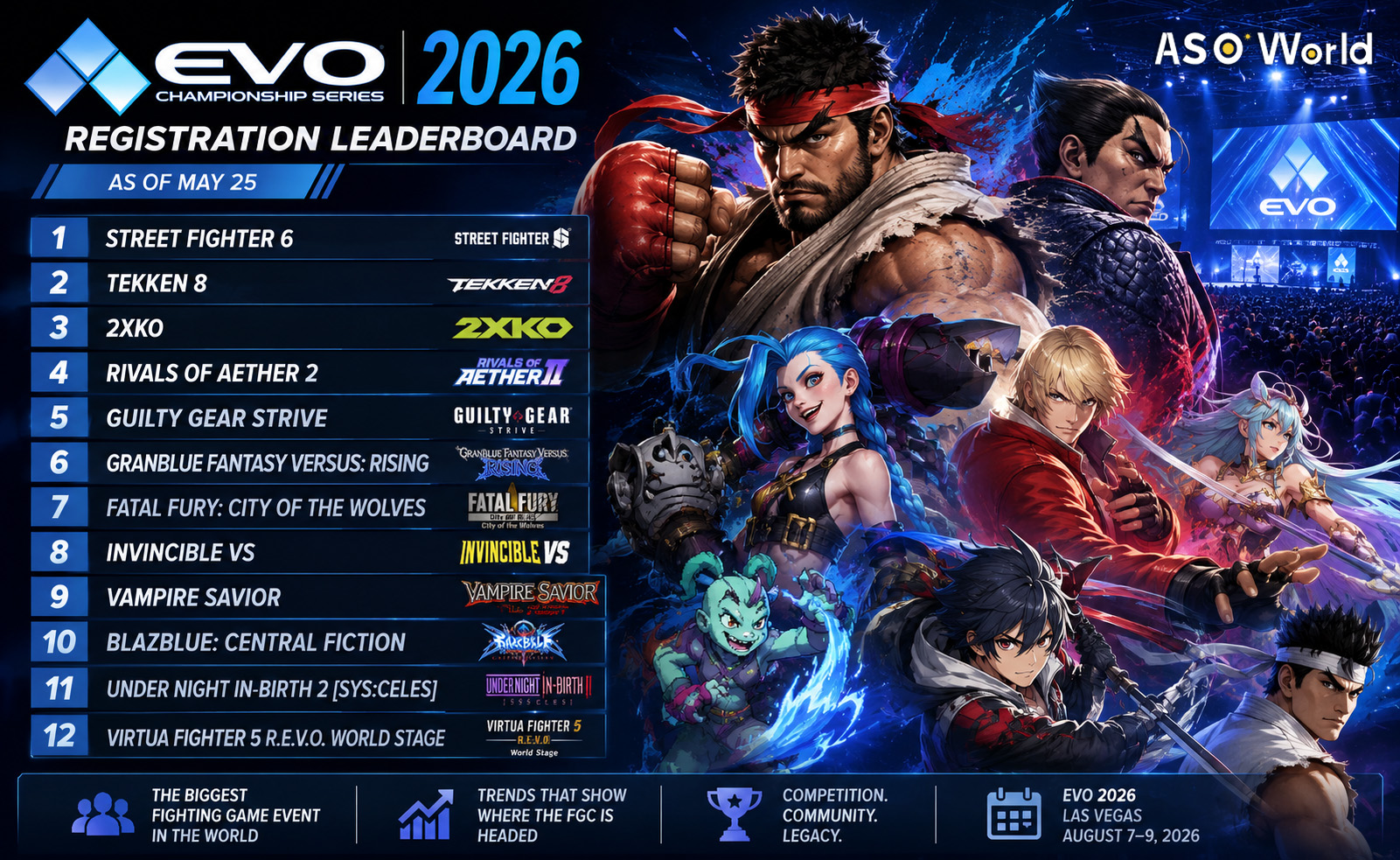
The latest EVO 2026 registration leaderboard offers a revealing snapshot of where the genre currently stands. Some franchises continue expanding their competitive ecosystems, while others are struggling to maintain visibility despite strong legacy reputations.
More importantly, the rankings highlight how modern fighting games are increasingly competing as long-term live-service ecosystems rather than standalone releases.
EVO 2026 Registration Leaderboard (As of May 25)
- Street Fighter 6
- Tekken 8
- 2XKO
- Rivals of Aether 2
- Guilty Gear Strive
- Granblue Fantasy Versus: Rising
- Fatal Fury: City of the Wolves
- Invincible VS
- Vampire Savior
- BlazBlue: Central Fiction
- Under Night In-Birth II Sys:Celes
- Virtua Fighter 5 R.E.V.O. World Stage
Street Fighter 6 Has Become the Genre’s Competitive Anchor
At this point, Street Fighter 6 holding the top spot is no longer surprising.

Since launch, Capcom has consistently maintained momentum through:
- regular balance updates
- strong online infrastructure
- accessible onboarding
- creator visibility
- stable esports support
Unlike earlier eras where fighting games often peaked shortly after release, Street Fighter 6 continues functioning as an active live-service platform. The game has successfully retained both veteran FGC players and newer competitive audiences, which is extremely difficult in the genre.
The ranking also reinforces something important for developers: Consistency matters more than launch hype.
Street Fighter 6 is not dominating because of novelty anymore. It is dominating because Capcom has built an ecosystem players continue trusting long after release.
Similar long-term retention patterns are also appearing across major mobile and cross-platform live-service titles, where sustained ecosystem support increasingly matters more than launch momentum alone. Developers exploring how platform visibility and live-service strategy affect long-term growth can explore this deeper analysis of Fortnite’s evolving mobile comeback and ecosystem strategy 👉Fortnite’s evolving mobile comeback and ecosystem strategy
2XKO’s Position May Be the Most Important Story on the List
The most interesting ranking may actually be 2XKO landing at #3.
For months, online discussion surrounding Riot’s upcoming fighter has been mixed. Concerns around pacing, accessibility, and gameplay identity have circulated heavily across social platforms.
Yet the EVO registration numbers suggest something different:competitive interest remains extremely strong.

This matters because it highlights how Riot’s ecosystem advantages continue influencing player behavior even before full release maturity. Riot already understands:
- live-service operations
- competitive ladder retention
- creator ecosystems
- spectator content cycles
- esports infrastructure
That operational experience may become one of 2XKO’s biggest long-term advantages. The EVO rankings suggest that many players are still willing to invest early into Riot’s competitive ecosystem despite ongoing criticism online. For developers, this is a reminder that modern competitive games are often sustained by ecosystem confidence as much as gameplay discussions. Teams looking to strengthen long-term game growth strategies can explore specialized approaches used by modern gaming app marketing agencies working across competitive and live-service ecosystems.
Rivals of Aether 2 Is Quietly Becoming One of EVO’s Biggest Success Stories
Rivals of Aether 2 reaching #4 may be one of the most impressive results on the entire leaderboard.
Platform fighters traditionally struggle to sustain long-term competitive visibility outside of the Super Smash Bros ecosystem. Yet Rivals of Aether 2 has managed to build meaningful tournament momentum relatively quickly.
The game’s success appears tied to several factors:
- strong rollback netcode
- active competitive support
- clear gameplay identity
- highly engaged community culture
- strong word-of-mouth growth
Its position above several legacy anime fighters also reflects a broader shift happening inside the FGC: players are increasingly prioritizing active ecosystems over franchise history alone. That creates a much more competitive environment for older fighting game brands that rely heavily on legacy reputation without maintaining strong live-service momentum.
Legacy Fighting Games Are Facing a Visibility Problem
One of the clearest patterns in the EVO 2026 rankings is the growing separation between actively supported ecosystems and legacy-maintained titles.
Games like:
- Under Night In-Birth II
- Virtua Fighter 5 R.E.V.O.
- BlazBlue: Central Fiction
Still maintain passionate communities, but their overall competitive visibility appears increasingly constrained compared to games receiving stronger operational support and broader platform exposure. This does not necessarily reflect gameplay quality. In many cases, these games are highly respected mechanically. The issue is ecosystem scale.
Modern fighting games increasingly require:
- continuous updates
- creator visibility
- onboarding accessibility
- matchmaking stability
- content cadence
- spectator reach
Without those systems, even technically excellent games can struggle maintaining large tournament participation. The EVO leaderboard is increasingly measuring ecosystem sustainability rather than pure competitive depth.
What the Rankings Say About the Future of Fighting Games
The EVO 2026 rankings suggest the fighting game genre is entering a new operational era.
Earlier generations of fighting games often survived primarily through grassroots loyalty and arcade-era legacy communities. That model still matters culturally, but it is no longer enough to sustain large-scale competitive ecosystems consistently.
The games leading EVO registrations today generally share the same characteristics:
- strong live-service management
- visible developer support
- stable online infrastructure
- ongoing community engagement
- scalable competitive ecosystems

For developers, the message is becoming clearer: Building a successful fighting game in 2026 is no longer only about mechanics. It is about maintaining an ecosystem players believe will still matter a year later. The latest EVO leaderboard may look like a simple ranking list on the surface, but it is increasingly functioning as a real-time indicator of which competitive ecosystems players trust enough to continue investing their time into.

 Follow Us on Facebook