
Key Takeaway:
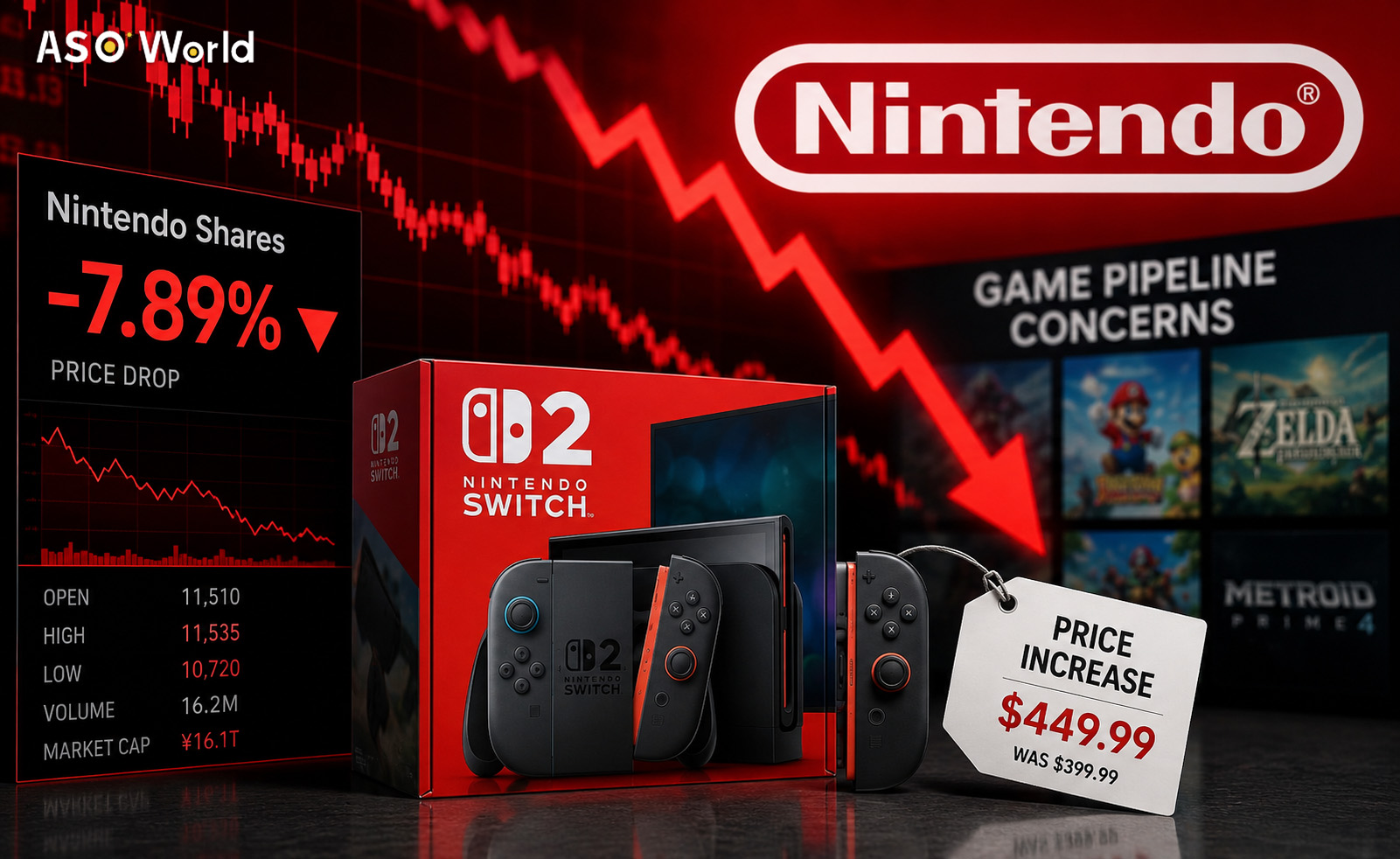
Nintendo shares fell roughly 7%–8% in a single trading session as investors reacted to global Switch 2 price increases and growing concerns over future game release momentum.
According to Reuters report, the sell-off reflects a broader reassessment of Nintendo’s growth expectations heading into its next hardware cycle.
Introduction: A Market Reaction Driven by Expectations, Not Just Numbers
The recent decline in Nintendo stock is not an isolated fluctuation. It represents a broader sentiment shift around the company’s Switch 2 strategy, where both pricing decisions and content pipeline visibility are being re-evaluated at the same time.
Instead of reacting to a single earnings signal, the market is pricing in two forward-looking uncertainties:
- higher hardware and software pricing
- potential slowdown in first-party game release cadence
This combination has amplified investor sensitivity, triggering a sharp intraday reaction. The reaction also highlights how gaming companies are increasingly judged on long-term visibility and user retention rather than launch momentum alone. For mobile publishers navigating similar competition pressure, this guide on ASO for games explores how sustained visibility strategies are evolving across app stores.
1. Nintendo Shares Fall ~7%–8%, Hitting Intraday Pressure
Market data shows:
- Shares declined approximately 7%–8% in a single session
- Intraday trading briefly approached a recent lower range
- Selling pressure concentrated during Tokyo trading hours
- Movement occurred after a period of already weakening sentiment
Rather than a standalone shock, this drop extends an existing downtrend shaped by expectations around the Switch 2 cycle. The key concern is not current performance, but the sustainability of future growth drivers.
2. Switch 2 Global Price Increases Trigger Immediate Sensitivity
A major catalyst for the reaction was the announced price adjustments for Switch 2 hardware across key regions.
Japan
- Price increased from approximately 49,980 yen to 59,980 yen
- Increase of around 10,000 yen
United States
- Price increased from $449.99 to $499.99
- Increase of $50 (~11%)
Europe
- Price increased from €469.99 to €499.99
- Increase of around €30
These adjustments represent a meaningful repositioning of entry pricing for a next-generation console still in its early market expansion phase. As pricing sensitivity rises across gaming markets, developers are under greater pressure to improve conversion efficiency without relying solely on monetization increases. Studios looking to strengthen organic acquisition can explore gaming app marketing strategies focused on retention-driven growth.
3. The Real Concern: Price Hikes Combined With Content Uncertainty
While pricing changes alone are not unusual in the gaming industry, market reaction intensified due to concerns about software supply momentum. Investors are focusing on three key uncertainties:
First-party release cadence
There are concerns that flagship titles may not maintain a consistent release rhythm, which is critical for sustaining hardware momentum.
Dependence on legacy IP
Current growth expectations appear heavily reliant on established franchises rather than a clearly expanding new content pipeline.
Moderated sales expectations
Nintendo has projected approximately 16.5 million Switch 2 units in annual sales, which some investors interpret as conservative relative to early-cycle expectations.
4. Why the Market Reaction Was Amplified
The sell-off is best understood as a repricing of growth visibility rather than a reaction to a single operational change. Three structural factors contributed: First, early-cycle hardware periods typically depend on accelerating content supply rather than price adjustments.
Second, consumers are increasingly sensitive to perceived value mismatches in entertainment spending. Third, uncertainty in content cadence directly impacts revenue predictability in gaming ecosystems. Together, these factors reduce confidence in near-term growth acceleration.
5. Spillover Implications for the Mobile Gaming Industry
Although the event originates in the console space, its implications extend into mobile gaming ecosystems.
In today’s App Store-driven environment, similar dynamics are already visible:
- Users are more sensitive to pricing versus perceived value
- Content update frequency directly influences organic visibility
- Short-term install spikes carry less weight in ranking systems compared to sustained engagement signals
For mobile game publishers and growth teams, this reinforces several operational priorities:
- clearer value communication on store pages
- stronger retention-driven onboarding design
- more structured live-ops content cadence to stabilize organic growth
The broader direction is clear: sustained engagement is becoming more important than acquisition bursts. Several publishers have already shifted toward retention-focused optimization strategies to stabilize organic growth. One example is this Japanese RPG ASO case study, where review and keyword optimization helped improve sustained installs.
Conclusion
The decline in Nintendo shares, down roughly 7%–8%, reflects more than a pricing or product announcement reaction. It signals a broader reassessment of growth visibility in the gaming industry.
Price increases themselves are not the core issue. The concern arises when pricing adjustments coincide with uncertainty in content delivery at a critical hardware expansion stage. This combination leads the market to reassess future growth stability rather than current performance.
FAQs
1. Why did Nintendo shares fall?
The decline was driven by Switch 2 price increases and concerns over future game release momentum.
2. How much did Nintendo stock drop?
Shares fell approximately 7%–8% in a single trading session.
3. How much did Switch 2 prices increase?
Around $50 in the US, 10,000 yen in Japan, and about €30 in Europe.
4. Why is content supply important for Nintendo’s valuation?
Because game release cadence directly impacts hardware adoption and long-term revenue expectations.
5. What does this mean for mobile gaming companies?
It highlights the growing importance of sustained engagement and content cadence over short-term acquisition spikes.

 Follow Us on Facebook