
For years, Apple’s Shortcuts app has been the secret weapon of the technical elite—a powerful, multi-app automation tool hidden behind an intimidating interface of logic blocks and variables. However, upcoming changes in iOS 27, which introduce generative AI to build workflows purely from natural language prompts, represent a seismic shift in the mobile ecosystem.
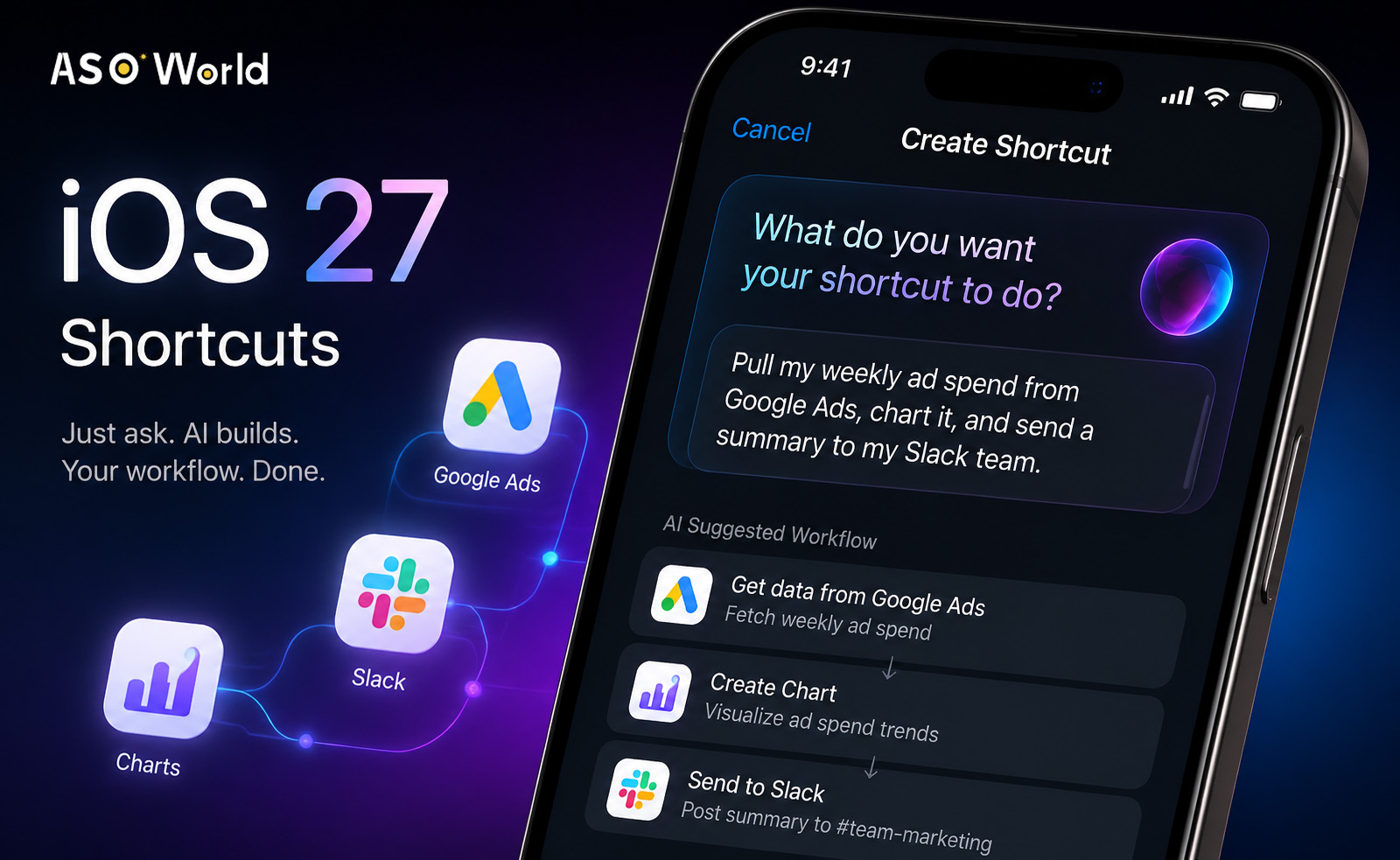
When users are simply asked, "What do you want your shortcut to do?" and an AI agent handles the underlying logic, the operating system effectively abstracts away individual applications. For mobile app developers, product managers, and ASO specialists, this isn't merely a UI update; it is an existential shift in how user traffic is distributed and how app value is delivered. If your application relies solely on visual real estate and traditional search discovery, you are facing a massive disruption. Here is a deep dive into how iOS 27 is rewriting the rules of user engagement and what you need to do to secure a first-mover advantage. For a broader look at Apple’s overall vision for AI in iOS 27 — including Siri’s evolving role and privacy-first positioning — explore this overview of Apple’s generative AI roadmap.
The Evolution of Intent: From App Discovery to Outcome Generation
What Happened: According to recent reports, iOS 27 allows users to type or speak their desired outcomes into a prompt, and the system automatically codes, compiles, and installs a custom Shortcut. The technical friction of bridging different apps and services is entirely erased by AI.
Why It Matters: This fundamentally alters user psychology and behavior. Users will transition from "app-centric" thinking (opening an app to perform a task) to "outcome-centric" thinking (commanding the OS to deliver a result). The operating system becomes an overarching AI orchestrator, treating installed apps merely as functional APIs rather than destinations.
Who Is Affected: Product Managers and UX Designers who have historically optimized for screen time, Daily Active Users (DAU), and visual engagement loops.
What Changes Going Forward: Applications that fail to expose their core functionalities to Apple’s system-level AI will be marginalized. The value of an app will increasingly be judged by how seamlessly it operates in the background, serving as a reliable node in a larger, AI-generated workflow. 👉 Learn about the top iOS 27 features and release details here
The New OS-Level SEO: "App Intent Optimization"
What Happened: When a user asks iOS 27 to "pull my weekly ad spend from Google Ads, chart it, and send a summary to my Slack team," Apple's generative AI must decide which apps and actions to string together to achieve this.
Why It Matters: Traditional App Store Optimization (ASO) focused almost entirely on keyword ranking, screenshot conversion, and download velocity. In the iOS 27 era, visibility means being the preferred underlying action chosen by Apple’s AI when generating a Shortcut. If your app’s actions are poorly indexed or described, the AI will bypass you for a competitor.
What Changes Going Forward: Marketing teams must pivot toward "App Intent Optimization." This involves meticulously defining, tagging, and structuring the metadata of in-app actions so that Apple’s semantic search engine understands exactly what your app can do. The battleground shifts from the App Store search bar to the AI model's internal routing logic.
Redefining Engagement Metrics and Retention Strategies
What Happened: Because users will increasingly execute complex tasks via Shortcuts without ever fully launching the app's graphical user interface, traditional engagement metrics will warp.
Why It Matters: If an app successfully becomes part of a user's daily AI-generated Shortcut, its actual utility and stickiness skyrocket. However, legacy KPIs like average session length, page views, and in-app clicks will plummet. This discrepancy can trigger false alarms in boardroom ROI discussions if teams don't understand the new paradigm.
Who Is Affected: Data Analysts, Marketers, and App Developers attempting to translate AI-driven background usage into business metrics.
What Changes Going Forward: Product teams must adopt new KPIs, such as "Task Completion Rate," "Background API Calls," and "Shortcut Integration Frequency." Retention strategies will rely less on push notifications designed to open the app, and more on providing flawless, frictionless, and rapid background execution that users learn they can rely on unconditionally.
The Developer's Playbook for the iOS 27 Era
What Happened: Apple has lowered the barrier to entry for complex automation from "knowing how to code" to "knowing how to speak."
Why It Matters: This democratization means the volume of custom, multi-app workflows will explode. Millions of everyday users will suddenly expect apps to talk to each other seamlessly. Developers who anticipate this will capture a highly lucrative, high-intent user base.
What Changes Going Forward: To maintain a competitive edge, development teams must execute on three fronts:
1. Modularize App Features
Stop building monolithic applications. Break down your core features into distinct, atomic actions (e.g., "Export Data," "Generate Image," "Send Message").
2. Semantic Action Tagging
Ensure that every action exposed to iOS uses clear, natural language descriptions. Apple's AI needs to understand the exact context and capability of your feature to recommend it in a generated Shortcut.
3. Design for Zero-UI Execution
Optimize for "headless" UX. Your app must be able to receive a payload from a Shortcut, process it instantly without demanding user interaction, and pass the result back to the OS flawlessly.
Comments
The iOS 27 Shortcuts update is far more than a quality-of-life feature; it is an aggressive move toward an AI-mediated operating system. By allowing natural language to generate complex automations, Apple is shifting power away from individual app interfaces and centralizing it at the OS level. For developers and marketers, the era of capturing attention via screen time is making way for the era of capturing intent via system-level utility. Adapting to "App Intent Optimization" and zero-UI execution is no longer optional—it is the prerequisite for survival in the generative AI mobile landscape.
FAQ
1. What are the practical use cases for developers with iOS 27 Shortcuts?
Developers can expose highly specific, modular actions (like "generate a weekly report" or "apply a preset filter") that the OS can stitch together. Instead of building complex internal workflows, developers can rely on the OS to integrate their app's core functions with other tools, significantly increasing the app's utility as a background service.
2. How does natural language automation in iOS 27 impact the broader AI industry?
It represents a major shift from cloud-based chatbot interfaces to local, OS-level AI orchestration. By turning the operating system into an active agent that controls local software, Apple is setting a new standard for AI assistants—moving from conversational responses to functional, deterministic software execution.
3. What are the productivity implications for end-users and digital marketers?
End-users will save countless hours by eliminating repetitive, multi-app tasks, creating highly personalized workflows just by asking for them. For marketers, this means marketing workflows (like pulling campaign data, formatting it, and messaging stakeholders) can be automated natively on mobile, drastically increasing on-the-go productivity.
4. How should product managers reposition their apps competitively in this new OS environment?
Product managers need to pivot from maximizing "time-in-app" to maximizing "indispensability." This means focusing on API reliability, ensuring app actions are deeply integrated with iOS App Intents, and measuring success by how frequently the app is utilized in background AI workflows rather than purely by visual engagement.

 Follow Us on Facebook