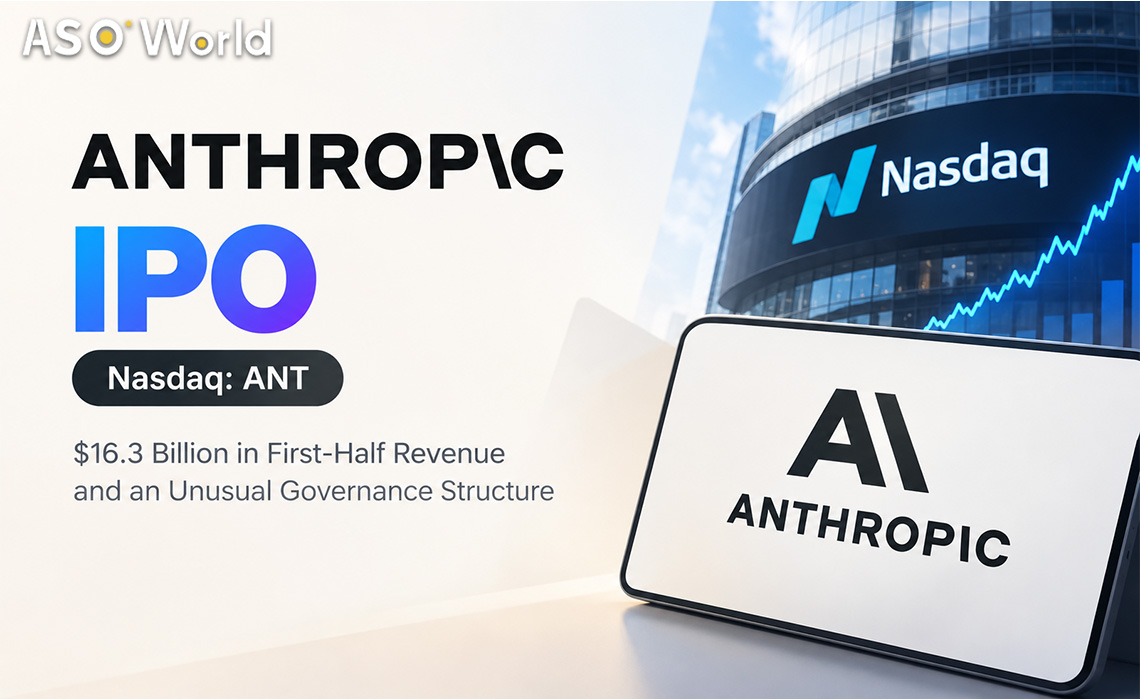

One of the largest technology listings on record is now moving into public view. On October 26, 2026, Anthropic, the company behind the Claude family of AI models, made its S-1 registration statement public and said it plans to list its Class A common stock on the Nasdaq Global Select Market under the ticker "ANT." The filing offers the first detailed look at the company's revenue, losses, spending commitments and unusual ownership structure.
The share count and price range have not yet been set, and the offering is subject to market conditions and SEC review. Below is a clear summary of what the filing shows, who stands to gain, how control will work after listing, and what remains unknown. This article reports on public filings and media coverage and is not investment advice.
Key Takeaways
- Listing plan: Class A shares on Nasdaq under "ANT," with Goldman Sachs and Morgan Stanley named first among 24 underwriters.
- Revenue: $16.29 billion in the first half of 2026, up from $1.16 billion a year earlier.
- Net loss: $80.7 billion, driven mostly by a $72.4 billion non-cash accounting charge tied to the company's rising valuation.
- Control: A trust will elect a majority of the board, and an entity owned by the seven co-founders will hold 50.1% of voting power.
- Timing: Reports point to a listing around mid-November. Anthropic has not confirmed a date.
What Anthropic Has Filed
| Detail | Info |
|---|---|
| Filing made public | October 26, 2026 (after a confidential draft submitted in June) |
| Exchange and ticker | Nasdaq Global Select Market, "ANT" |
| Shares offered | Both Anthropic and existing shareholders will sell; share count and price range not yet set |
| Underwriters | 24, led by Goldman Sachs and Morgan Stanley |
| Last private valuation | $965 billion, after a $65 billion raise in May |
| Reported ambitions | Media reports describe a raise of $100 billion or more and valuation talk of $1.5 trillion to $2 trillion; none of this is in the filing |
The Financials
| Metric | Figure |
|---|---|
| Revenue, first half of 2026 | $16.29 billion (versus $1.16 billion in the same period of 2025) |
| Revenue, full-year 2025 | $4.59 billion (versus $386 million in 2024 and $41 million in 2023) |
| Operating loss, first half of 2026 | $693 million |
| Net loss, first half of 2026 | $80.7 billion |
| Total capital raised (to June 30) | $141.1 billion |
| Cash and equivalents (June 30) | $112.4 billion, plus $19.3 billion in short-term investments |
| Large customers (September 30) | More than 1,900 customers at $1 million+ in trailing 12-month revenue; about 250 at $10 million+ |
Half-year revenue is about 14 times the same period a year earlier, and more than three and a half times the whole of 2025. The headline net loss looks dramatic, but most of it, $72.4 billion, comes from a non-cash charge for changes in the fair value of convertible notes and other instruments. The filing says that is primarily driven by an increase in the company's valuation, so the loss reflects accounting rules rather than cash leaving the business. The operating loss of $693 million is a better guide to day-to-day economics.
A Very Large Compute Bill
The filing shows how much of Anthropic's future depends on computing capacity. The company has spent more than $19 billion on AI infrastructure since its founding in 2021, and has committed to much larger sums with cloud and chip partners:
| Partner | Commitment |
|---|---|
| $114.5 billion | |
| Amazon Web Services | At least $110 billion over 10 years |
| SpaceX | Up to $120.5 billion |
| Microsoft | At least $45 billion between November 2026 and May 2033 |
The company also estimates future payments for additional compute at roughly $125 billion to $150 billion. Separately, chipmaker Broadcom has said it secured $63 billion from major U.S. banks to finance AI chips for Anthropic.
Who Gains Most: Amazon, Google and the VCs
Amazon
Amazon first invested in 2023 and structured much of its funding as convertible notes, a form of debt that converts to shares at an IPO or sale. Those notes had $6.2 billion in principal outstanding on June 30, which is Anthropic's entire debt load. They could convert into as many as 1.84 billion shares, but a cap limits Amazon to 12% of the "partially diluted" share count, a limit Amazon can waive. Notes that cannot convert will stay outstanding and convert in later quarters.
Amazon has also invested $10 billion in nonvoting preferred stock this year, bringing its total investment to about $18 billion. Amazon's own filings valued its note holdings at $97.9 billion as of June 30. It is also set to keep earning revenue from Anthropic through its cloud commitments.
Google held about 14% of Anthropic in early 2025 according to court filings, and has invested more since, including $10 billion in April. After later funding rounds diluted its stake, one analyst estimates it at about 5.6%.
Venture capital
No venture firm owns 5% or more, the threshold for appearing in the filing's principal stockholders table. That is unusual for a tech IPO, but it reflects scale. At a $965 billion valuation, 1% of the company is worth nearly $10 billion, so even a roughly $14 billion position equals only about 1.5%. Backers such as Menlo Ventures, Sequoia and Spark Capital still stand to make billions.
How Control Will Work After the IPO
Anthropic is a public benefit corporation, so its directors must weigh shareholders' financial interests against the public effects of its conduct and its stated mission of responsibly developing advanced AI for humanity's long-term benefit. On top of that, several layers share power:
| Layer | Who | Power |
|---|---|---|
| Long-Term Benefit Trust | Five seats, financially disinterested trustees; one currently vacant | Elects and can remove a majority of the board through a special share class |
| Co-founders | Seven co-founders, through a single Class F share | 50.1% of voting power on most matters and the right to elect three directors |
| Board | Chaired by Daniela Amodei; members include Dario Amodei, Reed Hastings, Christopher Liddell, Vas Narasimhan and Yasmin Razavi; one vacancy | Can decline certain trust moves and send them to an employee vote |
| Public Class A holders | Buyers of ANT stock | One vote per share, but limited influence on board composition |
The structure makes Anthropic a "controlled company" under Nasdaq rules. The filing itself warns that it may effectively eliminate the ability of Class A holders to influence important decisions, including a change in control.
The arrangement is not permanent. The co-founders' control can end ten years after the IPO, or earlier if fewer than three of them remain. The trust continues until 85% of common shareholders vote to end it, or it steps down with board approval.
Public benefit commitments
- About 847 million non-voting shares, roughly 5% of fully diluted shares, have been contributed to a subsidiary dedicated to the company's public benefit purpose.
- Each co-founder has pledged to give 80% of their personal equity to philanthropic causes.
Risks the Filing Highlights
- Limited shareholder influence. The governance structure concentrates control away from public holders.
- Dependence on cloud providers. The filing notes that some of Anthropic's cloud partners also build competing AI models and may not always share its goals.
- Heavy spending. Compute commitments are large and long-dated compared with current revenue.
Why It Matters for AI App Developers and Marketers
This section is ASOWorld's editorial analysis, not a statement from Anthropic.
A public listing makes a major AI platform's economics visible, and that matters for teams building products on top of it:
- Transparency. Regular public reporting will show how fast enterprise demand is growing, which helps teams judge whether AI model providers are likely to remain stable long-term partners.
- Pricing and capacity. Heavy compute costs mean model pricing, usage limits and capacity are likely to stay closely tied to infrastructure supply. App teams should model costs under different scenarios.
- Platform concentration. Apps that depend on a single model provider carry supplier risk, so many teams design for multiple models.
- Competition for attention. Large AI listings tend to lift general interest in AI apps and assistants, which can shift search demand and category competition.
For more coverage of AI platforms and their impact on app businesses, browse the AI Tech section on Marketing Trending.
📱 App Marketing Angle
As AI platforms mature and attract more capital, user expectations for AI apps rise too. Clear positioning, strong ratings and well-optimised store listings help AI apps stand out in a crowded category. See how ASOWorld's AI app marketing solutions help AI apps turn rising category interest into rankings, installs and revenue.
What to Watch Next
- Price range and share count. An amended filing will set out how many shares are offered and at what range.
- Listing date. Reports suggest mid-November, but SEC review and market conditions could shift it.
- The first earnings report. Quarterly results as a public company will show whether growth continues at this pace.
- Other AI listings. OpenAI has reportedly pushed its own IPO plans to 2027, so the timing of the first major model-developer listings is still open.
Quick Answers: Anthropic IPO
What is Anthropic's ticker symbol?
"ANT," on the Nasdaq Global Select Market.
When will Anthropic list?
No date has been confirmed. Reports point to around mid-November 2026.
How much revenue does Anthropic make?
$16.29 billion in the first half of 2026, up from $1.16 billion a year earlier, and $4.59 billion for all of 2025.
Why is the net loss so large?
Most of the $80.7 billion loss is a $72.4 billion non-cash charge linked to the rising value of convertible notes. The operating loss was $693 million.
Who controls Anthropic after the IPO?
A Long-Term Benefit Trust elects a majority of the board, and an entity owned by the seven co-founders holds 50.1% of voting power. Public Class A holders get one vote per share.
How much of Anthropic will Amazon own?
Its note conversion is capped at 12% of the partially diluted share count, and it also holds nonvoting preferred stock. Amazon can waive the cap.
 Follow Us on Facebook