
Three years after ChatGPT arrived on the App Store, AI is no longer a category of its own. It is an ingredient: a tutor inside Duolingo, a profile assistant inside a dating app, a recipe generator that starts with a photo of your fridge. Adjust’s new study tracks that shift across installs, sessions, session length and retention from January 2024 through September 2026, and it lands on an uncomfortable conclusion.
Acquisition is still growing. Engagement is still deepening. Retention is not.
The report defines AI apps as apps that use generative AI to complete a job for the user — answer a question, draft an email, summarize a document, or turn a prompt into an image or other finished output. That definition matters, because it covers both general assistants and single-purpose tools, and the two behave nothing alike once the download is complete.
The 2026 Scoreboard: Growth Is Slowing, Not Stopping
Adjust’s headline comparison is a tale of two years. In 2025, comparing January–September with the same months of 2024, AI app installs grew 104% and sessions grew 267%. In 2026, the same comparison shows installs up 14% and sessions up 16%.
Slower, yes. But 14% growth on top of a year that more than doubled is still meaningful volume — and the monthly pattern suggests the category has not plateaued.
| Metric | 2025 vs 2024 (Jan–Sep) | 2026 vs 2025 (Jan–Sep) |
|---|---|---|
| Installs | +104% | +14% |
| Sessions | +267% | +16% |
| Average session length | 30.8 min | 30.4 min |
September 2026 was the strongest install month in the entire measurement window, running 39% above the 2026 monthly average. Sessions peaked in January 2026 at 38% above the January–September average, slid through spring to 7% below average in May, and have been climbing since. Even during that dip, every month of 2026 recorded more sessions than any month of 2024 or the first half of 2025.
In other words, the install curve is no longer the interesting chart. The retention curve is.
Session Length Tells You Which Kind of AI App You Built
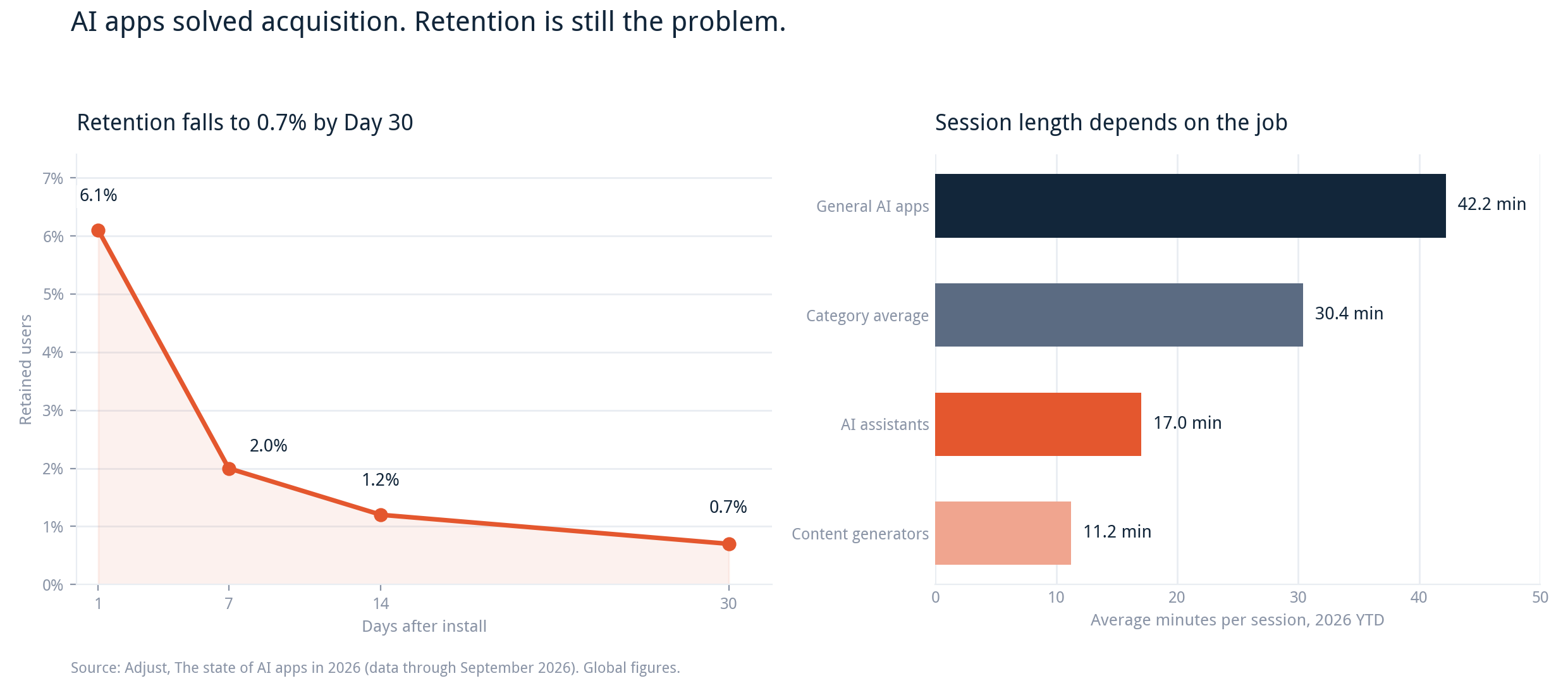
The category average hides three very different products. AI app sessions averaged 17 minutes in 2024, rose to 30.8 minutes in 2025, and sit at 30.4 minutes in 2026 so far. Within that average, the spread is enormous.
| Subvertical | 2026 session length | What it signals |
|---|---|---|
| General AI apps | 42.2 min | Multi-task workspace: chat, search, writing and image tools in one place |
| AI assistants | 17.0 min | Quick question-and-answer: ask, get the answer, close the app |
| Content generators | 11.2 min | Task-completion tool: generate the output, then leave |
General AI apps hold users for 42.2 minutes a session, up from 39.1 minutes in 2024, because one session often covers several jobs. AI assistants fell to 17 minutes from 25.1 minutes in 2025, consistent with utility-style use. Content generators are the shortest at 11.2 minutes — a tool you open with a specific output in mind.
For app marketers, session length is a product-positioning signal before it is a marketing metric. A 42-minute app can justify a subscription that bundles multiple use cases. An 11-minute app has to prove its value in a single output, which changes both the store creative and the paywall timing.
Retention Is the Number That Should Worry the Category
Here is where the story turns. AI apps retained 6.1% of users on Day 1 in 2026, down from 6.8% in 2025 and 6.7% in 2024. By Day 7, retention falls to 2%. By Day 14, 1.2%. By Day 30, 0.7%.
| Retention point | 2024 | 2025 | 2026 YTD |
|---|---|---|---|
| Day 1 | 6.7% | 6.8% | 6.1% |
| Day 7 | — | — | 2.0% |
| Day 14 | — | — | 1.2% |
| Day 30 | — | — | 0.7% |
The one exception is general AI apps, which improved Day 1 retention to 9.3% in 2026, up from 8.3% in 2025 and 7.3% in 2024. Every other subvertical saw Day 1 retention decline. The lesson is not that users are rejecting AI. It is that bundling multiple jobs into one app gives people a reason to come back, while single-purpose tools are judged almost immediately.
The subscription picture points the same way. Adjust cites RevenueCat’s 2026 State of Subscription Apps report, built on data from more than 115,000 apps: at the median, users cancel annual subscriptions to AI apps about 30% faster than to non-AI apps, and after 12 months AI apps keep 21.1% of annual subscribers against 30.7% for everyone else.
One caveat matters for anyone quoting these numbers: Adjust measures active users, RevenueCat measures paid subscribers. The two figures are not directly comparable. But they describe the same problem from two angles — the category is good at getting people in the door and weaker at giving them a reason to stay.
Where the Users Are: APAC Installs, LATAM Attention
The regional split complicates any single global strategy.
APAC posted the fastest install growth at 43%, three times the global rate of 14%. Europe followed at 30%, MENA at 15%. Session growth was more even: North America and APAC each grew around 16%, in line with the global figure.
Attention, however, is distributed differently. Average session length is highest in LATAM at 40.6 minutes, followed by North America at 37.1 minutes. Europe averages 27.5 minutes, with APAC and MENA around 21–22 minutes.
Day 1 retention reverses the ranking again: North America leads at 7.1%, Europe sits at 6.7%, and APAC, LATAM and MENA cluster between 5.5% and 6%.
Read together, the three charts suggest three different jobs:
- APAC is a volume market. Installs are growing three times faster than the world, but sessions are shorter and Day 1 retention is below the global average. Localized use cases and lightweight onboarding matter more than deep feature bundles.
- LATAM is an attention market. Users stay longer per session than anywhere else. The opportunity is depth — more jobs per session, stronger habit loops, and content that rewards time spent.
- North America is a retention market. Install growth is not the headline; the highest Day 1 retention is. The battle is fought in onboarding, paywall design and the first week.
📱 App Marketing Angle
The report’s most useful takeaway for app marketers is that the funnel now breaks in a predictable place: between the install and the second session. Six changes follow from that.
- Sell the finished job, not the model. Store screenshots that show a chat interface all look the same. Screenshots that show the output — the edited photo, the summarized document, the finished recipe — give a single-purpose tool a reason to be tapped. This is especially true for content generators, where the average session is 11.2 minutes and the value must be obvious before the download.
- Treat Day 1 as a product metric, not a marketing metric. A 6.1% Day 1 retention rate means roughly 94 of every 100 installs do not return the next day. The general AI cohort’s improvement to 9.3% shows that bundling multiple jobs into one app can move this number. Onboarding should demonstrate a second use case before the first session ends.
- Rebuild keyword strategy around jobs to be done. “AI app” is a crowded, undifferentiated query. “AI photo editor,” “summarize PDF,” “AI resume builder” and “recipe from photo” describe outcomes. For single-purpose apps, the keyword set should match the job, not the technology — and the store listing should repeat that job in the subtitle and first screenshot.
- Optimize for Day 7, not CPI. Adjust’s own conclusion is blunt: a channel delivering cheap installs that disappear by Day 2 is more expensive than it looks. Compare channels on Day 1 and Day 7 behavior, not cost per install. The first week is where paid traffic either becomes a cohort or becomes a cost.
- Price for the first week, not just the first payment. With AI annual subscriptions retaining 21.1% after 12 months, conversion is only half the equation. Trial length, paywall timing and the first renewal message should be designed around whether the user has formed a habit — not around the fastest possible first charge.
- Match the region to the job. APAC rewards volume and localization; LATAM rewards depth and session length; North America rewards retention discipline. A single global creative and a single onboarding flow will underperform in at least two of the three.
What Comes Next
The 2026 data ends on a rising install line and a falling retention line. September was the strongest install month of the window, and sessions have been climbing since May. The open question is whether that new cohort behaves differently from the ones before it.
Two signals are worth watching in the next two quarters. First, whether general AI apps continue to improve Day 1 retention as they add more jobs — that would validate the bundle strategy. Second, whether the September install spike converts into January session growth, which is when the category has historically peaked.
The category has solved distribution. It has not solved the second session. Until it does, the most important number in AI apps will not be downloads, revenue or session length. It will be the 0.7% still there on Day 30.

 Follow Us on Facebook