업계 정보
뉴스 핫스팟

Apple’s EU App Store Revolution: New Fees, Alternative Payments & Web Distribution — The Complete 2026 Developer Guide

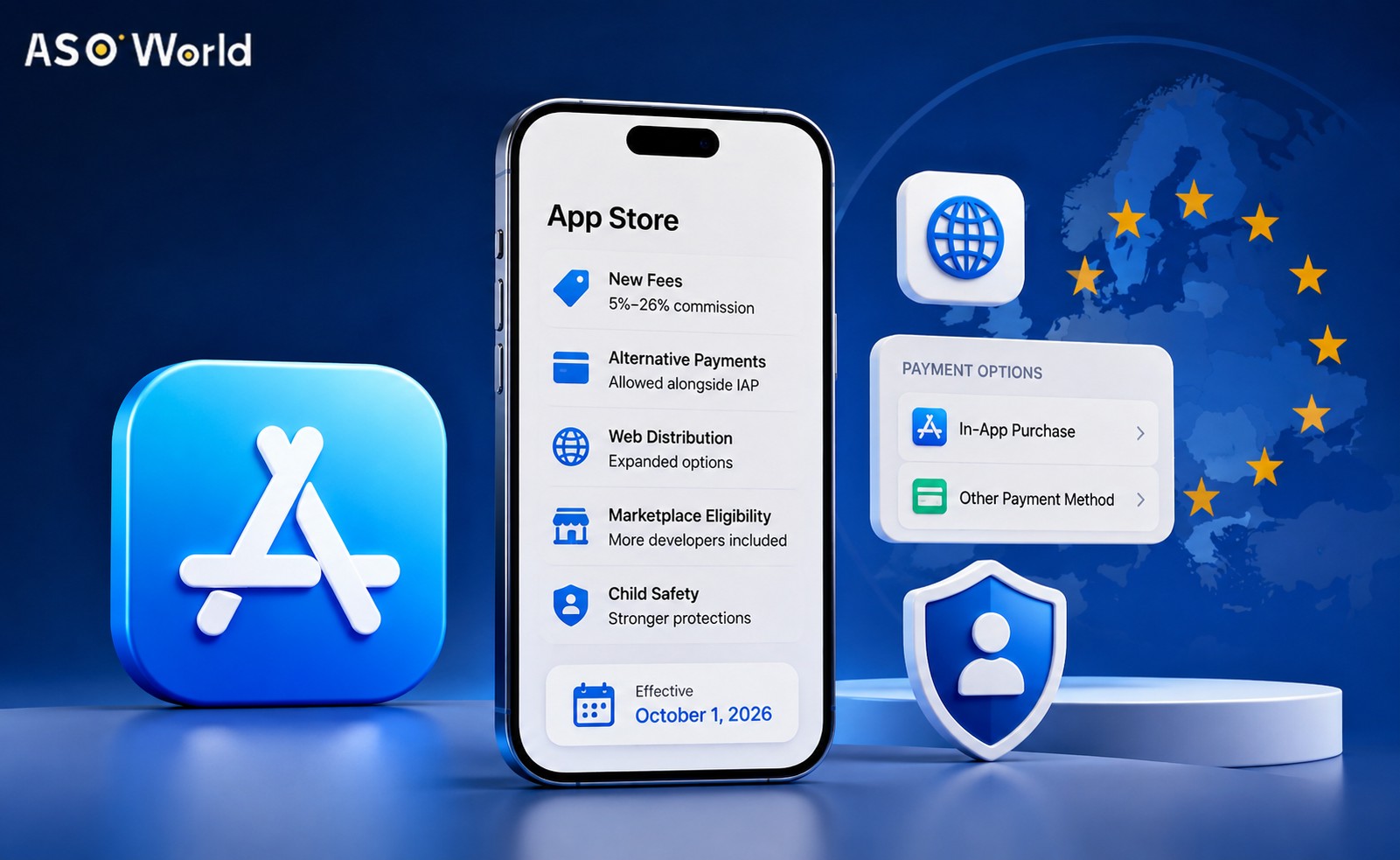
Apple is unifying its EU App Store terms, scrapping the Core Technology Fee, lowering commissions to 5–26%, allowing alternative payments alongside IAP, expanding marketplace eligibility, and tightening child safety rules — all effective October 1.
공개 날짜: Today
업데이트 날짜: Today
Apple’s EU App Store Revolution: New Fees, Alternative Payments & Web Distribution — The Complete 2026 Developer Guide

In a move that reshapes the mobile app economy across Europe, Apple has announced sweeping changes to its business terms for apps distributed in the European Union, effective October 1, 2026. The update, unveiled on August 18 following what Apple describes as "close collaboration with the European Commission," replaces the fragmented fee structure introduced under DMA compliance with a single, unified model — while simultaneously rewriting commission rates, expanding distribution options, and tightening child safety rules.


From Fragmented to Unified: One Set of Terms for All EU Developers


Since January 2024, developers distributing apps in the EU have navigated a labyrinth of addendums, alternative terms, and region-specific obligations born from the Digital Markets Act (DMA). That complexity is now gone. Under the new agreement, every developer operating in EU storefronts moves to a single set of business terms.


The most symbolic casualty of this consolidation is the Core Technology Fee (CTF) — the controversial €0.50 per-install charge that sparked backlash from indie developers and major publishers alike. It is replaced by the Core Technology Commission (CTC), a straightforward 5% commission on digital transactions for apps distributed outside the App Store. The much-criticized Initial Acquisition Fee and Store Services Fee are also eliminated entirely.


New Commission Tiers: What Developers Actually Pay


Perhaps the most closely watched element of Apple's announcement is the revised commission matrix. Here is how fees break down starting October 1:


Distribution & Payment Method Standard Rate Reduced Rate*
App Store + Apple In-App Purchase 26% 15%
App Store + Alternative Payment Processing 20% 10%
App Store + External Link to Web 15% 10%
Alternative Marketplace or Web Distribution 5% Core Technology Commission

*Applies to Small Business Program, Mini Apps Partner Program, Video Partner Program members, and auto-renewing subscriptions after year one.


For context, prior to these changes, standard App Store commissions sat at 30% (or 15% for small businesses and subscriptions beyond the first year). The new model lowers headline rates across nearly every category — but with an important caveat. Developers must now choose their payment infrastructure and stick with it for 12 months, a lock-in clause designed to prevent constant switching and user confusion.


Apple IAP and Alternative Payments Can Now Coexist


One of the most significant operational shifts involves payment flexibility. Previously, EU developers using Apple's ecosystem were barred from displaying alternative payment options alongside Apple In-App Purchase within the same app. That restriction is lifted.


Starting in October, developers can offer Apple In-App Purchase side-by-side with external processors or web checkout links — subject to presentation requirements intended to keep the user experience consistent and transparent. This hybrid approach gives consumers genuine choice at the point of purchase, something regulators have pushed for since the DMA first took shape.


However, the privilege comes with strings attached. Once a developer selects their preferred payment configuration (IAP-only, alternative processor, external link-out, or any combination), that choice must remain unchanged for a full 12-month period. Apple says this reduces UX fragmentation; critics argue it limits competitive responsiveness.


Child Safety Protections Tighten for Non-IAP Transactions


With greater payment freedom comes stricter safeguarding. Apple worked with the European Commission to implement child safety measures specifically targeting alternative payment flows:


  • Kids category apps are prohibited from linking out to external websites for transactions, closing off a vector for scams targeting young users.


  • For users under 18, any app using alternative payments or external links must implement a parental gate requiring guardian involvement before purchases proceed.


  • For users under 13, outbound transaction links are banned outright.


  • In EU member states where parental consent thresholds exceed age 13 (e.g., some jurisdictions set the bar at 16), protections scale accordingly.


These measures attempt to preserve the App Store's reputation as a trusted environment for families, even as payment walls come down.


Alternative Distribution Barriers Lowered


Beyond payments, Apple is widening the gate for alternative app marketplaces and direct web distribution in the EU. Previously stringent eligibility criteria are being relaxed. Starting October 1, entities qualify to operate third-party marketplaces or distribute via web if they meet any one of the following:


  • Pass a moderate financial-stability assessment via Dun & Bradstreet;


  • Are publicly traded (or owned by one);


  • Have received venture funding from an established investment firm;


  • Have completed a financial audit by a licensed accountant;


  • Are a government entity, educational institution, or approved nonprofit;


  • Provide a standby letter of credit of USD $1 million; or


  • Have recorded one million first annual installs worldwide.


Notably, companies are no longer required to maintain a legal entity physically established inside the EU — a change that should accelerate marketplace launches from international players.


Despite the openness, Apple emphasizes that notarization remains mandatory for every alternatively distributed app. This baseline review checks for malware, functionality accuracy, security vulnerabilities, and privacy compliance. Unlike full App Review, notarization does not enforce content or commerce policies, but it ensures bad actors cannot linger undetected in sideloaded or web-distributed software.


Industry Context: Why This Matters Beyond Brussels


While the changes apply only to EU storefronts, their ripple effects are global. The European Union has become the regulatory laboratory for platform economics:


  • In the United States, the Epic v. Apple litigation has already opened the door to external payment links without commission — though Apple is appealing the ruling to the Supreme Court, leaving long-term uncertainty.


  • In Japan, the Mobile Software Competition Act took effect December 2025, mandating dual payment options and approved third-party marketplaces. Epic Games Store and AltStore already launched there in early 2026.


  • In the United Kingdom, the CMA's Strategic Market Status designation is pushing toward fairer review processes and ranking transparency, with steering measures expected before year-end.


What emerges is a world where no single monetization stack fits all markets. Developers now face parallel economic models, each with distinct reporting, compliance, and UX requirements. For subscription apps and high-LTV products, this fragmentation complicates forecasting, raises operational overhead, and forces regional pricing strategies that were unnecessary just two years ago.


What Should Developers Do Next?


With the new terms available for signature today and enforcement beginning October 1, developers have roughly six weeks to evaluate their EU strategy. Key considerations include:


  • Payment path audit: Compare effective take-home rates under the new tiers versus your current setup. Remember that alternative payments carry engineering, fraud prevention, and customer service costs that Apple previously absorbed.


  • Lock-in risk: Because payment configurations are frozen for 12 months, choose based on projected user behavior rather than short-term experiments.


  • Child safety compliance: If your app serves minors, review parental gating implementation now. Non-compliance will block updates.


  • Distribution diversification: With lower barriers to marketplace operation and web distribution, assess whether bypassing the App Store entirely (at 5% CTC) makes sense for mature products with established audiences.


  • Regional monetization stacks: Accept that your US, EU, Japan, and UK funnels may need different architectures. Build analytics accordingly.


Bottom Line


Apple's August 2026 update is best understood not as a concession, but as a recalibration. By collapsing multiple fee layers into a cleaner structure, lowering headline commissions, and permitting payment coexistence, Apple removes some of the sharpest thorns that provoked regulatory intervention. Yet the 12-month commitment rule, notarization gates, and scaled child protections show that Cupertino still controls the perimeter.


For developers, the message is clear: the era of global, uniform App Store economics is over. Success in 2026 and beyond requires localized monetization expertise, agile infrastructure, and a willingness to treat platform policy as a moving target rather than a fixed cost.


Stay tuned to our App Store coverage for ongoing analysis as these changes roll out across EU markets this fall.

ASO World
ASO World
앱 스토어 최적화(ASO) 서비스 제공업체
앱 설치, 키워드 설치, 앱 리뷰 & 평점, 보장된 앱 순위 상승으로 당신의 앱을 성장시키세요!
ASO World
ASO World
ASO World
ASO World