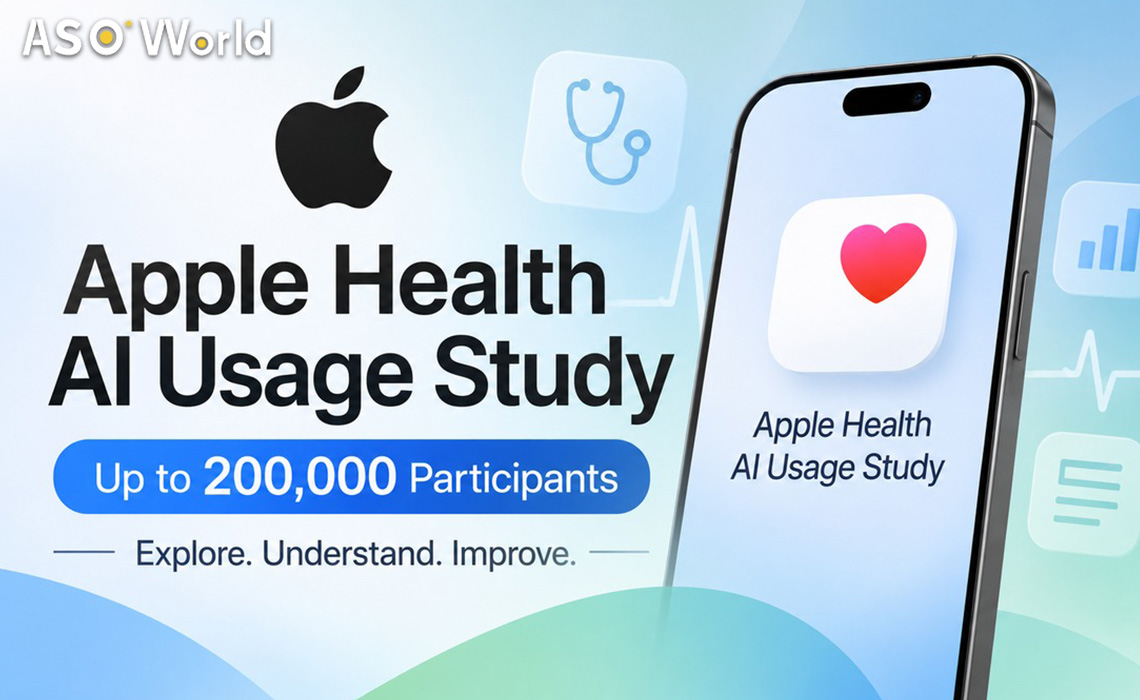

Apple has begun enrolling participants in the Apple Health AI Usage Study, a year-long research project built around a dedicated iPhone app that answers health questions using clinically sourced AI. The study, run with medical AI company OpenEvidence, is open to 200,000 adults in the United States and launched on November 15, 2026. Apple says the goal is to understand trust, comprehension and real-world behaviour, not to ship a product.
Key Takeaways
- What it is: a virtual research study and companion iOS app, not a consumer health feature.
- Who can join: US residents aged 21 or older with an Apple Intelligence-capable iPhone running iOS 26.
- Scale: up to 200,000 participants, each taking part for up to 12 months.
- How answers are built: OpenEvidence generates responses grounded in peer-reviewed sources, with citations attached.
- Data rules: study data is not used to train AI models, and Apple says participants control what HealthKit data they share.
What the Study Actually Is
The app works like a general-purpose chatbot pointed at medicine. Participants type health questions and receive plain-language answers with links to peer-reviewed clinical material. They can rate responses on accuracy, detail and relevance, and are asked to complete a baseline survey plus monthly follow-ups.
Unlike a general chatbot, the answers are grounded in a defined library that includes The New England Journal of Medicine, JAMA, Nature, National Comprehensive Cancer Network guidelines and the Cochrane Database of Systematic Reviews. The study is therefore less a test of raw model intelligence than a test of whether cited answers change how people understand their own health.
Participants may also link Apple Health data — resting heart rate, activity, sleep or lab results — to see whether personal context improves the relevance of responses. A second thread examines whether the tool helps people prepare for appointments with their own doctors.
Why Apple Picked OpenEvidence
OpenEvidence is not a consumer brand. It is a clinical AI platform used by physicians, and its answers are built from medical literature rather than open web content. For a study about trust, that distinction is the entire premise: Apple is testing a tool that behaves more like a medical reference than a conversational companion.
"OpenEvidence is the most trusted and loved brand product among doctors. Apple is the most trusted and loved brand and product among consumers," OpenEvidence CEO Daniel Nadler said at the announcement, held at the HLTH conference in Las Vegas.
Sumbul Desai, Apple's vice president of Health and Fitness, framed the project around scientific rigour rather than product ambition. "Health is deeply personal," she said, calling a dedicated study "the most thoughtful way" to understand how people evaluate health AI.
Eligibility and What Participants Do
| Detail | Requirement |
|---|---|
| Location | United States |
| Age | 21 or older |
| Device | Apple Intelligence-enabled iPhone (iPhone 15 Pro or later) |
| Software | iOS 26 or later |
| Participants | Up to 200,000 |
| Duration | Up to 12 months per participant |
| Partner | OpenEvidence |
The app is text-based. Dictation works through the standard iOS keyboard, but the experience is not integrated with Siri, and Apple has not said whether the underlying technology will appear in the Health app. On-device foundation models are used for supporting tasks such as classifying question categories, which is why the device requirement is stricter than a typical app install.
Privacy: What Apple Says Happens to the Data
Apple has made three commitments. Study data is not used to train AI models. Queries are anonymised before being sent to a third-party cloud provider. And OpenEvidence deletes query and response data after 24 hours.
Participants choose whether to share HealthKit metrics and survey responses, and can use the app without linking health data at all. The app also includes guardrails designed to detect concerning questions and point users toward a clinician or other resources.
Apple is explicit that the app is not a diagnostic tool. It does not diagnose or treat conditions, and participants are told to consult a doctor about health concerns or to verify information they receive.
The Pattern Behind the App
Apple has run consumer health research since 2019, when it launched the Research app and began partnering with medical institutions on studies covering hearing, heart health, movement and women's health. Those projects were followed by features: irregular rhythm notifications, ECG readings, hearing tests and, more recently, a hearing aid capability for AirPods Pro.
That history is the most useful lens for this launch. A study with 200,000 participants is slow by product standards, but it produces something a feature team cannot generate internally: evidence about how people interpret medical information outside a lab. If Apple eventually adds conversational health answers to the Health app or Siri, this study is the groundwork for defending that decision.
The context also explains the urgency. Surveys suggest roughly one in three US adults already ask chatbots about health, and OpenAI said earlier this year that its users send more than 300 million health-related queries each week. Apple is arriving late to that behaviour, and it is arriving with a measuring instrument rather than a product.
What the Study Won't Tell Us
It is not a clinical trial. There is no control group, no clinical endpoint and no peer-reviewed protocol published at launch, and participants self-select — people who download a health AI study app are not a representative sample of iPhone owners, let alone of patients. Apple has also not committed to publishing results on a fixed schedule, or to acting on them. The study can inform feature development without ever producing a product.
What to Watch Next
Enrolment pace.
Reaching 200,000 participants in a single market will indicate how much appetite exists for a clinical-grade alternative to general chatbots.
Published findings.
Whether Apple releases methodology and outcomes, rather than summaries, will determine how much weight the study carries in medical circles.
Health app integration.
Any move to bring cited answers into the Health app or Siri would turn a research project into a consumer product — and invite regulatory scrutiny that a study app avoids.
Competitor response.
Other AI companies have pushed health features this year. A well-designed Apple study could still reset the standard for how those tools are evaluated, even without a shipping product.

 Follow Us on Facebook