




Key Takeaways
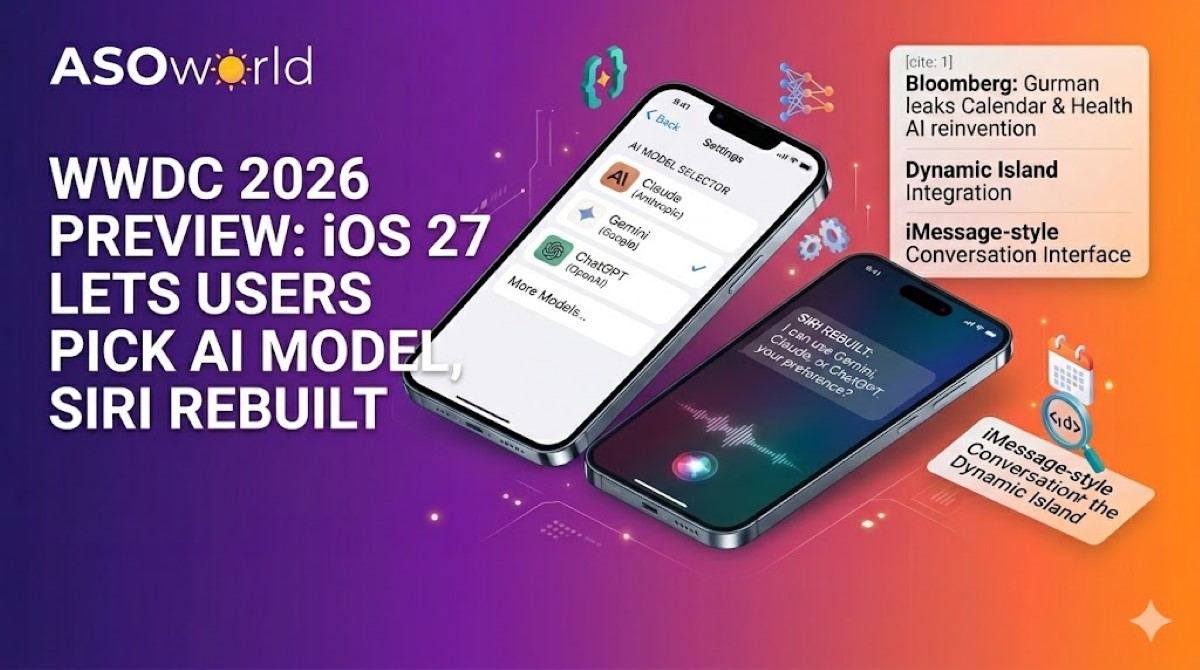
- iOS 27's "Extensions" framework will let iPhone users pick from Google Gemini, Anthropic Claude, or OpenAI ChatGPT as the default AI engine powering Siri, Writing Tools, and Image Playground — a first in mobile OS history.
- Siri is being completely rebuilt with a standalone app, iMessage-style chat interface, Dynamic Island integration, and system-wide "Ask Siri" / "Write with Siri" toggles — all debuting at WWDC 2026 (June 8–12).
- A dedicated App Store section will list compatible AI apps that plug into the Extensions system, creating a new AI-app discovery channel that developers must optimize for.
- Apple's R&D spending hit 10.3% of revenue in the March 2026 quarter — the first time in 30 years it has crossed the 10% threshold — as the company races to close the AI gap before incoming CEO John Ternus takes over on September 1.
- Apple just agreed to a $250M settlement over delayed Siri AI features, putting immense pressure on iOS 27 to deliver the chatbot experience promised at WWDC 2024.
With WWDC 2026 now just 32 days away, the rumor cycle has reached fever pitch — and for good reason. Apple's 37th annual Worldwide Developers Conference, running June 8 through June 12, is shaping up to be not just a software showcase but a strategic turning point for the world's most valuable tech company Apple WWDC26. Between a CEO transition, a $250 million Siri lawsuit settlement, and the most radical rethinking of how AI integrates with iOS since the platform's inception, this year's keynote carries stakes that extend far beyond the developer community.
Here's everything App Store developers, iOS marketers, and Apple watchers need to know — and why iOS 27's AI model marketplace could fundamentally reshape how apps get discovered and monetized.
Apple Turns iOS Into an AI Marketplace
The headline feature of iOS 27 is undeniably the "Extensions" system — Apple's internal name for a framework that lets users choose which large language model drives their on-device AI experience. According to Bloomberg's Mark Gurman, test versions of iOS 27 display a message reading: "Extensions allow you to access generative AI capabilities from installed apps on demand, through Apple Intelligence features such as Siri, Writing Tools, Image Playground and more" .
In practical terms, this means an iPhone user could set Google's Gemini as the default for text generation, Anthropic's Claude for image editing, and keep OpenAI's ChatGPT for Siri conversations — or mix and match freely. Apple will even allow users to assign different Siri voices to different AI models, so you'll audibly know whether Claude or Gemini is answering your query.
This is a dramatic departure from Apple's historically walled-garden approach. The company already uses ChatGPT as an opt-in fallback for Siri on iOS 26, but iOS 27 elevates third-party AI from a feature to a platform. As TechCrunch characterized it, Apple is making iOS 27 a "choose-your-own-adventure of AI models".
For App Store developers, the implications are profound. Apple is reportedly building a dedicated App Store section that will surface AI apps compatible with the Extensions framework — creating an entirely new discovery surface that didn't exist before. Apps that integrate with Extensions early could capture outsized visibility in this new curation channel, much like the early adopters of iMessage apps or Siri Shortcuts gained a first-mover advantage in previous iOS cycles.
📱 ASO Insight: With iOS 27 introducing a dedicated AI-app discovery channel, your App Store metadata — especially keywords related to "AI," "Gemini," "Claude," and "ChatGPT integration" — will become critical ranking signals. For a comprehensive AI-app marketing strategy, explore ASOWorld's AI App Marketing solutions.
Apple will also display a disclaimer warning users that it isn't responsible for content generated by third-party models — a move that signals both regulatory caution and a willingness to offload AI liability onto developers and AI providers.
Siri's Biggest Overhaul: Standalone App, Chatbot Interface, and Dynamic Island
Siri is finally getting the generative AI makeover Apple promised at WWDC 2024 — and then delayed, leading to the 250millionclass − actionsettlementannouncedthisweek.Thesettlement,whichcouldpayeligibleiPhone 16andiPhone 15Probuyersupto95 per device, covers claims that Apple misled customers about AI-powered Siri features that never shipped.
iOS 27 is where Apple aims to make good. Leaked details paint a picture of a radically different Siri experience:
- A standalone Siri app with an iMessage-like chat interface, complete with conversation history you can return to.
- Dynamic Island integration: When you invoke Siri, it will display "Searching" on the Dynamic Island, then expand into a translucent Liquid Glass window with its response.
- System-wide "Ask Siri" and "Write with Siri" toggles embedded across Apple's native apps — highlight text in Mail and tap "Ask Siri" for contextual help, or pull up "Write with Siri" for AI-assisted text generation anywhere in the OS.
- Multi-action capability: Siri will reportedly handle multiple actions from a single request — a feature that the delayed "App Intents" architecture was originally designed to enable.
Apple's urgency is underscored by its R&D spending. In the March 2026 quarter, Apple's R&D hit 10.3% of revenue — the first time the metric has crossed double digits in at least 30 years. CEO Tim Cook told analysts the company is "investing in products and services" and that R&D is "accelerating much higher than the company is." With Cook handing the reins to hardware chief John Ternus on September 1, 2026, iOS 27 represents the outgoing CEO's final major product cycle — and the incoming CEO's first.
Beyond Siri: Calendar, Health, Photos, and More Get AI Upgrades
Several other iOS 27 features have surfaced through Bloomberg's reporting, and together they suggest Apple is embedding AI across the entire OS rather than treating it as a Siri-specific feature:
| Feature | What's Coming |
|---|---|
| Photos App | Three AI-powered editing tools: Extend (generative expand beyond frame), Enhance (auto-improve color/lighting), Reframe (shift perspective on spatial photos) |
| Calendar & Health | AI-powered revamps — Health likely includes coaching, nutritional tracking, and educational videos originally planned for a scrapped "Health+" subscription |
| Camera App | New "Siri" mode joining Photo/Video options; Visual Intelligence expanded to scan nutrition labels and capture contact details |
| Apple Wallet | "Create a Pass" — scan any QR code or build a pass from scratch, with standard/membership/event templates |
| Safari | Auto-name Tab Groups via Apple Intelligence |
| Keyboard | Autocorrect expansion with Grammarly-like alternative word suggestions |
These features collectively position iOS 27 as Apple's most AI-forward release, even as the company maintains its privacy-first posture by running much of the intelligence on-device.
The Ternus Era Begins: What iOS 27 Signals About Apple's AI Strategy
John Ternus, Apple's longtime hardware engineering chief, will become CEO on September 1, with Tim Cook moving to Executive Chairman. The timing places WWDC 2026 and iOS 27's fall launch squarely at the transition point between two eras.
Ternus inherits a company that's widely perceived as "behind" on AI but that is now spending aggressively to close the gap. The Google Gemini deal — announced in January 2026 — ensures Apple doesn't have to build its own frontier models from scratch, while the Extensions framework hedges that bet by making iOS model-agnostic.
The App Store's role as an AI distribution layer is a strategy no competitor can easily replicate. Google's Android allows sideloading and multiple app stores by default, but Apple's curated ecosystem — now with a first-class AI-app discovery surface — could become a powerful moat if developers flock to build Extensions-compatible apps.
📊 Developer Takeaway: The multi-AI model ecosystem Apple is building mirrors the strategy behind the App Store itself: own the distribution layer, not necessarily the content. As Musk's recent feud with Apple over AI app policies demonstrated, navigating Apple's platform dynamics has never been more complex. Read our analysis of how Musk's Apple controversy shapes ASO strategies for AI apps.
What Developers Should Do Now
WWDC is 32 days away, and the developer beta of iOS 27 will likely drop the same day as the keynote. Here's what App Store developers and growth operators should prioritize:
1. Audit your AI integrations. If your app uses any AI functionality — chatbots, image generation, text processing — evaluate how it could plug into the Extensions framework. Early adopters will get prime placement in the new AI-app discovery section.
2. Revisit your App Store metadata strategy. Keywords like "AI assistant," "Gemini," "Claude integration," and "Apple Intelligence" are about to become high-volume search terms. For a real-world case study on how AI-app keyword strategy drives top-5 rankings, see how an AI video generator app dominated high-competition keywords via ASO.
3. Prepare for Siri as a distribution channel. A standalone Siri app with chatbot functionality means Siri becomes a user-facing surface where app actions and integrations can be surfaced directly — potentially bypassing the traditional App Store browse flow.
4. Watch the Liquid Glass slider. Apple is reportedly adding a slider to adjust Liquid Glass transparency intensity, responding to backlash from iOS 26. UI changes of this scale affect every app's visual integration and screenshot strategy Yahoo Tech.
5. Monitor the Ternus transition. Leadership changes at Apple often trigger strategic pivots. Ternus's hardware background suggests deeper OS-hardware integration — and possibly new device form factors that create fresh App Store categories.
FAQ for App Developers & Growth Operators
Q1: How will iOS 27's Extensions framework affect my app's App Store visibility?
The Extensions system creates a dedicated App Store section for compatible AI apps — essentially a new curated discovery channel. Apps that support Extensions early could gain significant organic visibility. You should optimize your App Store listing with relevant "AI" and model-specific keywords (Gemini, Claude, ChatGPT) ahead of the iOS 27 public launch this fall. For tailored ASO support, ASOWorld's AI App Marketing Agency offers data-driven keyword optimization and competitor benchmarking for the AI-app vertical.
Q2: Will users actually switch from Apple's default AI to third-party models?
The precedent is mixed. ChatGPT integration on iOS 26 required users to opt in manually, and adoption rates have been modest. However, iOS 27 makes model selection a first-class setting rather than a buried toggle, and the ability to assign distinct voices to different models could drive more active switching behavior. For AI-app developers, this means building Extensions support is a visibility play first and a usage play second — at least initially.
Q3: What does the $250M Siri settlement mean for Apple's AI credibility with users?
The settlement covers U.S. buyers of iPhone 16 series and iPhone 15 Pro devices who expected the AI-powered Siri shown at WWDC 2024. iPhone users could receive up to
Q4: How does the Tim Cook → John Ternus CEO transition affect App Store policies?
Ternus takes over September 1, 2026 — right around iOS 27's public release. As a hardware veteran, Ternus may prioritize deeper OS-device integration over services revenue maximization, but his public statements on App Store policies have been limited. Developers should watch his WWDC keynote presence closely for signals. Cook's move to Executive Chairman suggests continuity in the near term, but Ternus will ultimately chart his own course on developer relations and App Store commission structures.
Q5: Should I build my iOS app to support all three AI models (Gemini, Claude, ChatGPT) or just one?
If the Extensions framework works as reported, supporting all three maximizes your App Store discoverability, as Apple's curation algorithm may favor apps that offer broad model compatibility. However, each integration carries technical overhead. A pragmatic approach: prioritize the model(s) that align with your app's core functionality — Claude for writing-heavy apps, Gemini for multimodal experiences, ChatGPT for general-purpose AI — and expand from there based on early developer beta feedback at WWDC.

 Follow Us on Linkedin
