



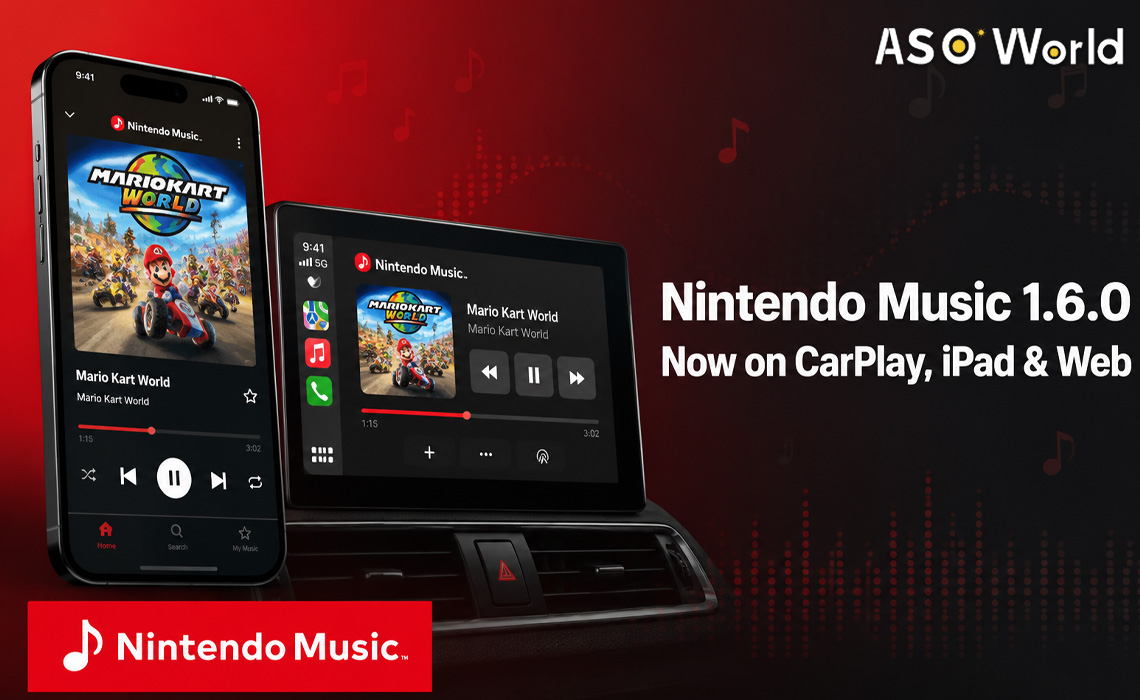

Nintendo just shipped one of the most feature-dense updates to its music streaming app since launch — and the headline is not just about Mario Kart. Version 1.6.0 of Nintendo Music, released on June 2, 2026, bundles a marquee content drop with a significant platform expansion that touches nearly every surface where users consume audio. For app developers and mobile marketers, the update offers a concrete case study in how to grow an app’s footprint without fragmenting the user experience.
Here is a breakdown of everything in the update, and what it means for your own product strategy.
Mario Kart World Soundtrack: Leveraging Franchise Momentum at the Right Moment
The centerpiece of the 1.6.0 update is the addition of the complete Mario Kart World soundtrack to Nintendo Music. The timing is deliberate: Mario Kart World is approaching its one-year anniversary, and interest in the title remains high across both gaming and mainstream audiences.
All in-game tracks have been added, with the exception of Free Roam music, which Nintendo says will be rolled out over time. This staggered release approach is worth noting — it creates multiple content moments from a single game’s soundtrack, giving Nintendo recurring reasons to re-engage users and generate fresh app store activity over the coming weeks.
For app developers, this illustrates a key content strategy principle: do not release everything at once. Drip-feeding high-value content creates sustained engagement cycles, keeps your app relevant in search results for longer periods, and gives you repeated opportunities to trigger push notifications and app store listing refreshes.
CarPlay and Android Auto: Meeting Users Where They Already Are
Perhaps the most strategically important additions in version 1.6.0 are CarPlay and Android Auto support. Nintendo Music can now display on-screen controls through a vehicle’s built-in display, allowing users to browse and play soundtracks while driving — the same way they would with Spotify, Apple Music, or YouTube Music.
This is a significant move because it positions Nintendo Music as a legitimate utility app, not just a novelty for gaming fans. By integrating with in-car systems, Nintendo is competing for a time slot — the daily commute — that was previously inaccessible to its app.
Why This Matters for App Developers
CarPlay and Android Auto integrations are often overlooked by developers outside the music and navigation categories. But the underlying principle applies broadly: identify the environments where your target users spend time, and build integrations that place your app in those contexts.
For any app that delivers audio content — podcasts, language learning, meditation, audiobooks — in-car platform support is a direct path to increased daily active usage. Even for non-audio apps, the lesson holds: platform integrations that extend your app beyond the phone screen (widgets, watch complications, TV apps) compound engagement without requiring users to change their behavior.
Siri Voice Search: Reducing Friction in Content Discovery
The update also adds Siri integration, allowing users to search for specific tracks using voice commands. This is a relatively small feature from a development standpoint, but it has outsized impact on usability — especially in the CarPlay context where hands-free interaction is essential.
Voice search integration also has ASO implications. Apps that support Siri Shortcuts and voice queries gain additional surface area in iOS’s search ecosystem. When a user says “Play Mario Kart music on Nintendo Music,” that interaction reinforces the app’s association with those keywords in Apple’s on-device intelligence systems.
Actionable takeaway: If your app serves searchable content (products, recipes, workouts, tracks, lessons), implementing Siri Shortcuts or Google Assistant routines can improve both discoverability and retention at minimal development cost.
iPad Support: Filling a Gap in the Device Matrix
Version 1.6.0 adds native iPad support to Nintendo Music, which previously required users to run the iPhone version in compatibility mode. A dedicated iPad interface means better layout utilization, improved navigation, and a more professional user experience on larger screens.
This matters because iPad users tend to engage in longer sessions than phone users. For a music streaming app, longer sessions translate directly to higher engagement metrics — metrics that influence app store ranking algorithms on both iOS and Android.
For developers who have been postponing tablet optimization, Nintendo’s approach here is instructive: tablet support does not need to be a separate app. A responsive layout that adapts to larger screens can be delivered as part of a standard update, improving your app’s reach without doubling your maintenance burden.
The Web Player: Breaking Free From App Store Dependency
The most forward-looking addition in this update is the launch of a browser-based web player at music.nintendo.com. Users can now stream Nintendo Music directly from any desktop or laptop browser without installing anything.
This is a strategic hedge against app store dependency — a concern that should be top of mind for every app developer in 2026. A web-based access point means:
- Lower acquisition friction. Users can try the service without committing to a download.
- SEO-driven discovery. Web pages are indexable by search engines, creating an entirely new organic acquisition channel.
- Platform independence. A web player works on any operating system, eliminating device-specific barriers.
For app developers, this underscores an emerging best practice: your app does not have to be your only product surface. A lightweight web companion — whether it is a preview experience, a dashboard, or a content browser — can serve as a top-of-funnel acquisition tool that drives users toward your native app for the full experience.
Nintendo's Broader Platform Strategy: Content as a Growth Engine
Zooming out, the 1.6.0 update reflects a broader pattern in Nintendo’s mobile strategy. Nintendo Music launched as a relatively simple app with a focused value proposition: listen to Nintendo game soundtracks. But with each update, the app has expanded its platform reach (phone, tablet, car, web) and its content library (now including franchises from Mario Kart to Star Fox).
This expansion follows a playbook that successful app developers across categories have used:
- Launch narrow. Start with a focused feature set and a clearly defined audience.
- Expand the content library. Use recurring content drops to drive re-engagement and press coverage.
- Extend platform reach. Add integrations that place your app in new usage contexts (car, desktop, wearables).
- Build alternative distribution channels. Reduce dependence on app store discovery by creating web-based entry points.
Nintendo’s execution is particularly effective because each expansion reinforces the others. Mario Kart World’s soundtrack drives downloads. CarPlay keeps daily users engaged. The web player captures search traffic from users who have not yet installed the app. Together, these elements create a compounding growth loop.
What to Watch Next
Nintendo has historically updated Nintendo Music on a weekly cadence, though the schedule has been inconsistent — this update arrived on a Tuesday rather than the previously expected Friday cycle. Developers tracking Nintendo’s content strategy should watch for:
- Additional Mario Kart World tracks (Free Roam music confirmed for future rollout)
- Further platform integrations that could include smart speakers, smart TVs, or gaming console companions
- Potential tie-ins with upcoming Nintendo Switch 2 titles, which could use Nintendo Music as a cross-promotion channel
The Bottom Line
Nintendo Music 1.6.0 is not just a patch note — it is a blueprint for how a content-driven app can systematically expand its reach across platforms, devices, and discovery channels. The combination of a high-profile content drop (Mario Kart World), infrastructure upgrades (CarPlay, Android Auto, iPad, web player), and utility features (Siri search) demonstrates a mature, multi-vector growth strategy.
For app developers and mobile marketers, the takeaways are clear: think beyond the app store listing, meet users in every context where they spend time, and use content as a recurring engine for engagement and discovery.
Stay tuned to ASOWorld MarketingTrending for the latest updates on mobile app marketing trends, platform strategies, and growth opportunities across iOS and Android.

 Follow Us on Facebook
