



Key numbers
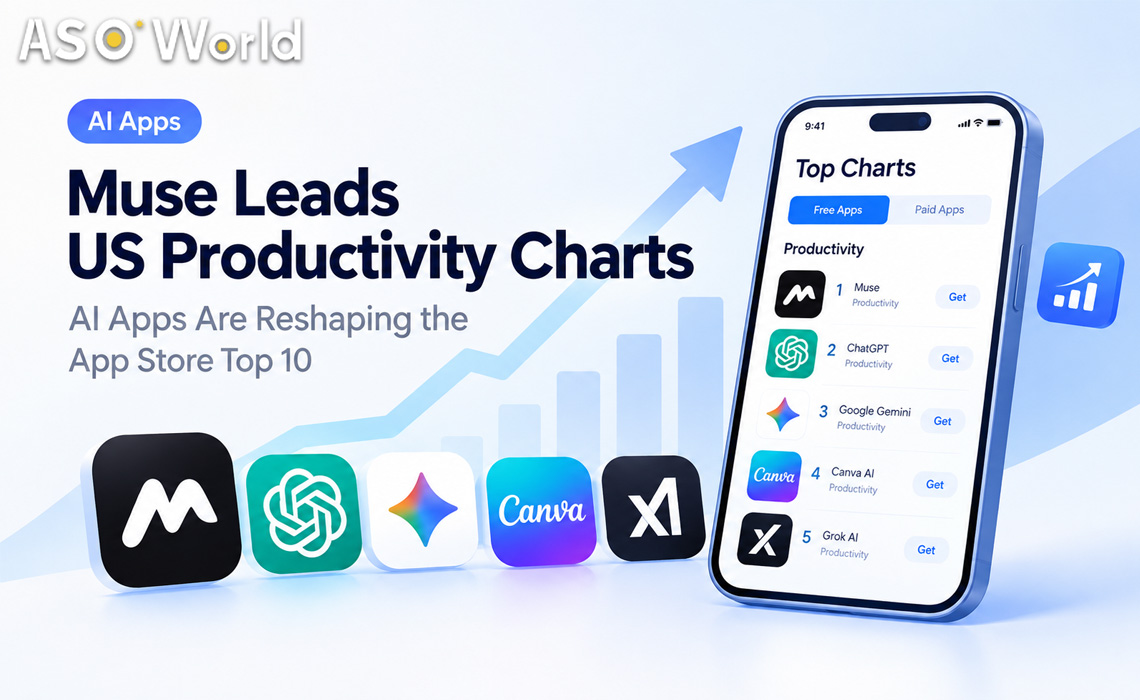
- Muse from Meta is the #1 free Productivity app on the US App Store, with an estimated 941,563 downloads in the week to October 29, about 1.7× ChatGPT's 556,033 (FoxData estimates).
- Muse launched on September 8, 2026 (US only) at ~60,789 downloads that day. Its US peak so far: 175,705 on October 17, a ~2.9× climb in six weeks.
- ChatGPT still leads Google Play in the US (509,758 a week); Gemini holds #3 on both stores (340,808 iOS / 141,500 Google Play).
- xAI now has two apps on the charts: Grok (#9 iOS, 238,655) and its newer agent app Grok Bot (#17 iOS, +5; #6 Google Play, +4).
- At least 5 of the top 10 free Productivity apps on US iOS are AI-native or AI-branded (Muse, ChatGPT, Gemini, Canva AI, Grok).
Figures are FoxData third-party estimates for the week ending October 29, 2026 unless noted; launch facts are from Meta and press coverage.
Source: FoxData download rankings and daily download estimates | US App Store + Google Play | Sep 8–Oct 29, 2026
The scoreboard
| Rank (US iOS Productivity, free) | App | Weekly downloads (est.) | Move |
|---|---|---|---|
| 1 | Muse from Meta | 941,563 | – |
| 2 | ChatGPT | 556,033 | – |
| 3 | Google Gemini | 340,808 | – |
| 8 | Canva AI Photo & Video Editor | 239,254 | +1 |
| 9 | Grok AI | 238,655 | –1 |
| 16 | Gauth: AI Study Companion | 147,397 | – |
| 17 | Grok Bot | 145,455 | +5 |
Google Play tells the same story with a different leader: ChatGPT #1 (509,758), Gemini #3 (141,500), Grok #5 (105,562), Grok Bot #6 (+4), Meta AI #7 (91,066, +1) and DeepSeek #13 (68,207). AI assistants are no longer a two-app race on either store. It is a multi-brand traffic contest with a long tail of independent apps behind it (AI Chatbot – Nova at #24 on Google Play, Wispr Flow at #27, up 12 places this week).
What this means for your app: if you ship an AI assistant or AI-adjacent utility, your head keywords now compete with the largest technology companies in the world. The winnable ground has moved to long-tail intent ("ai [task] for [niche]") and to markets where the big launches haven't arrived. ASOWorld's guide on how to pick the right keywords shows how to score those long-tail terms by relevance and difficulty.
The Muse curve: what a six-week launch sprint looks like
Meta launched Muse on September 8, 2026 as a "personal AI agent" that completes tasks such as bookings and purchases. At launch it was available only in the US, on iOS, Android, the web and inside WhatsApp. Reports show it reached No. 1 on the overall US free iPhone chart about a week later.
In our data, US iOS downloads started at ~60,789 on launch day, crossed 100K a day by September 16, wobbled through early October, peaked at 175,705 on October 17, and settled into a ~130–137K daily plateau through October 29. That adds up to roughly 5.9M US iOS downloads since launch (est.).
| Milestone | Date (2026) | Daily downloads (est.) |
|---|---|---|
| Launch day | Sep 8 | 60,789 |
| Crosses 100K/day | Sep 16 | 100,105 |
| US peak | Oct 17 | 175,705 |
| Latest full day | Oct 29 | 134,069 |
ChatGPT's US iOS curve over the same weeks is the contrast: a steady ~72–93K a day, with no launch spike and no decay. The incumbent's flat line versus the challenger's staircase.
What this means for your app: the data can't tell us why Muse grew this fast, but one factor is clear from the launch itself: Meta could promote Muse to an existing audience across Facebook, Instagram and WhatsApp on day one. Most launches don't have that. Without it, launch-week velocity, a sharp subtitle and a converting product page do the job instead. That is what a structured mobile app launch marketing plan is built to provide.
From assistants to agents
The two newest chart climbers share a theme. Muse positions itself as an agent that acts for you, and Grok Bot is xAI's separate agent product, launched in August 2026 and still in early access, alongside the main Grok chat app. Two agent apps climbing at the same time as the incumbent chat assistants hold steady suggests the category is splitting into "ask" apps and "do" apps.
For app marketers, that split shows up in metadata: "agent", "assistant", "chat" and task-specific verbs are becoming distinct search intents. Apps that describe what they do for a user may find less crowded keywords than apps that describe what they are.
What this means for your app: audit your title and subtitle for job-to-be-done language. If your AI app completes a task (book, write, summarize, shop), say so; it may open keyword space the generic "AI assistant" terms no longer offer.
The two-store split is back
The same asymmetry we measured on Black Friday shopping charts shows up here: Muse leads iOS while ChatGPT leads Google Play, Grok's two apps chart differently on each store, and Meta AI charts on Google Play but not in the iOS top 20 we pulled. One possible explanation is that iOS chart positions react faster to short bursts of installs, while Google Play rankings appear to weigh longer-term signals. Neither store publishes its chart formula, so treat that as a working hypothesis.
What this means for your app: an AI app running one launch calendar across both stores may be leaving rank on the table. On iOS, plan concentrated launch-week momentum; on Google Play, protect rating quality over weeks. Negative reviews hit AI apps hard when answers go wrong, so a plan for app reputation and negative review management belongs in the launch checklist.
What to watch next (this tracker's next update)
- Does Muse hold #1 into November? The first holiday traffic wave (Singles' Day week) usually lifts shopping charts while productivity charts cool.
- Grok Bot vs Grok: whether xAI's agent app keeps climbing as access widens, or plateaus while it stays plan-gated.
- The long-tail floor: Nova (#24 on Google Play) and Wispr Flow (#27, +12) show independent apps can still chart. Watch whether entry thresholds (currently ~35–40K a week at Google Play ranks 24–27) rise in Q4.
FAQ
Is Muse from Meta bigger than ChatGPT now?
On US iOS Productivity downloads this week, yes: ~941.6K vs ~556.0K (FoxData estimates, week ending Oct 29, 2026). ChatGPT still leads US Google Play, and Muse launched in the US only, so global comparisons don't apply yet.
When did Muse launch, and how fast did it grow?
Meta launched Muse on September 8, 2026. In our US iOS series it grew from ~60.8K downloads on launch day to a 175.7K single-day peak on Oct 17 (about 2.9×), with ~5.9M downloads accumulated (est.).
Is Grok Bot an official xAI app?
Yes. Grok Bot is xAI's agent product, launched in August 2026 in early access, separate from the main Grok chat app. Both chart in US Productivity: Grok #9 and Grok Bot #17 on iOS this week.
Which AI assistants are in the US top 10?
On iOS Productivity, at least five: Muse, ChatGPT, Gemini, Canva AI and Grok. On Google Play, ChatGPT, Gemini, Grok, Grok Bot and Meta AI all sit in the top 7.
What should a new AI app realistically target?
This week's US Google Play Productivity entry band around ranks 24–27 runs ~35–40K weekly downloads (est.), a concrete Q4 benchmark for smaller launches. ASOWorld's AI app marketing practice
 Follow Us on Facebook

