




Key Takeaways
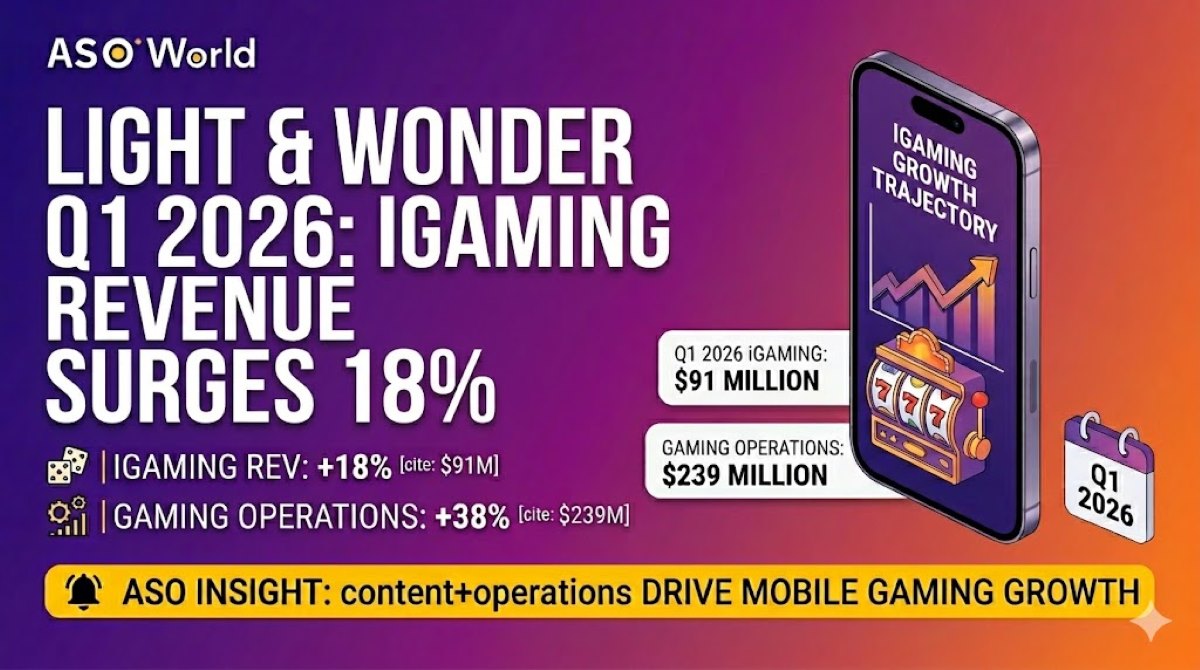
- iGaming revenue hit $91 million in Q1 2026, an 18% year-over-year jump - making it Light & Wonder's fastest-growing segment and the strongest signal yet that mobile-first gaming content is reshaping the broader gaming industry.
- Gaming operations surged 38% to $239 million, marking the 23rd consecutive quarter of growth in this segment, driven by content expansion across North American markets.
- SciPlay, the social casino arm, posted a 7% revenue decline to $187 million - a cautionary data point for mobile developers that even established social gaming platforms face player engagement headwinds.
- Net income dropped 37% to 52 million due to a one- time 50 million legal reserve tied to Aristocrat-related litigation, but adjusted EBITDA rose 5% to $327 million - signaling underlying operational health remains intact.
- CEO Matt Wilson called this "the beginning of the company's next phase of growth," with full-year 2026 guidance projecting mid-to-high-single-digit adjusted EBITDA growth ahead of the company's 2028 financial targets.
Global gaming technology leader Light & Wonder (LNW) has delivered its Q1 2026 financial results, painting a compelling picture of accelerating momentum across its digital and operational divisions. With iGaming emerging as the company's fastest-growing segment and gaming operations posting a standout 38% year-over-year increase, the report signals a broader structural shift in how digital gaming revenue is being generated — one that carries direct implications for mobile app developers and iOS game publishers watching the market closely.
📊 Q1 2026 Financial Highlights at a Glance
| Metric | Q1 2026 | YoY Change |
|---|---|---|
| Consolidated Revenue | $790M | +2% |
| iGaming Revenue | $91M | +18% |
| Gaming Operations Revenue | $239M | +38% |
| Open Gaming System Wagers | $29.9B (quarterly record) | — |
| Net Income | $52M | -37% |
| Adjusted EBITDA | $327M | +5% |
Source: Light & Wonder Q1 2026 Earnings Release, May 7, 2026
iGaming Becomes the Breakout Segment
If there's one headline buried inside Light & Wonder's Q1 numbers, it's the iGaming division's 18% revenue jump to $91 million — making it the single fastest-growing business unit in the company's portfolio this quarter.
This isn't a coincidence. The broader iGaming ecosystem has been experiencing structural tailwinds throughout early 2026: expanded regulatory frameworks in North America, growing mobile-first user bases across Southeast Asia and Europe, and a measurable shift in younger demographics toward app-based gambling entertainment over traditional casino floors.
CEO Matt Wilson framed the quarter's results with notable confidence: "This marks the beginning of the next phase of our growth trajectory." That language, coming from a company with cross-platform gaming infrastructure at scale, is worth paying attention to.
What's particularly striking is that the 38% surge in gaming operations revenue to $239 million didn't come from a single product push — it reflects a compounding flywheel effect driven by both content quality and operational execution. Light & Wonder's Open Gaming System processed a record $29.9 billion in wagers during Q1 alone, underscoring the infrastructure's capacity to scale with demand.
The Net Income Dip: What's Behind the -37% Drop?
The 37% decline in net profit to $52 million deserves context. The drop is largely attributed to legal reserve provisions tied to an ongoing dispute with Aristocrat Leisure — a one-time financial headwind rather than a signal of operational weakness. Adjusted EBITDA rising 5% to $327 million confirms that the underlying business engine remains healthy and expanding.
For investors and industry watchers, the separation of adjusted vs. reported figures here is critical: Light & Wonder's core operating leverage is demonstrably improving even as headline profit faced one-quarter pressure from litigation-related accruals.
📊 ASO Insight - Gaming App Marketing
The 18% iGaming growth and 38% gaming operations surge at Light & Wonder validate a trend ASOWorld has been tracking across its client portfolio: gaming apps that combine rich content updates with disciplined App Store Optimization consistently outperform. For studios launching or scaling social casino, RPG, or strategy titles, ASOWorld's gaming app marketing agency provides end-to-end UA strategy - from keyword optimization to paid acquisition - specifically calibrated for the gaming vertical.
SciPlay's Engagement Dip: A Warning for Social Casino Developers
SciPlay's 7% revenue decline to $187 million is the quarter's most relevant data point for mobile-first gaming studios. The social casino segment - which distributes titles like Jackpot Party Casino and Quick Hit Slots through the App Store and Google Play - experienced lower player engagement during Q1 2026, a metric that directly impacts in-app purchase revenue and ad monetization yields.
This decline arrives at a moment when Apple's App Store is itself undergoing structural changes. The recently seeded iOS 26.5 Beta 3 (released April 20, 2026) introduced new App Store subscription features, including a 12-month commitment model that reshapes how developers structure their monetization funnels. For social casino and gaming app developers, the combination of engagement headwinds and evolving App Store monetization rules means ASO strategy is no longer optional - it's existential.
The broader iOS 26.5 update also lays groundwork for Apple Maps advertising, tests end-to-end encryption for RCS messaging between iPhone and Android, and expands Live Activities support for third-party wearables in the EU - all signals that Apple's ecosystem is becoming more porous and advertiser-friendly. For gaming app marketers, this evolution opens new user acquisition channels - but only for those with the ASO infrastructure to capitalize on them.
🔑 Developer Takeaway
SciPlay's engagement decline underscores a truth ASOWorld's case studies have repeatedly validated: ASO is not a set-it-and-forget-it exercise. When a Japanese RPG developer boosted organic installs by 32% through ASOWorld's strategic Google Play optimization, the gains came from continuous keyword refinement, A/B testing of creative assets, and deep competitive analysis - not a one-time metadata refresh. In a market where even established players like SciPlay face engagement erosion, proactive ASO is the margin of safety.
CEO Matt Wilson's "Content-Centric" Vision and the Road to 2028
CEO Matt Wilson framed the Q1 results as "the beginning of the company's next phase of growth," emphasizing a "content-centric operating model" that prioritizes game portfolio quality over hardware volume. The company expects 2026 earnings to be weighted toward the second half of the fiscal year, with full-year guidance projecting mid-to-high-single-digit adjusted EBITDA growth as it progresses toward its 2028 financial targets.
This content-first philosophy mirrors the strategic orientation of the most successful App Store gaming publishers. Whether it's Supercell's famously small portfolio of high-retention titles or Playrix's data-driven content cadence, the mobile gaming winners of 2026 share Light & Wonder's thesis: sustainable growth comes from content depth, not catalog breadth.
The 50 million legal reserve - attributed to historical Aristocrat - related litigation - is the primary reasonnet income fell 3752 million. Strip that one-time charge away, and the quarter's adjusted EBITDA of $327 million (+5% YoY) paints a far more favorable picture of operating leverage and margin discipline.
What This Means for the App Store Gaming Economy
For App Store developers and iOS marketers, Light & Wonder's Q1 2026 earnings function as a de facto market intelligence report. Here's the translation into actionable insight:
- iGaming is outpacing traditional gaming infrastructure by a wide margin. The 18% growth in iGaming versus 3% in the broader Gaming division suggests developer attention - and venture dollars - will continue flowing toward mobile-first, real-money-adjacent gaming experiences.
- Content operations are the new hardware. Gaming operations' 38% surge and 23-quarter growth streak validates the recurring-revenue model. App Store developers optimized for retention and in-app purchase frequency are structurally aligned with where the industry's profit pools are migrating.
- Engagement is getting harder, not easier. SciPlay's 7% decline is a reminder that even scaled social gaming portfolios require constant refresh cycles. With iOS 26.5's subscription model changes and WWDC 2026 (June 8-12) expected to bring further App Store policy evolution, developer agility is at a premium.
- Apple's ad infrastructure expansion creates new UA channels. The Apple Maps ad groundwork in iOS 26.5 Beta 3, combined with the existing Search Ads ecosystem, means gaming app marketers who master multi-channel ASO will structurally outperform those optimizing for Search Ads alone.

FAQ for App Developers & Growth Operators
How does Light & Wonder's iGaming growth impact my App Store gaming app strategy?
The 18% iGaming growth signals sustained demand for casino-style and real-money-adjacent mobile experiences. For social casino, slots, and card game developers, this validates the market. But SciPlay's engagement decline also shows that even category leaders need aggressive ASO - keyword optimization, creative A/B testing, and conversion rate tuning - to defend install share. For a tailored approach, explore ASOWorld's gaming app marketing solutions.
What iOS 26.5 Beta 3 changes should gaming developers prepare for?
The April 20 beta introduced a 12-month subscription commitment model and laid groundwork for Apple Maps advertising - both directly relevant for gaming apps with subscription tiers or location-based features. Developers should audit their monetization funnels now, before the public release, to ensure compliance and competitive positioning. Read ASOWorld's complete ASO for games guide for step-by-step optimization workflows.
Can organic ASO alone compete in the increasingly crowded gaming category?
Light & Wonder's results show the gaming market is growing but fragmenting. Pure organic ASO works for niche keywords, but sustained install growth requires a hybrid approach: keyword-optimized metadata plus targeted paid acquisition. In one case study, ASOWorld helped a Japanese RPG game boost organic installs by 32% through strategic review cycles on Google Play - proving that continuous optimization compounds over time.
How does the "content-centric" model apply to mobile gaming ASO?
Matt Wilson's content-first philosophy maps directly to ASO best practices: regular metadata updates, seasonal keyword refreshes, localized store listings, and responsive creative asset rotation. Developers who treat their App Store product page as a living content asset - not a static landing page - consistently outperform in conversion rate and keyword ranking velocity.
With WWDC 2026 approaching in June, what should gaming developers prioritize?
WWDC 2026 (June 8-12) is expected to bring iOS 27 previews, including multi-model AI integration and potential Siri overhaul. For gaming developers, the immediate priority is securing strong ASO foundations now - so that when new App Store features launch, you're positioned to capture early-adopter install surges rather than playing catch-up.

 Follow Us on Linkedin
