




Big Tech Is All-In on Agentic Voice - Most Developers Are Not
Apple's move puts it in direct competition with Google's Gemini-powered Assistant, which already handles cross-app actions on Android 16 and claims a 27 percent increase in multi-step task completions since its March 2026 rollout. Amazon, meanwhile, has pivoted Alexa+ to a subscription model with deep third-party app hooks, reaching an estimated 14 million paying households. Both platforms have had agentic voice capabilities in market for months.
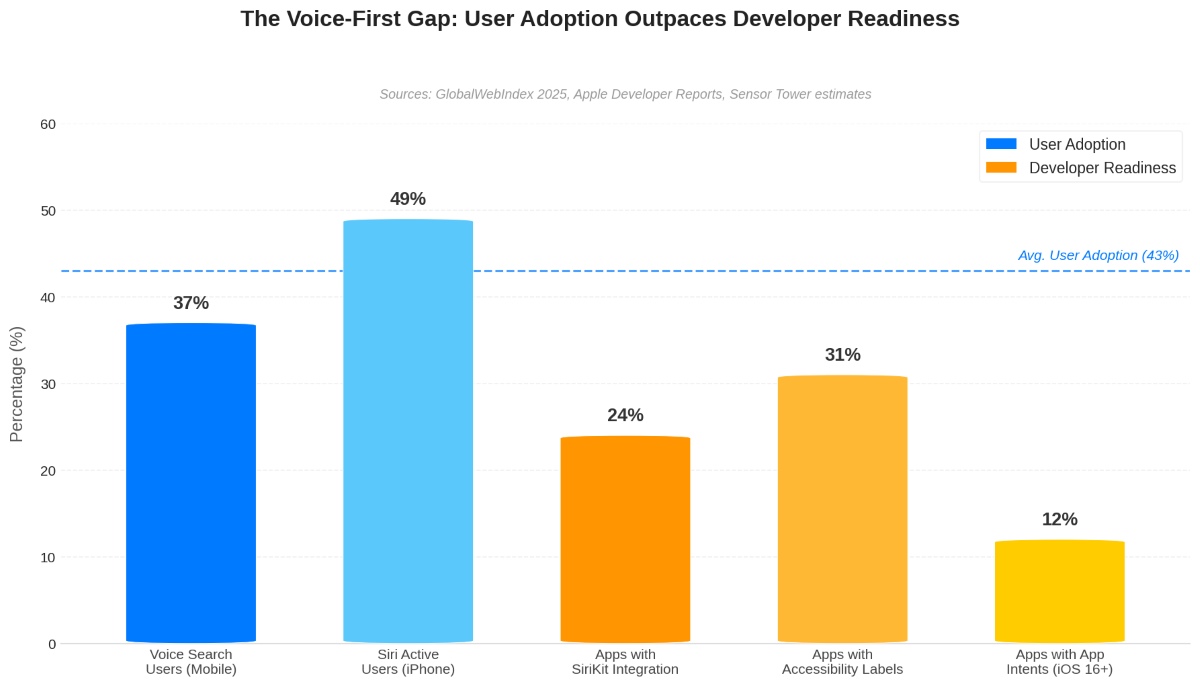
On the developer side, the readiness gap is stark. According to Sensor Tower data, only around 24 percent of the top 1,000 iOS apps have integrated SiriKit shortcuts, and just 12 percent have adopted the newer App Intents framework introduced in iOS 16. Contrast that with emerging players like Arc Browser and Notion, which shipped full App Intents suites within weeks of the iOS 17 launch and have since reported 18–22 percent higher retention among Siri-referred users.
For ASO strategists, this creates a bifurcated optimization problem. In high-voice markets, natural language queries tend to be longer (averaging 6.2 words versus 2.8 for typed searches) and more intent-specific. An iOS 27 user saying "find me a photo editor that removes backgrounds automatically" will trigger Siri's on-screen awareness to match against app metadata, Accessibility Labels, and declared App Intents — not just keyword-stuffed subtitles.
Localization compounds the challenge. Apple Intelligence's natural language layer will need to parse intent across English, Spanish, Mandarin, Hindi, and German at launch. Apps without localized Accessibility Labels in these markets will simply not surface in voice-driven flows.
Legacy Apps Face an Invisible Demotion
The bigger structural risk sits with long-tail and legacy apps. Roughly 69 percent of App Store titles have not updated their Accessibility Labels since initial submission. For these apps, Siri's on-screen awareness has nothing meaningful to parse: generic button labels like "Button 1" or "Image View" will yield zero matches against natural language commands.
This is not a hypothetical scenario. Apple's existing Voice Control (pre-AI) already struggles with apps that lack proper accessibility markup — users see numbered overlays instead of named controls. With Apple Intelligence, the system will attempt to infer intent from visual context, but apps with well-structured labels will receive priority ranking in Siri's action suggestions.
Traditional ASO levers — keyword density in titles, screenshot A/B testing, review velocity — will not disappear, but they will share the stage with a new class of metadata: structured intent declarations that tell Siri what your app can do, screen by screen.
The Core Tension: Platform Power vs. Developer Adoption Lag
The central contradiction heading into WWDC 2026 is this: Apple is building an agentic Siri that can see, understand, and act across any app on screen — but the vast majority of apps are not structured to participate. Apple's answer so far has been backward-compatible inference (the AI guesses what unlabeled buttons do), but inference is unreliable and creates unpredictable user experiences.
Some studios are already moving. Duolingo updated its App Intents coverage to 14 discrete actions in Q1 2026 and saw Siri-initiated sessions climb 31 percent quarter-over-quarter. Headspace added voice-triggered meditation shortcuts and reported a 9 percent lift in day-7 retention from voice-referred installs. These are early signals, not guarantees — but they suggest that the apps which invest in structured voice integration will compound an advantage that is difficult to replicate once the ecosystem matures.

If developer adoption remains at the current 12 percent App Intents penetration by the time iOS 27 ships in September, Apple faces a chicken-and-egg problem: a powerful agentic Siri with very few apps that can fully leverage it. The likely response will be aggressive WWDC tooling announcements — expect Xcode 19 templates, auto-generated App Intents scaffolding, and possibly App Store ranking signals tied to voice readiness.
✅ Key Takeaways
- Voice Control's natural language mode is the first production proof of the agentic AI engine powering iOS 27's Siri overhaul — not a standalone accessibility update.
- Only 12% of apps have adopted App Intents; 69% have never updated Accessibility Labels. The readiness gap is a concrete ASO risk, not a theoretical one.
- Voice search queries average 6.2 words versus 2.8 for typed input. ASO keyword strategies must shift from short-tail to natural language intent matching.
- Early movers are seeing measurable lifts: Duolingo reported +31% more Siri-initiated sessions; Headspace saw +9% higher day-7 retention from voice installs.
- WWDC 2026 (June 8) will likely introduce new Xcode tooling and possible App Store ranking signals tied to voice and intent readiness.
FAQs
How will iOS 27's agentic Siri change App Store search and discovery?
Siri's on-screen awareness means it can recommend and launch apps based on what users describe verbally, bypassing the traditional App Store search box. Apps with rich App Intents and Accessibility Labels will surface in these voice-driven flows. Learn how ASOWorld tracks voice-driven discovery trends →
What should app developers optimize now to prepare for Siri's on-screen awareness?
Start with a full audit of your Accessibility Labels (every interactive element should have a descriptive, human-readable label). Then declare App Intents for your app's core actions. Both are indexed by the new Voice Control engine and will feed into Siri's action-matching system. Explore ASO audit tools →
Will voice-driven app navigation impact ASO keyword strategies in iOS 27?
Yes. Voice queries are longer and more conversational than typed searches. ASO strategies need to incorporate natural language phrases and intent-based keywords, not just short-tail terms. Try ASOWorld's keyword research tools →
How can developers ensure their app's Accessibility Labels are ready for Voice Control?
Use Xcode's Accessibility Inspector to scan every screen. Replace auto-generated labels ("Button," "Image") with descriptive ones ("Edit Photo," "Share to Instagram"). Test with VoiceOver enabled and verify that Voice Control can identify every interactive element by name.
What App Intents should developers prioritize for iOS 27's revamped Siri?
Focus on your app's top 3–5 user actions (e.g., "start a workout," "create a new document," "play my playlist"). These high-frequency intents are most likely to be triggered by Siri's natural language matching. See ASOWorld's iOS 27 readiness checklist →

 Follow Us on Linkedin
