



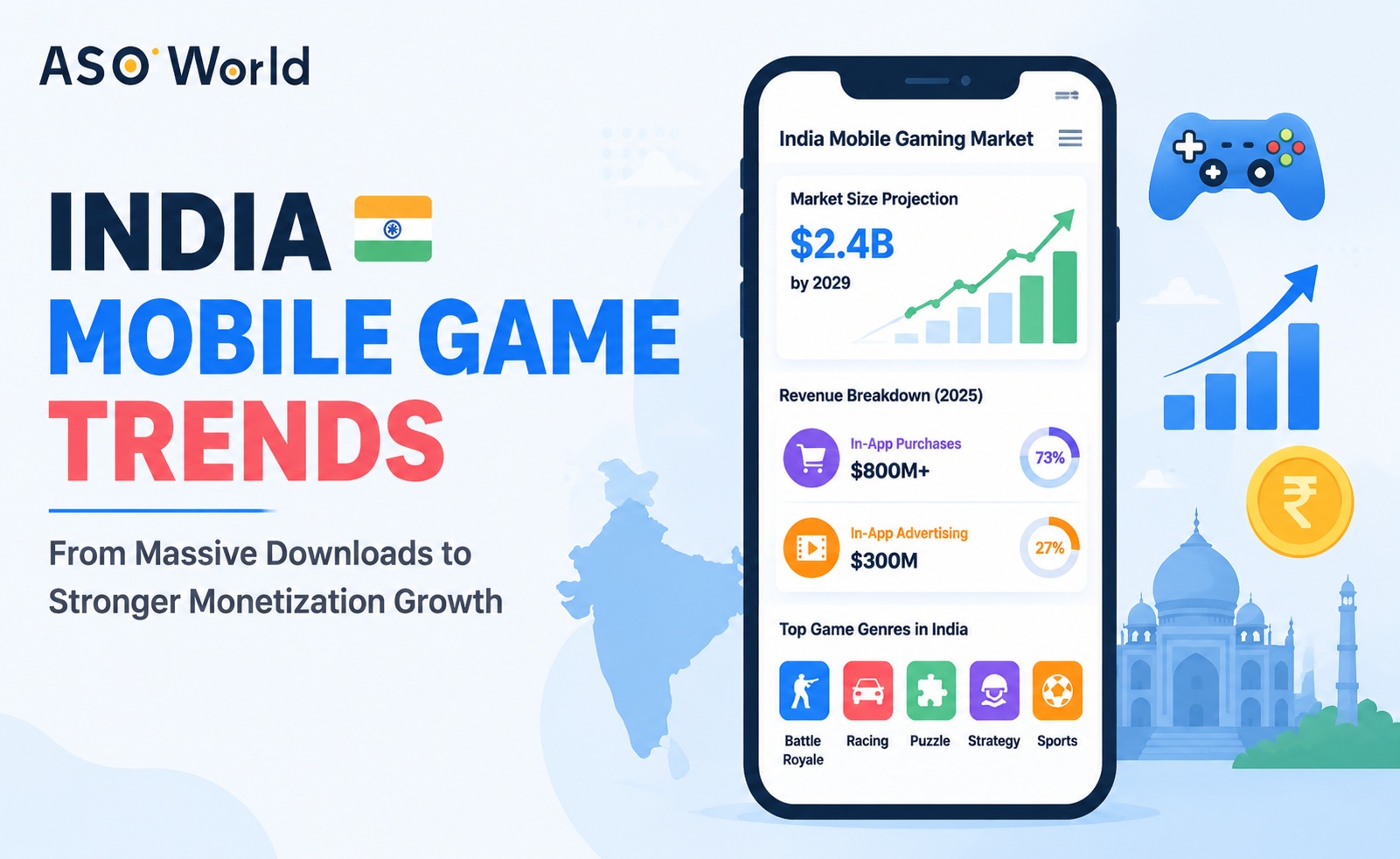

India’s mobile gaming market is projected to reach $2.4 billion by 2029, signaling a shift from install-led expansion to stronger monetization across in-app purchases and advertising.
India has long been one of the world’s largest mobile gaming markets by downloads. Now, the market appears to be entering a new stage: revenue growth is beginning to matter more than sheer install volume.
According to MIXI Global Investments’ India’s State of Play report, India’s mobile gaming revenue is expected to grow from $1.5 billion in 2026 to $2.4 billion by 2029, representing a 17% compound annual growth rate. The forecast points to a maturing gaming economy where publishers are increasingly focused on player value, monetization systems, and sustainable user acquisition.
Mobile gaming revenue is accelerating despite slower download growth
The report estimates that India’s combined in-app purchase and in-app advertising revenue will reach $1.5 billion in 2026, up 35% year over year from around $1.1 billion in 2025.
This is notable because India’s download growth has started to stabilize. The country still generates nearly 8 billion mobile game downloads annually, with Google Play accounting for the majority of installs. However, downloads declined slightly through 2025, suggesting that the next phase of growth will be less about acquiring first-time players and more about improving engagement and monetization among existing audiences.
For developers and publishers, this marks an important strategic change. India is no longer just a high-volume testing ground for low-cost installs. It is becoming a market where better retention, stronger live operations, and more localized monetization design can directly influence revenue performance.
In-app purchases are gaining momentum
In-app purchases are becoming a larger part of India’s mobile gaming economy. The report indicates that India surpassed $800 million in IAP revenue in 2025, more than doubling over the past five years.
This growth reflects a gradual move beyond purely ad-supported casual titles. More players are engaging with games that feature deeper progression systems, competitive loops, social features, and midcore mechanics. These genres typically support stronger lifetime value because users have more reasons to return, progress, and spend.
The trend mirrors patterns seen in other fast-growing Asian gaming markets, where early download growth was followed by higher monetization as players became more familiar with mobile-first entertainment and digital payments.
Advertising remains essential for mass-market reach
While IAP is rising, in-app advertising remains a key pillar of India’s gaming market. IAA generated an estimated $300 million in 2025, accounting for more than one-third of total mobile gaming revenue.
India’s relatively low average revenue per user and limited credit card penetration mean that ad-supported and hybrid monetization models remain highly relevant. Hypercasual and casual games continue to serve as entry points for new players, while rewarded video, interstitial ads, and hybrid monetization allow developers to generate revenue without depending entirely on direct spending.
For many publishers, the opportunity lies in balancing both models: using advertising to monetize broad audiences while gradually introducing IAP systems for more engaged player segments.
Regulatory changes may redirect investment into traditional gaming
The report also highlights the impact of regulatory changes affecting real money gaming. While the restrictions have influenced engagement patterns and total time spent, they may also benefit the broader free-to-play gaming ecosystem over time.
As capital, talent, and user attention move away from real-money formats, more resources could flow into conventional mobile games. This may create new opportunities for studios building casual, puzzle, lifestyle, strategy, and midcore titles designed around long-term engagement rather than short-cycle cash gaming behavior.
Low CPI keeps India attractive for global publishers
India’s cost-efficient user acquisition environment remains one of its strongest advantages. AppsFlyer data cited in the report suggests that gaming cost per install has fallen to around $0.05, making India one of the lowest-cost markets for acquiring mobile game users.
Low CPI does not automatically guarantee profitability, but it gives publishers more room to test creatives, onboarding flows, monetization mechanics, and genre-market fit before scaling globally. For international studios, India can function as both a growth market and a live testing environment for product iteration.
India’s developer ecosystem is also expanding
India now has more than 2,000 gaming companies, according to the report. The local ecosystem is moving beyond outsourcing and service work toward original intellectual property, game technology, AI-assisted development, and global content creation.
This evolution could strengthen India’s position not only as a consumer market, but also as a production hub for games designed for both domestic and international audiences. With a young player base, improving monetization, and rising development capability, India is becoming more strategically important for global mobile gaming companies.
Why this matters for app developers and marketers
India’s mobile gaming market is still defined by scale, but the growth story is changing. The next stage will likely be shaped by monetization quality, retention, localization, and smarter acquisition rather than downloads alone.
For app developers, this means product-market fit in India requires more than low CPI campaigns. Games need localized store pages, culturally relevant creatives, accessible onboarding, flexible monetization, and retention systems that support long-term engagement.
For app marketers, India’s projected growth to $2.4 billion by 2029 makes the market difficult to ignore. But success will depend on understanding where users come from, what motivates them to stay, and how different monetization models perform across segments.
FAQ
How big is India’s mobile gaming market expected to become?
India’s mobile gaming market is projected to reach $2.4 billion by 2029, growing from an estimated $1.5 billion in 2026.
What is driving India’s mobile gaming revenue growth?
Growth is being driven by rising in-app purchases, continued in-app advertising revenue, low user acquisition costs, and a larger ecosystem of local gaming companies.
Why is India important for mobile game publishers?
India offers massive download scale, low CPI, a young gaming audience, and improving monetization potential, making it a key market for both user acquisition and product testing.

 Follow Us on VK
