



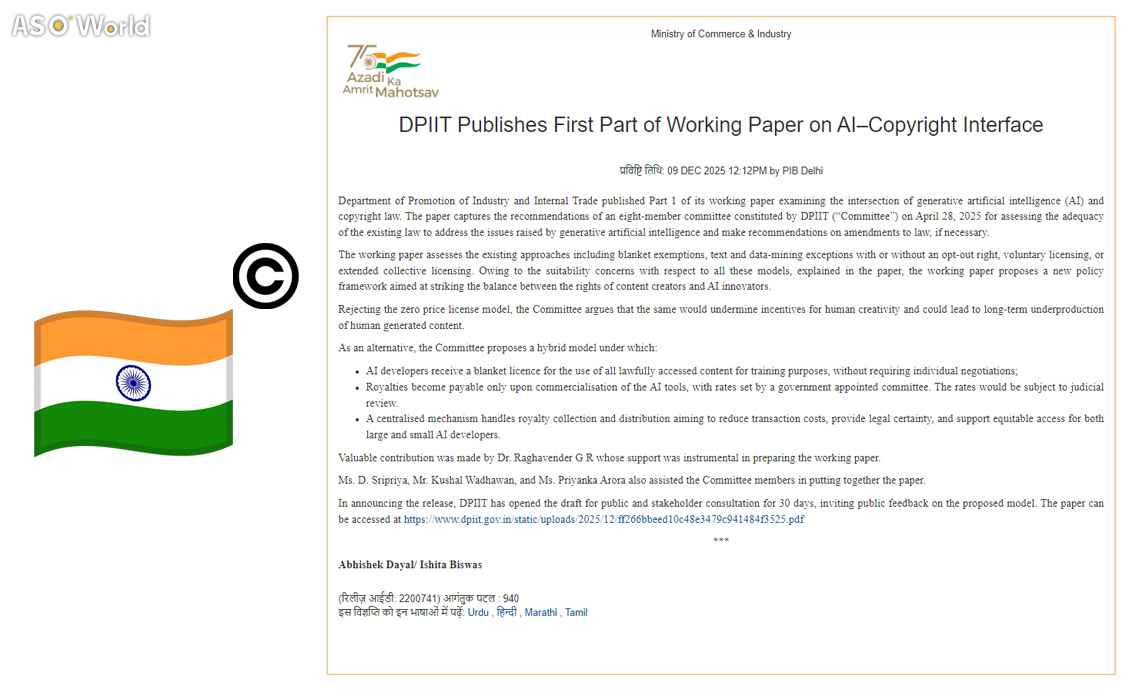

On December 9, 2025, India's Department for Promotion of Industry and Internal Trade released a working paper proposing mandatory royalties for AI companies using copyrighted content in model training.
The plan, from an eight-member committee, creates a centralized system for automatic access to Indian works like books, music, and articles, in exchange for revenue-based payments to rights holders.
Core Elements of the Proposal
The framework introduces a "blanket license" that grants AI developers broad access without individual deals, but requires payments through a new body called the Copyright Royalties Collective for AI Training.
Key Features
-
Mandatory license: Automatic permission for lawfully obtained content, with no creator opt-out and retroactive application.
-
Royalty structure: Fixed percentage of global AI revenue, set by a government committee and distributed to registered creators.
-
Transparency rules: AI firms must reveal training data sources if disputed, with proof burdens on companies.
-
Scope: Applies to all commercial generative AI in India, with possible lower fees for startups.
Reasons for the New System
The committee highlights risks of uncompensated AI use eroding original content value and leading to recycled outputs.
This approach aims to cut legal uncertainties, lower costs for AI firms by 70-80%, and boost India's creative economy, worth over $30 billion yearly, while aligning with national AI goals like the IndiaAI Mission.
Benefits for All Sides
Creators gain guaranteed payouts without negotiations; tech companies get streamlined data access; the economy benefits from AI growth adding up to $500 billion to GDP by 2025.
Reactions from Stakeholders
Responses are mixed. Creators and groups like news agencies support it for safeguarding rights, with positive social media buzz calling it a "landmark move."
Tech bodies like Nasscom oppose it as a potential "tax on innovation," favoring free data mining with opt-outs.
On Twitter, there're lots of debates about its impact on global tech, with posts noting it could "reshape the tech scene."
Broader Global Implications
India's plan stands out as more hands-on than U.S. fair use or EU opt-outs, potentially inspiring other nations.
It could force worldwide royalty standards, especially given India's large AI user base, and spark data audits or higher model costs.
Editor's Comments
India's royalty proposal builds on global IP debates, echoing lawsuits like those against OpenAI in the U.S., and advances ethical AI frameworks seen in strategies from the EU AI Act.
This move positions India as a pioneer in balancing tech progress with creator protections, potentially generating billions for local industries.
Future outcomes may include refined opt-out options during feedback, but widespread adoption could accelerate sovereign AI development while influencing international norms by 2030.

 Follow Us on Facebook
