




Key Takeaways:
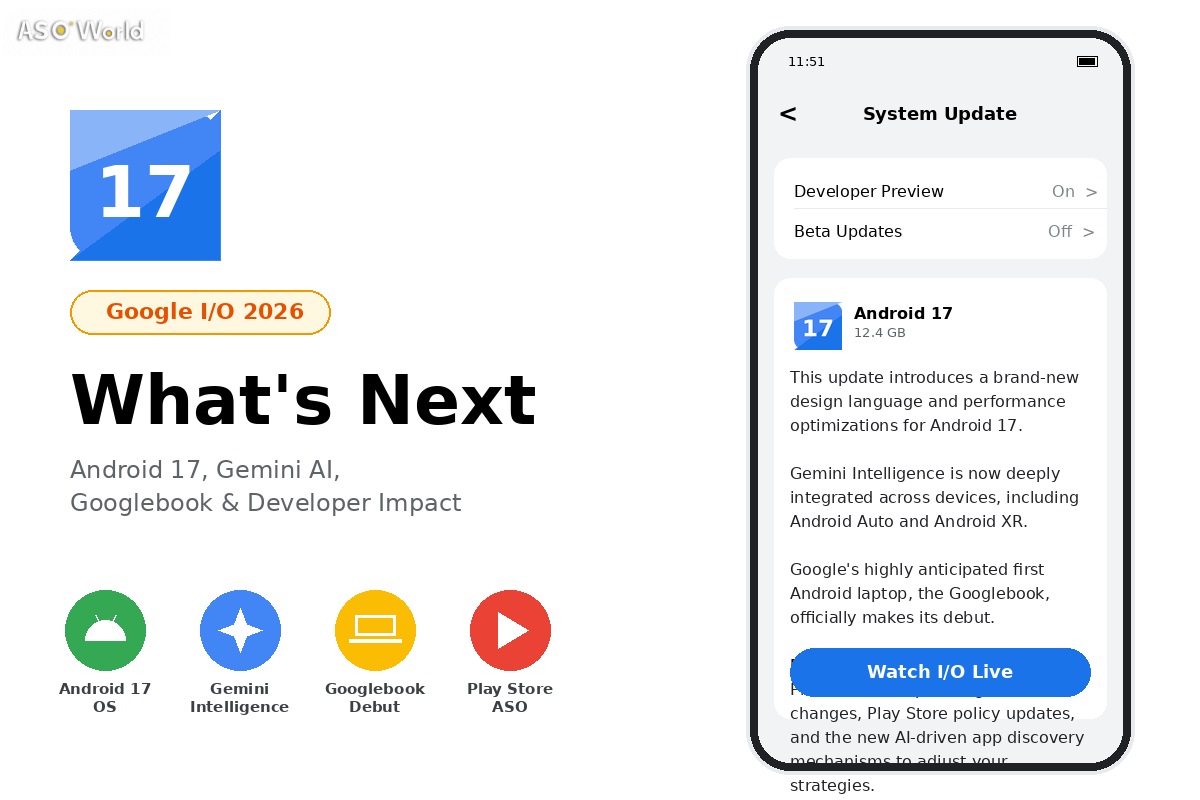
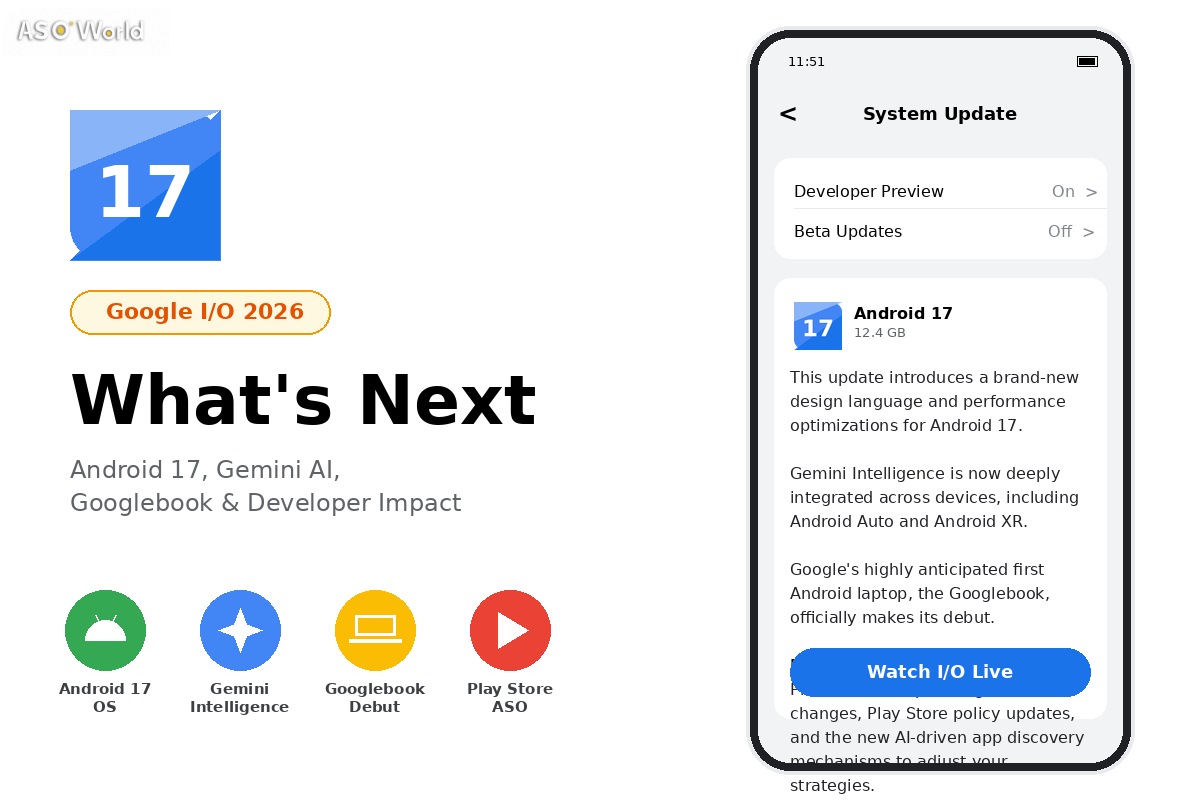
- Major OS Overhaul: Google I/O 2026 begins tomorrow (May 19-20), bringing Android 17 with a revamped design language and major API shifts that cross-platform developers must track.
- Omnipresent AI: Gemini Intelligence is expanding beyond phones into Android Auto and Android XR glasses, setting a high benchmark ahead of Apple's iOS 27 WWDC announcements.
- Hardware Surprises: The highly anticipated "Googlebook"-Google’s first true Android-powered laptop-aims to blur the line between mobile and desktop computing.
- App Discovery Evolution: AI-driven search in the Play Store will force marketers to adapt their keyword strategies, mirroring upcoming shifts in App Store algorithms.
- Strategic Adaptation: iOS and Android developers must unify their cross-platform App Store Optimization (ASO) strategies to maintain visibility in an increasingly AI-curated ecosystem.
Just hours ahead of its official kickoff, live blogs and tech forums are already buzzing with confirmed leaks regarding Google’s annual developer conference, Google I/O 2026, scheduled for May 19-20. Following the highly revealing "The Android Show: I/O Edition," the industry is bracing for a seismic shift.
While this event is firmly rooted in the Google ecosystem, the ripple effects of Android 17, omnipresent Gemini AI integrations, and the hardware wildcard known as "Googlebook" are guaranteed to impact App Store developers and iOS marketing professionals.
With Apple recently seeding iOS 26.5 Beta 3 to developers, the contrast between how these two tech giants are approaching the second half of 2026 provides a critical roadmap for cross-platform app growth.
The Cross-Platform Implications of Android 17
Tomorrow’s deep dive into Android 17 is expected to reveal a sweeping new design language and under-the-hood performance optimizations that will redefine user expectations across all mobile devices. For developers managing both iOS and Android applications, major API changes in Android 17 mean that feature parity will require significant roadmap adjustments. While iOS 26.5 Beta 3 focuses heavily on refining the current ecosystem and patching security layers ahead of the iOS 27 transition, Android 17 appears to be aggressively pushing the boundaries of background processing and real-time data syncing.
For App Store developers, monitoring Android 17 is less about copying features and more about understanding shifting consumer expectations. When Google introduces native system-level functionalities-such as enhanced predictive back gestures or seamless cross-device state saving-iOS users often begin expecting similar fluidity from their iPhone applications. Furthermore, changes to Play Store policies accompanying Android 17 will likely influence Apple’s own App Store Review Guidelines, especially concerning data privacy and AI-generated content disclosures.
Gemini Intelligence: The AI Benchmark for iOS 27
The most heavily anticipated segment of Google I/O 2026 is the expansion of Gemini Intelligence. Leaks from top tech outlets confirm that Google is moving Gemini out of the browser and deeply integrating it into the OS level, spanning Android Auto, Android XR glasses, and smart home ecosystems. This omnipresent AI assistant will feature deep-linking capabilities, allowing it to execute multi-step tasks across third-party apps without user intervention.
This presents a fascinating challenge for iOS developers. Apple is widely expected to overhaul Siri with advanced large language models (LLMs) in the upcoming iOS 27, potentially allowing users to choose between models like Claude, Gemini, or ChatGPT for system functions. Google’s aggressive rollout tomorrow sets the baseline. App marketers must begin preparing their app metadata and in-app indexing to be "machine-readable" by AI agents. If Gemini can pull data directly from an app's UI to answer a user query, developers need to ensure their App Store positioning highlights these AI-ready capabilities to drive downloads.
Enter the "Googlebook": Redefining Mobile-Desktop Convergence
Perhaps the most disruptive news dominating the top stories today is the impending announcement of the "Googlebook." Moving away from the ChromeOS architecture for high-end tasks, Google is reportedly launching a flagship laptop running a desktop-optimized version of Android. This convergence aims to seamlessly blend the vast Android app ecosystem with desktop-class productivity.
For iOS and iPadOS developers, the Googlebook represents a direct threat-and a unique opportunity. Apple has long maintained a strict boundary between macOS and iPadOS, even as it transitioned Macs to Apple Silicon. If the Googlebook successfully scales mobile apps to desktop utility, consumer demand for true desktop-class mobile apps will skyrocket. Developers building for the App Store will need to double down on optimizing their iPadOS apps, ensuring robust keyboard/mouse support and resizable windows, to remain competitive against Android counterparts that are now natively targeting laptop users.
The Evolution of User Acquisition in 2026
The combination of a new OS, ubiquitous AI, and hybrid hardware means the user acquisition (UA) funnel is fundamentally changing. In the mobile gaming sector, for instance, we’ve already seen record-breaking revenue in April 2026 from titles like Honor of Kings (
With Gemini curating Play Store recommendations based on hyper-personalized user contexts, ASO is no longer a manual, set-and-forget task. It requires dynamic, data-driven optimization. As Google updates its discovery algorithms during I/O, developers who manually guess at keyword performance will fall behind. Scaling effectively in this new era requires sophisticated tools and expertise to analyze cross-platform trends and execute rapid A/B testing on metadata. To navigate this complexity seamlessly, many top-tier publishers are shifting toward automation, partnering with an AI App Marketing Agency to maintain dominant rankings across both iOS and Android ecosystems.
Preparing Your Cross-Platform Roadmap
As we tune into the Sundar Pichai keynote tomorrow, iOS developers shouldn't view Google I/O 2026 as just an "Android event." The announcements made will dictate the competitive pressure Apple faces at WWDC next month. From the integration of end-to-end encrypted RCS messaging-which recently reshaped cross-platform communication-to the rollout of Android XR, the standard for mobile technology is being elevated.
The smartest App Store developers and marketing operators are those who analyze Android updates to predict consumer behavior shifts. Whether it is redesigning your app's interface to compete with the fluid animations of Android 17 or updating your App Store screenshots to highlight AI-driven features that rival Gemini, the work begins the moment the keynote ends.
FAQ for App Developers & Growth Operators
1. How does Android 17 affect my iOS app development roadmap?
While Android 17 code won't affect your iOS app directly, the user experience standards it sets will. Features like advanced predictive gestures and deep AI integration will raise consumer expectations, pressuring iOS developers to implement equivalent features using Apple's upcoming iOS 27 SDKs.
2. What is Googlebook, and should I optimize my app for it?
Googlebook is reportedly Google's first flagship laptop running a desktop-optimized version of Android. If you develop cross-platform apps, optimizing your Android build for desktop environments (keyboard, mouse, resizable windows) is crucial. This also indicates you should refine your iPadOS versions to remain competitive.
3. Will Gemini AI change how App Store Optimization (ASO) works?
Yes. As generative AI becomes the primary way users search for and discover apps, traditional keyword matching is evolving into semantic, intent-based discovery. Your app's metadata must be highly descriptive and naturally written so AI agents can accurately understand and recommend your product.
4. How does the current iOS 26.5 Beta 3 compare to the Android 17 previews?
iOS 26.5 Beta 3 is an iterative update focused on stability, security, and minor tweaks before the major iOS 27 overhaul. In contrast, Android 17 is a generational leap introducing new design languages and core AI integrations. Apple's true counter to Android 17 will be revealed at WWDC in June.
5. How can I efficiently manage marketing and ASO for both iOS and Android?
Managing distinct algorithms requires specialized strategies. Leveraging an AI App Marketing Agency and advanced ASO platforms allows developers to automate keyword tracking, optimize metadata for both the App Store and Google Play simultaneously, and focus resources on core product development.

 Follow Us on Linkedin
