



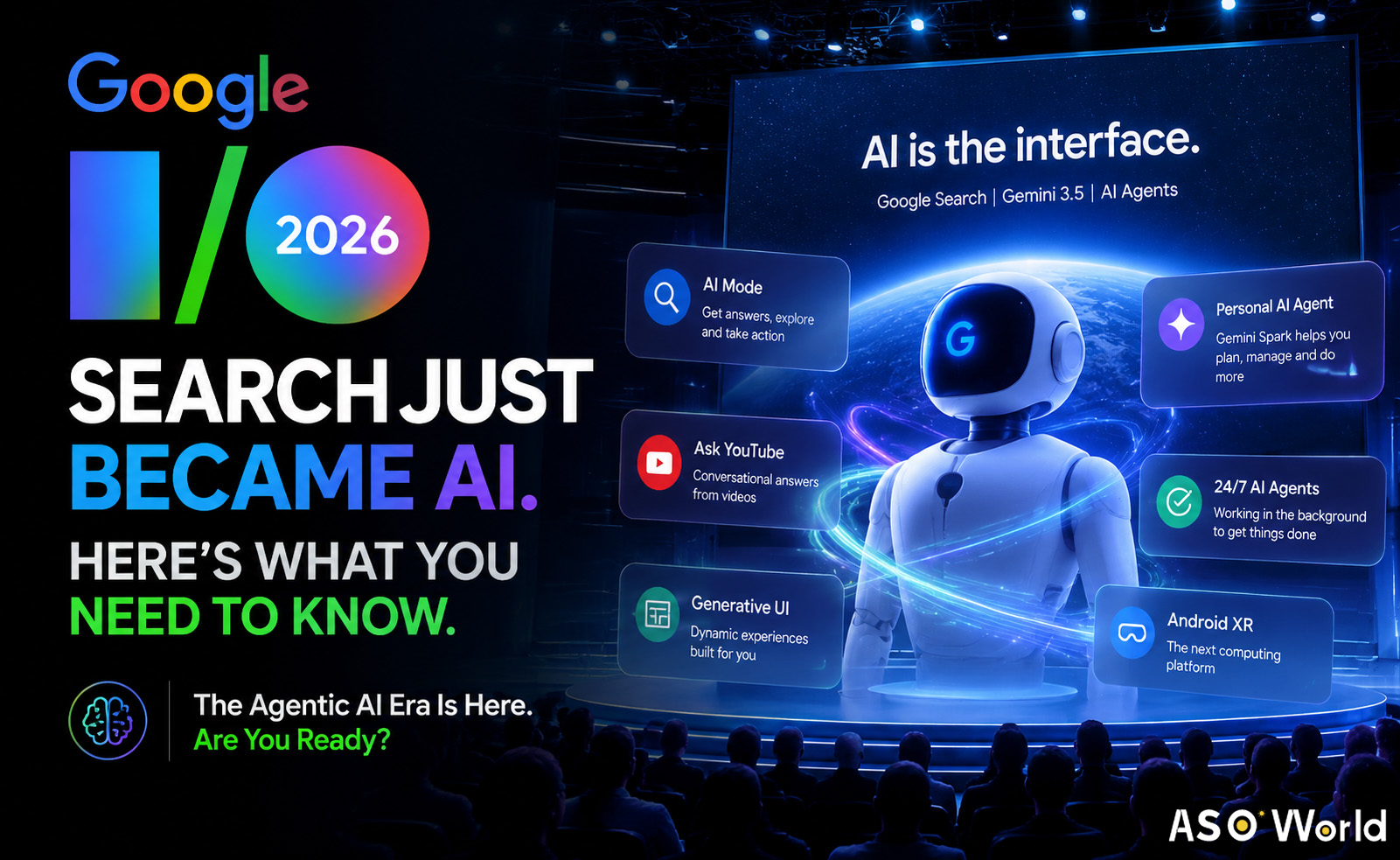

Google I/O 2026 wasn’t just another developer conference. It was Google publicly confirming that the internet is entering the agentic AI era — a world where AI doesn’t simply answer questions, but actively completes tasks, researches information, compares products, books services, and even builds interfaces for users automatically.
For marketers, publishers, app developers, and ASO professionals, this is bigger than a product launch. This is the beginning of a completely new discovery ecosystem. And if you still think traditional SEO or App Store optimization alone will protect your visibility, you’re already behind.
The Biggest Theme of Google I/O 2026: AI Becomes the Interface
For years, Google Search was built around one thing: Users type keywords → Google returns links → users click websites. That model is collapsing. At I/O 2026, Google introduced a new AI-first Search experience powered by Gemini 3.5 Flash, alongside autonomous AI agents capable of monitoring the web, summarizing information, making bookings, and interacting with apps on behalf of users.
Some of the biggest announcements included:
- AI-powered Search redesign
- Gemini Spark personal AI agent
- “Ask YouTube” conversational search
- Docs Live voice creation
- Android XR smart glasses
- Generative UI inside Search
- AI agents that operate in the background 24/7
Google is no longer treating AI as a feature.AI is now the operating layer of the ecosystem.
Google Search Is Becoming an AI Operating System
One statement from Google I/O stood out more than anything else:“Google Search is AI Search.”
That single shift changes how traffic works online. Instead of showing users ten blue links, Google increasingly wants to:
- Answer questions directly
- Compare products inside Search
- Build mini-app experiences dynamically
- Call businesses automatically
- Monitor topics continuously through agents
- Complete tasks without sending users to websites
This means clicks are no longer the primary metric of visibility. AI citation becomes visibility. Entity recognition becomes visibility. Structured trust signals become visibility. In practical terms, brands are competing not only for rankings anymore — they’re competing to become the AI’s preferred source.
Zero-Click Search Is Accelerating Faster Than Most Businesses Realize
Marketers have talked about “zero-click search” for years. But Google I/O 2026 showed that zero-click behavior is no longer a side effect. It is now the product strategy. Google revealed that AI Mode already reached over 1 billion monthly users, while AI-driven Search interactions continue growing rapidly.
The implications are massive:
- Users may never visit publisher websites
- Product research happens inside AI summaries
- Local service discovery may happen via agents
- Comparisons may occur before a click exists
- Apps could be surfaced contextually without traditional search intent
This fundamentally changes acquisition funnels. Traffic becomes fragmented. Discovery becomes conversational. And brand authority becomes more important than raw keyword positioning.
What This Means for SEO in 2026
Traditional SEO is not dead. But “10 blue links SEO” absolutely is. Google’s AI-first direction confirms that shift. Winning visibility in 2026 increasingly depends on:
1. Entity Authority
Google now prioritizes recognizable brands and trusted entities over isolated pages. If AI systems don’t understand who you are, your visibility shrinks dramatically.
2. Structured Information
Messy websites become harder for AI to cite. AI agents prefer:
- concise explanations
- clean schema
- factual formatting
- verified sources
- clear metadata
3. Multi-Platform Presence
Discovery no longer belongs to Google alone. Search behavior is expanding across:
- ChatGPT
- TikTok
- YouTube
- Amazon
- app stores
- AI assistants
4. AI Citation Optimization
The future isn’t just ranking #1. It’s becoming the source AI systems quote. That requires:
- expertise
- authority
- consistent branding
- topical depth
- trustworthy content ecosystems
Why App Developers Should Pay Close Attention
Most discussions about Google I/O 2026 focus on websites and publishers. But app developers may actually experience the biggest disruption. Here’s why. Google is transforming Search into an action engine. Instead of searching “best budgeting app,” users may soon ask:“Find me a budgeting tool that tracks subscriptions and works with Chase.”
The AI agent could:
- compare apps
- summarize reviews
- analyze permissions
- recommend one directly
- install it automatically in future ecosystems
Final Thoughts
Google I/O 2026 may eventually be remembered as the moment Search stopped being a search engine. And started becoming an AI operating system. For marketers, publishers, and app developers, this shift is uncomfortable — but also full of opportunity. The rules are changing faster than most businesses can adapt. But the companies that understand AI discovery early will gain a massive advantage over everyone still optimizing for yesterday’s internet. The era of “ten blue links” is fading. The era of AI-mediated discovery has officially begun.
 Follow Us on Facebook
