



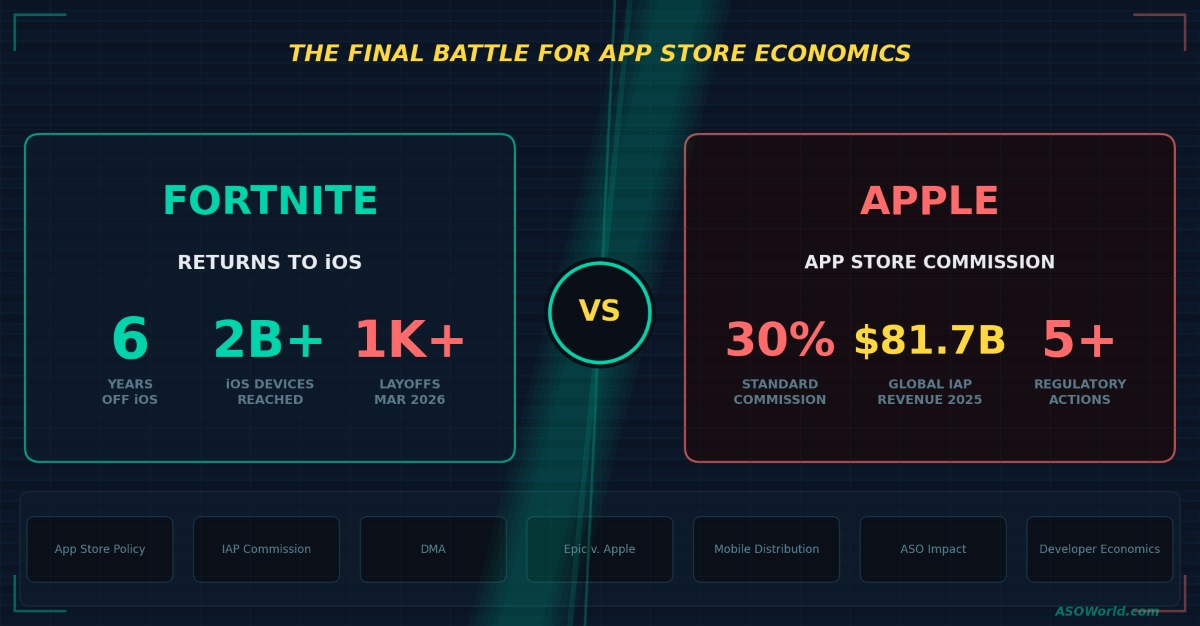

Epic Games returned Fortnite to the App Store in nearly every market worldwide on May 19, reaching an estimated two billion-plus iOS devices for the first time since 2020, as the company weaponizes its six-year legal battle with Apple into a coordinated campaign to dismantle the platform's 30 percent commission structure - a shift that will force every app developer to rethink their monetization stack, ASO strategy, and user acquisition math.
✦ What's New
- Fortnite is back on iOS - reaching 2B+ devices after a five-year absence, and deliberately absent only from Australia.
- Epic's legal leverage - the Ninth Circuit case is forcing a reckoning over Apple's 30% commission across global jurisdictions.
- Regulatory fragmentation is accelerating - EU DMA, Japan's Transparency Act, and UK CMA investigations are already reshaping the rules market by market.
- ASO is evolving - external payment links shift conversion optimization from a single checkout to a multi-channel funnel.
- Epic's financial cracks - 1,000+ layoffs, declining Fortnite engagement, and shuttered game modes reveal a weakened negotiating position.
- A two-tier outcome looms - large publishers may extract better terms; mid-market and indie studios risk being left behind.
The move resets the competitive calculus for mobile's biggest IAP generators. In the global mobile gaming market - worth an estimated $114 billion in 2024, with IAP revenue alone hitting $81.75 billion in 2025 (up 1.3 percent YoY per Sensor Tower) - Apple's iOS share of premium spending remains disproportionately high relative to its install base.
Fortnite, which generated over $1 billion in cumulative iOS revenue before its 2020 removal, returns to a landscape now dominated by Tencent's Honor of Kings and Supercell's Squad Busters in the competitive multiplayer segment, while newer entrants like Hoyoverse's Zenless Zone Zero and Krafton's Inzo have carved out significant IAP share in Asia-first markets.
Epic's real leverage isn't Fortnite's download count - it's the precedent that a top-grossing title can bypass Apple's payment rails and survive. For ASO practitioners, the immediate implication is clear: if external payment links become standard, conversion optimization shifts from a single App Store checkout flow to a multi-channel funnel where keyword ranking, listing assets, and on-page conversion rates become even more critical as the "last mile" before a user decides where to pay.
The geographic dimension matters - and so does how you localize for it. The EU's Digital Markets Act already forced Apple to allow alternative app marketplaces and reduced commissions in Europe; Japan's Transparency Act for Smartphone Software Competition took effect in April 2025; and the UK's Competition and Markets Authority has an active investigation into mobile ecosystems.
Epic's decision to re-enter every market except Australia - where a court already ruled Apple's developer terms unlawful but Apple continues to enforce them - is a deliberate escalation strategy.
This has been part of the new Siri https://t.co/w9LR46cWtC https://t.co/VSvAtfofCX
— Mark Gurman (@markgurman) May 19, 2026
By making Fortnite available across jurisdictions where regulators are watching the US case, Epic is daring Apple to pull the app again in front of an audience of antitrust enforcers. For growth teams, this fragmentation creates a new operational challenge: App Store listing strategies, pricing tiers, and even UA creative will increasingly need to be jurisdiction-aware, since the rules governing what payment options you can surface — and how you can describe them - now vary by market.
But Epic is playing this hand from a weaker position than its rhetoric suggests. In March 2026, the company laid off over 1,000 employees - roughly a quarter of its workforce - citing a "downturn in Fortnite engagement that started in 2025" and acknowledging that spending significantly exceeded revenue.
Several game modes, including Fortnite Ballistic and Festival Battle Stage, were killed; Rocket Racing is set to shut down in October. The $500 million in cost savings Epic identified through layoffs, contractor cuts, and marketing reductions signals a company optimizing for runway, not growth.
Meanwhile, Apple's App Store services revenue continues to climb, and the 30 percent commission - while under legal siege - remains the default rate for the vast majority of developers worldwide. For the long tail of studios that lack Epic's legal budget, the commission structure is unchanged - and so is the ASO playbook: maximize organic visibility to offset acquisition costs that a 30 percent revenue share makes harder to justify.
What's at stake for every app developer?
The core tension going forward is structural: the Ninth Circuit has sent the case back to Judge Gonzalez Rogers to determine what commission Apple can charge on purchases made through external payment links, but there is no guarantee the resulting rate will be meaningfully lower than the current 27 percent Apple proposed for link-outs.
Epic is betting that court-ordered cost transparency will reveal Apple's fees to be unjustifiable, prompting a cascade of regulatory action across jurisdictions - but if the US court sets a rate that still allows Apple to capture 20-plus percent on external transactions, the "Apple Tax" narrative shifts from abolition to negotiation, and developers outside the top 50 grossing apps will see little practical relief.
The risk for the broader ecosystem is a two-tier outcome: large publishers with legal resources and direct-to-consumer channels extract better terms, while mid-market and indie studios remain locked into the default commission, widening the already significant gap in mobile app economics.
⚡Take Away
The era of a single, universal App Store fee structure is ending. Whatever the court rules, the gap between developers who adapt - and those who don't - will translate directly into margin.
The developers who move fastest to optimize their ASO, diversify their pricing strategy, and build jurisdiction-aware distribution will capture the margin that others leave on the table. That window is open now.
For the full dataset on App Store commission structures, mobile gaming IAP benchmarks, and regulatory timelines across 15 jurisdictions - plus actionable guidance on optimizing your App Store presence for a multi-payment-channel world - visit the ASOWorld App Store Policy Tracker.

 Follow Us on Linkedin
