




Breaking News
On June 23, 2026, a coalition of 48 Chinese iOS developers submitted a formal antitrust complaint to the State Administration for Market Regulation (SAMR). The complaint alleges Apple is abusing its market dominance by levying "unfair and excessive" App Store commissions.
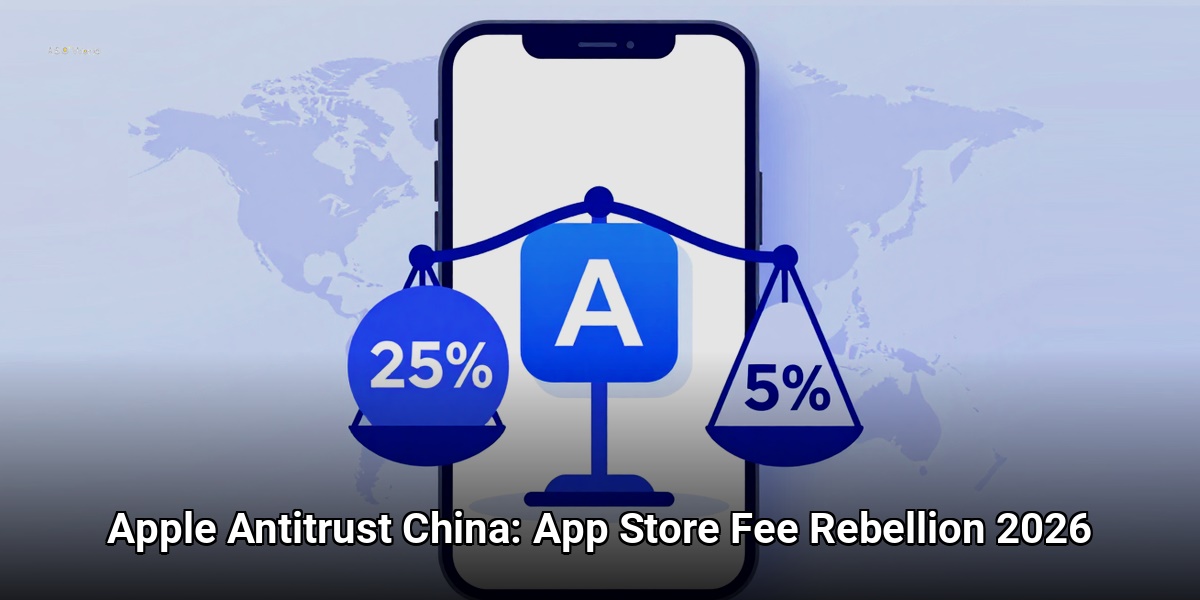
While Apple recently reduced its commission rate in China from 30% to 25% (and 12% for subscription renewals) in March 2026, developers argue this is insufficient. Their core demand? A drastic reduction of effective commission rates to around 5% and the legalization of third-party app stores in the Chinese market, citing recent global regulatory shifts as precedent.

Policy Breakdown: The Global Domino Effect
This isn't an isolated incident. The Chinese developers' complaint strategically leverages Apple's recent concessions in other major markets. This represents a significant shift from isolated grievances to a coordinated, globally informed legal strategy.
The Brazilian Catalyst
The timing is no coincidence. Just last week, Apple reached a landmark settlement with Brazil’s Administrative Council for Economic Defense (CADE). The Brazilian agreement slashed commission rates to between 10% and 21% and cracked the door open for third-party app distribution.
Chinese developers are directly using this Brazilian settlement as hard evidence that Apple has the capability and precedent to offer significantly more favorable terms without breaking its ecosystem.
The EU DMA Benchmark
Furthermore, the developers are pointing to the European Union's Digital Markets Act (DMA) as the ultimate benchmark. The DMA forced Apple to introduce the Core Technology Fee (CTF) and allow alternative app marketplaces, effectively proving that an iOS ecosystem with alternative distribution and drastically lowered effective fees (approaching the 5% requested by the Chinese coalition) is technically and operationally feasible.
Core Insights & Historical Event Chronicle (2025-2026)
To understand where the SAMR complaint might lead, we must look at how similar regulatory battles have unfolded. ASO World has extensively covered the global pressure mounting against Apple's App Store policies.
1. Global Antitrust & Regulation Milestones
Apple's "walled garden" has faced relentless international scrutiny, shaping the current Chinese developer rebellion.
- Brazil's Turning Point: Apple Agrees Antitrust Settlement Allowing Third-Party iOS Stores in Brazil (Dec 2025) - The direct precedent cited in the SAMR complaint.
- European Pressures: Apple Loses Antitrust Appeal in Germany Over App Store Rules (Mar 2025)
- Web Expansion: Apple Expands App Store to the Web Amid Antitrust Pressure (Nov 2025)
2. The Evolution of Commission & Payment Policies
How Apple attempts to maintain revenue while navigating legal mandates.
- EU Models: Apple App Store Policy Updates June 2025 (EU CTC Transition)
- U.S. Alternative Payments: Apple's App Store Review Guidelines Update (May 2025)
- Global Tax Shifts: App Store Tax & Price Updates August 2025
Trend Insights & ASO Strategic Impact
If SAMR acts in favor of the developers, the ripple effects will transform the Chinese mobile ecosystem. Here is how we categorize the impending changes and how developers should prepare.
📉 1. Developer Monetization & Revenue Shifts
Tags: #App Monetization #Third-Party Billing #Developer Revenue #App Store Payments
A drop from 25% to potentially 5% (or even the 10-21% Brazilian standard) radically alters Unit Economics. Developers of mid-to-hardcore games and high-retention subscription apps (where the 12% renewal fee currently applies) will see immediate margin improvements.
Action: Recalculate your Life-Time Value (LTV) models immediately. A higher margin allows for more aggressive User Acquisition (UA) bidding.
🚪 2. Alternative Distribution Channels & Fragmentation
Tags: #Alternative App Store #App Distribution #Sideloading #China App Market
The Chinese market is already heavily fragmented on Android. If iOS opens up to third-party stores, developers must navigate a multi-channel iOS strategy.
Action: Begin preparing technical infrastructure for side-loading or third-party store submissions. Your metadata and promotional assets must be adaptable across different storefront interfaces, not just Apple's proprietary design.
🚀 3. ASO Strategy in a De-Monopolized Ecosystem
Tags: #ASO Strategy #User Acquisition #App Ecosystem #Competitor Analysis
If Apple's commission drops, expect marketing budgets to surge. The savings will likely be reinvested directly into UA and ASO.
Action: Prepare for intensified competition in App Store Search. As rivals gain more capital from reduced fees, keyword bidding (Apple Search Ads) and organic ASO efforts will become more expensive and crucial. Developers must leverage tools like FoxData to monitor competitor metadata updates and identify emerging long-tail keyword opportunities before the market floods with reinvested capital.
⚖️ 4. Policy & Compliance Agility
Tags: #Antitrust #SAMR #Apple Monopoly #Digital Markets Act
The regulatory landscape is no longer static. Apple's "one-size-fits-all" approach is fracturing into regional policies (EU vs. US vs. Brazil vs. China).
Action: Assign dedicated resources to monitor regional compliance. What works in the US App Store may now be suboptimal or even restricted compared to what is allowed in the EU or, soon, China.
Executive Conclusion & Strategic Recommendations
As we navigate this pivotal moment in app ecosystem economics, developers and marketers must adopt a proactive, data-driven approach. Here are the definitive strategic recommendations:
1. Capitalize on Global Precedents for SEO & Strategy
The narrative has shifted from "can we challenge Apple?" to "how much can we negotiate?" Developers should closely monitor the unfolding events, utilizing historical frameworks like the EU DMA implementations and the Brazilian antitrust settlement to anticipate Apple's potential concessions in China.
2. The Global Commission Calculus
It is crucial to understand the fractured global landscape of App Store fees. Developers must critically evaluate Apple's regional compromises:
- European Union: The transition to the Core Technology Fee (CTF) and CTC models.
- United States: The 27% commission for utilizing third-party payment processing.
- Brazil: The negotiated 10%-21% tiered commission structure.
- China: The current 25% reality versus the developers' aggressive 5% demand.
Actionable Takeaway: Run financial models comparing these regional structures to determine where to focus your upcoming localization and UA budgets.
3. Leverage Free Tools for Competitive Intelligence
The coalition of 48 developers likely shares common traits - such as being mid-to-hardcore game publishers, high-LTV subscription apps, or aggressive global expanders.
By leveraging our data intelligence tools, marketers can reverse-engineer the strategies of these leading developers, using concrete data to validate how the current commission structures are suppressing ROI, and more importantly, how a potential fee reduction will instantly flood the market with reinvested UA capital.
Stay ahead of the regulatory curve and optimize your global app strategy with the latest insights and data-driven tools at ASO World.

 Follow Us on Linkedin
