




Key Takeaways
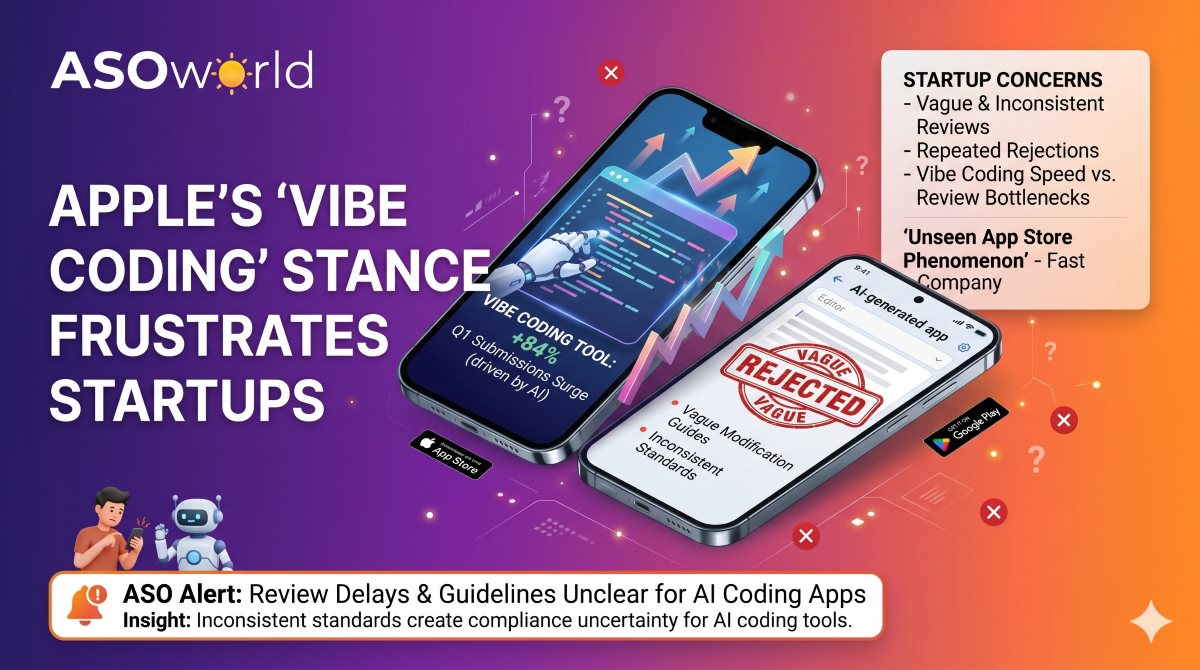
- Apple has blocked updates for at least two major vibe coding apps — Replit and Vibecode — and temporarily removed Anything from the App Store in March 2026, citing guideline 2.5.2 violations.
- App Store submissions jumped 84% in Q1 2026, driven by the explosion of AI-generated apps, pushing Apple's review infrastructure to its limits with delays stretching to 30+ days.
- Startups accuse Apple of inconsistent enforcement — Replit had its app approved over 100 times since 2022 with the same features now being blocked, while Anthropic's Claude continues to offer similar in-app code generation capabilities.
- The financial stakes are enormous: the App Store fuels a $109 billion Services business with 75%+ gross margins, and every app that bypasses the store represents lost commission revenue.
- Apple's own Xcode 26.3 now includes agentic AI coding capabilities, raising accusations of anti-competitive behavior as third-party tools face restrictions while first-party alternatives expand.
The Crackdown That Sparked an Uproar
Over the past six weeks, a quiet but escalating conflict has been unfolding between Apple and a new wave of AI-powered development platforms. The dispute, first reported by The Information in March 2026 and amplified by the Financial Times on May 3, centers on "vibe coding" — the practice of using natural language prompts to generate fully functional applications without writing traditional code.
Apple's response has been decisive: block updates, pull apps, and enforce long-standing App Store guidelines against tools that let users build and execute code inside iOS applications. The affected startups, including Replit (valued in the billions) and Anything, argue they're being targeted with inconsistent, shifting standards that make it impossible to operate on iOS.
"We're in the dark," Anything founder Dhruv Amin told the Financial Times. "Either they should stop enforcing the rules in this weird way, or they should update the guideline to let this use case emerge."
The Numbers Behind the Surge
The scale of what Apple is dealing with is unprecedented. According to data compiled by The Information and Sensor Tower, App Store submissions in Q1 2026 surged by 84% compared to the prior quarter — the highest growth rate in nearly a decade.
| Metric | Value | Source |
|---|---|---|
| Q1 2026 submission growth | +84% QoQ | The Information / Sensor Tower |
| Full-year 2025 new apps | 557,000 | The Information |
| Monthly submission growth (Dec 2025) | +56% YoY | Sensor Tower |
| Weekly peak submissions (2025) | ~200,000 | Sensor Tower |
| Review delays (March 2026) | 7–30+ days (vs. 24–48hr baseline) | Developer reports |
| App Store Services revenue (FY2025) | $109 billion | Apple financials |
The influx has strained Apple's review infrastructure. Developers submitting apps in March 2026 reported review delays of 7 to 30 or more days, a sharp departure from the historical 24-to-48-hour turnaround. Apple has pushed back on these claims, stating that 90% of submissions are still reviewed within 48 hours with an average review time of 1.5 days — though this assertion has been met with skepticism from developers experiencing multi-week waits.
The App-by-App Timeline: How It Unfolded
Replit: Blocked Since January 2026
Replit, the most prominent player in the vibe coding space, has been unable to update its iOS app since January 2026. The company — which lets users describe an app idea and have an AI agent build it — says Apple has shifted its reasoning multiple times over the past four months, raising new objections even after Replit addressed earlier ones.
The impact has been measurable: Replit dropped from #1 to #4 in the App Store's developer tools category and has lost revenue during the period, according to a person familiar with the matter. Replit's statement captured the frustration: "We are surprised and disappointed that Apple would block us from releasing updates, given that we have been on the platform for years abiding by their rules."
Replit CEO Amjad Masad has been even more direct, publicly describing Apple's policies as making developer tools for iOS "unfeasible."
Anything: Removed, Then Reinstated
On March 30, 2026, Apple escalated its enforcement by removing the vibe coding app Anything from the App Store entirely — after months of blocking its updates. Co-founder Dhruv Amin had attempted to modify the app so that AI-generated outputs would preview in a web browser rather than execute inside the app, but Apple blocked that update as well.
After further adjustments, Anything was permitted to return to the App Store on April 3, 2026. The rapid reversal — from removal to reinstatement in four days — only underscored the inconsistency that startups are protesting.
Vibecode: Caught in the Crossfire
Vibecode, another popular no-code app builder, was also blocked from updating in mid-March 2026. Apple told 9to5Mac that "the problem is not vibe coding per se, but apps violating certain guidelines" — yet the distinction between which apps face enforcement and which don't remains murky.
The Rule at the Center: Guideline 2.5.2
Apple's enforcement relies primarily on Section 2.5.2 of the App Store Review Guidelines, which states that apps must be self-contained and cannot "download, install, or execute code which introduces or changes features or functionality of the app." A companion provision — Section 3.3.1(B) of the Developer Program License Agreement — restricts interpreted code that changes an application's primary purpose.
The tension is inherent: vibe coding tools, by design, create and execute new code in real time. Apple's entire App Store gatekeeping model is built on pre-reviewing code before it reaches users. Vibe coding inverts that model.
Apple told the Financial Times that its review process was "created to protect users' privacy and security" and denied that an uptick in AI-generated apps had led to slower approvals.
The Hypocrisy Question: Xcode vs. Third-Party Tools
The most pointed criticism leveled at Apple is not about safety — it's about competition. In February 2026, Apple released Xcode 26.3 with built-in agentic AI coding capabilities, powered by integrations with Anthropic's Claude and OpenAI's Codex models.
Meanwhile, Anthropic's Claude app — which also lets users build, preview, and run applications — remains on the App Store without restriction. The difference, according to Apple, is that Claude runs code within the app rather than a browser sandbox. But for affected startups, the distinction feels arbitrary.
CNBC columnist Jon Fortt captured the contradiction: "From the outside, Apple looks like a company arguing with itself: an App Store team that benefits from vibe coding's surge in submissions and a developer tools team that doesn't want competition for Xcode — with no one at the top reconciling them."
📱 ASO Insight: Navigating the AI App Landscape
For App Store developers and marketers, the vibe coding controversy creates both challenges and opportunities. Apps built with AI tools still need to pass App Store review — and as this crackdown shows, Apple's scrutiny of AI-generated apps is intensifying. ASOWorld's AI App Marketing Agency specializes in helping AI-powered apps navigate App Store compliance, optimize keyword strategies, and maintain visibility amid growing competition. With 84% more apps competing for the same keywords, a data-driven ASO strategy has never been more critical.
The Financial Equation: Why Apple Can't Afford to Let Go
Beneath the policy debate lies an enormous financial calculus. The App Store is the toll booth at the center of Apple's Services business, which generated $109 billion in revenue last fiscal year with gross margins above 75% — nearly double what Apple earns from hardware sales.
Every app that goes to the web instead of the App Store represents lost commission revenue (15–30% per transaction). As CNBC noted, "vibe coding doesn't have to punch through Apple's walled garden — it can simply walk around." A developer can use Replit in a desktop browser, build a progressive web app, and never pay Apple a cent.
The risk for Apple is that aggressive enforcement pushes the next generation of builders entirely off-platform. Vanderbilt antitrust professor Rebecca Haw Allensworth summarized the dynamic: "They want to control the direction of innovation away from things that would disrupt their monopoly."
iOS 26.5 Beta 3: What Developers Should Watch
Amid the vibe coding controversy, Apple seeded iOS 26.5 Beta 3 to developers on April 20, 2026. While the update doesn't directly address the vibe coding crackdown, several features signal Apple's evolving platform strategy:
- Apple Maps ad infrastructure: Apple is laying the groundwork for advertisements in Maps, opening a new user acquisition channel for location-based apps
- RCS end-to-end encryption: E2EE for RCS messages between iPhone and Android users is being tested, improving cross-platform security
- Third-party wearable support (EU): Proximity pairing, notification forwarding, and Live Activities for third-party earbuds and smartwatches — expanding the accessory ecosystem beyond AirPods and Apple Watch
- Suggested Places in Maps: AI-driven location recommendations based on trends and recent searches
Notably, iOS 26.5 does not include new Siri capabilities — those are being held for iOS 27, expected to debut at WWDC 2026.
What Happens Next
The vibe coding standoff is far from resolved. Apple has maintained consistent communication with Replit — including three phone conversations in the last two months — but no resolution has been reached.
As WWDC 2026 approaches, all eyes are on whether Apple will clarify its guidelines or introduce a formal framework for AI-generated apps. The timing is critical: the vibe coding market barely existed 18 months ago, and today the companies building these tools are valued in the billions.
The broader question for the iOS ecosystem is existential: will Apple embrace the democratization of app development, or will it protect the walled garden at the expense of the next wave of innovation?
FAQ for App Developers & Growth Operators
1. How does Apple's vibe coding crackdown affect my existing AI-powered app on the App Store?
If your app uses AI to generate content but does not let users create or execute new code within the app, you're likely unaffected. The enforcement targets apps that allow in-app code generation and execution — the core feature of tools like Replit and Anything.
However, Apple's inconsistent application of guideline 2.5.2 means that any app with AI code-generation features should review its compliance posture proactively. For apps navigating this gray zone, ASOWorld's AI App Marketing Agency offers compliance-aware ASO strategies tailored to AI-powered applications.
2. With 84% more apps competing on the App Store, how can I protect my app's visibility?
The submission surge means keyword competition is fiercer than ever. Focus on:
- Long-tail keyword optimization to capture niche search intent
- App Store A/B testing for screenshots and descriptions
- Rating and review velocity as a ranking signal
For a real-world example, see how an AI Video Generator app ranked in the Top 5 for high-competition keywords through strategic ASO despite the crowded AI app landscape.
3. Is Apple's stance likely to change at WWDC 2026?
WWDC 2026 is widely expected to address the tension between Apple's developer tools strategy and third-party AI coding platforms. Given that Xcode 26.3 already includes AI agent capabilities and Apple's partnership with Anthropic, the most likely outcome is a clarified — not eliminated — enforcement framework. Developers should watch for updates to guideline 2.5.2 and any new "AI App" categorization in App Store Connect.
4. Should I build my next app as a web app instead of a native iOS app to avoid review risk?
Not necessarily. While progressive web apps (PWAs) bypass App Store review, they also miss out on the $109 billion App Store ecosystem, in-app purchase monetization, and iOS-native discoverability. The smarter play is to build native while ensuring your app's AI features comply with current guidelines. For strategic guidance on balancing platform risk with growth, our analysis of how regulatory controversies shape ASO strategies provides actionable frameworks.
5. How will Apple Maps ads (coming in iOS 26.5) change user acquisition for location-based apps?
Apple Maps ads represent a brand-new acquisition channel for apps with location-based functionality — travel, food delivery, retail, navigation, and augmented reality apps all stand to benefit. Early adoption will likely yield lower CPCs before the channel becomes saturated. Developers should start preparing Map-optimized creatives and location-based keyword strategies now, ahead of the iOS 26.5 public release.

 Follow Us on Linkedin
