



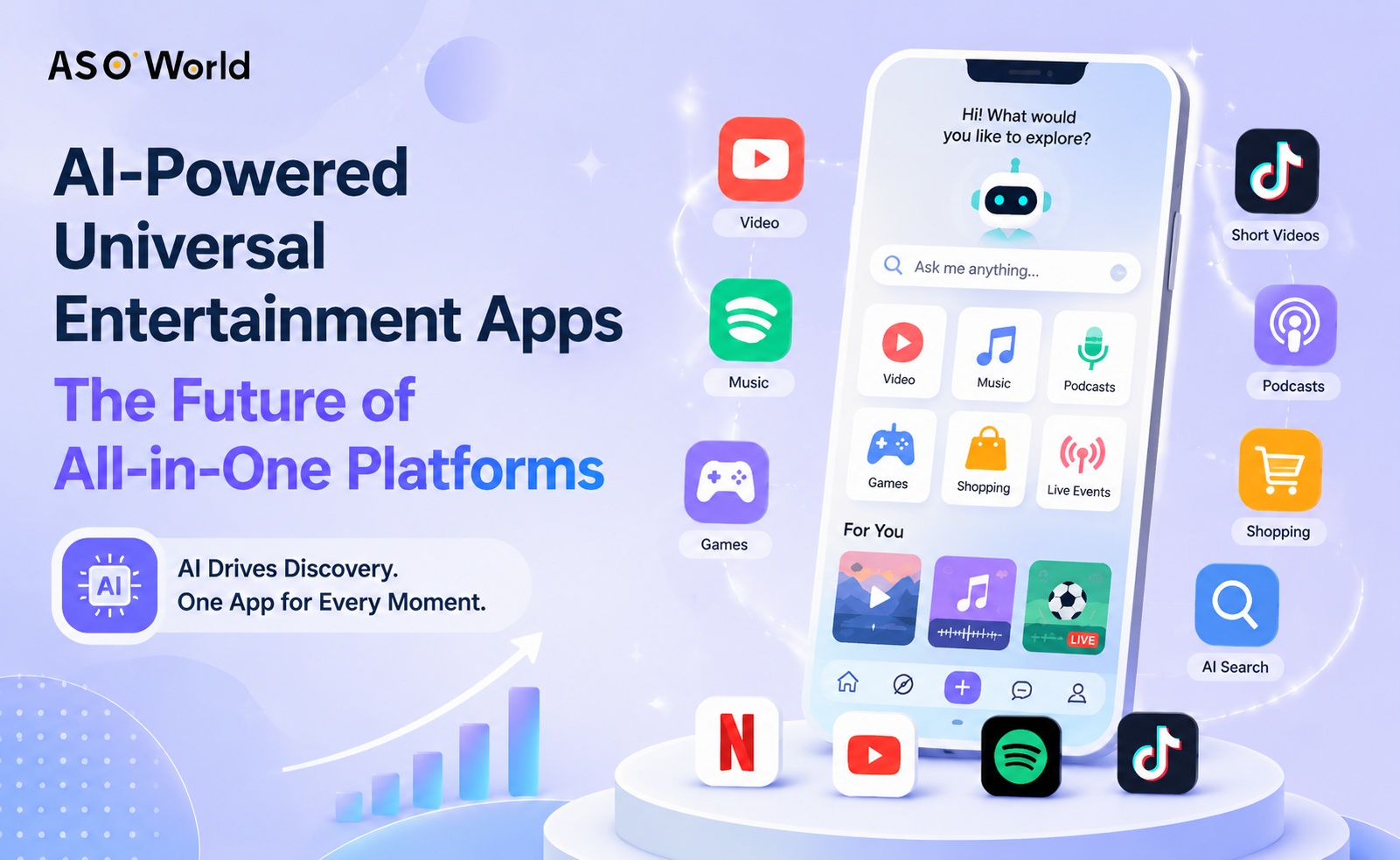

As major platforms blur the lines between video, music, podcasts, games, shopping and search, AI is becoming the engine behind a new generation of all-in-one entertainment apps.
The next major competition in consumer apps may not be about which platform owns short video, streaming music, podcasts or mobile games. It may be about which app becomes the default place users go whenever they have free time.
A recent report highlights a growing trend among Netflix, Spotify, YouTube and TikTok: entertainment platforms are no longer staying inside one content category. Instead, they are expanding into multiple formats, using AI to recommend, produce, organize and monetize content across the entire user journey.
For app developers and app marketers, this shift is more than a media industry story. It signals a broader change in user acquisition, retention and app discovery: the most powerful consumer apps are becoming “attention operating systems.”
Entertainment Apps Are Converging Across Formats
For years, entertainment apps had clear identities. Netflix was for long-form video, Spotify was for music, YouTube was for creator videos and TikTok was for short-form social entertainment.
That separation is fading.
Netflix has moved beyond movies and TV into games, live events, sports-related content, short video and podcasts. Spotify has expanded from music into podcasts, video podcasts, audiobooks, social features, messaging, narrated articles and even physical book sales. YouTube now spans Shorts, podcasts, music, live streams, movies, TV, shopping, sports and AI-powered search. TikTok has added longer videos, shopping, local discovery, travel planning, event ticketing and standalone apps for microdramas and cultural events.
The direction is clear: the winning app is no longer just the best app for one content type. It is the app that can keep users inside its ecosystem across many moments of intent.
Why AI Is Accelerating the Universal App Trend
AI is making this convergence faster for three reasons.
1. AI improves cross-format recommendations
When an app contains music, video, podcasts, games, shopping and live content, discovery becomes complicated. AI helps platforms understand user behavior across formats and recommend the next piece of content more effectively.
This matters because entertainment platforms are now competing for total time spent, not just category leadership. If AI can move a user from a short video to a podcast, from a podcast to a product page, or from a show clip to a live event, the platform increases both engagement and monetization opportunities.
2. AI lowers the cost of content creation and product expansion
Generative AI tools are helping creators produce videos, images, voiceovers, subtitles, translations and promotional assets faster. At the platform level, AI-assisted development may also speed up experimentation with new content formats and app features.
That gives large platforms an advantage: they can test more surfaces, launch more creator tools and personalize more experiences without relying only on manual curation.
3. AI turns search into a discovery layer
Entertainment discovery is becoming more conversational. Instead of typing keywords or scrolling endlessly, users may increasingly ask AI assistants what to watch, listen to, buy or play next.
This changes how apps compete for visibility. Search is no longer limited to app stores or traditional search engines. Discovery can happen inside YouTube, TikTok, Spotify, Netflix or AI-powered recommendation interfaces.
What This Means for App Developers
For developers building consumer apps, the rise of universal entertainment platforms creates both risk and opportunity.
The risk is that large platforms may absorb more user attention, making it harder for standalone apps to win daily engagement. If users can watch, listen, shop, search, chat and play inside one app, smaller apps need a sharper reason to exist.
The opportunity is that niche apps can still win by offering deeper utility, stronger communities, better personalization or specialized content that large platforms cannot serve well. AI can help smaller teams compete by improving onboarding, recommendations, content generation, localization and lifecycle marketing.
Developers should pay close attention to three product questions:
- Can the app support multiple user intents? A fitness app, for example, may combine video, audio coaching, community, commerce and AI planning.
- Can AI reduce friction? AI can help users find the right content, complete tasks faster or receive more personalized guidance.
- Can the app create a habit loop? The strongest apps give users a reason to return daily, not only when they need one specific feature.
What This Means for App Marketers
For app marketers, the universal app trend changes the logic of acquisition and retention.
Traditional app marketing often focuses on a single core value proposition. But as users become accustomed to apps that serve multiple needs, marketers may need to communicate broader value without losing clarity.
For example, an entertainment app should not only market its content library. It may need to highlight personalization, creator access, community, exclusive formats, AI-powered discovery and cross-device experiences.
ASO and paid user acquisition strategies should also reflect this shift. Keywords around “AI recommendations,” “personalized entertainment,” “short videos,” “podcasts,” “live events,” “creator tools,” “social shopping” and “content discovery” may become increasingly relevant depending on the app category.
The New Competitive Metric: Share of Attention
The biggest platforms are no longer only optimizing for downloads. They are optimizing for share of attention.
This means app marketers should look beyond installs and cost per acquisition. Retention, session depth, content consumption, repeat engagement, subscription conversion and ad monetization are becoming more important indicators of long-term growth.
AI strengthens this model because it allows platforms to personalize the experience at scale. The more content formats an app supports, the more behavioral data it can collect. The more data it collects, the better its recommendations become. That creates a powerful retention loop.
Bottom Line
The rise of AI-powered universal entertainment apps suggests a major shift in the app economy. Netflix, YouTube, TikTok and Spotify are not simply adding new features. They are trying to become default destinations for entertainment, discovery, social interaction and commerce.
For app developers, the message is clear: single-purpose apps must become more intelligent, more personalized and more habit-forming. For app marketers, the challenge is to position apps not only around features, but around ongoing user attention and intent.
As AI reshapes how users discover and consume content, the next growth battle will not be won only in the app store. It will be won wherever users decide what to watch, hear, buy, play or explore next.

 Follow Us on Facebook
