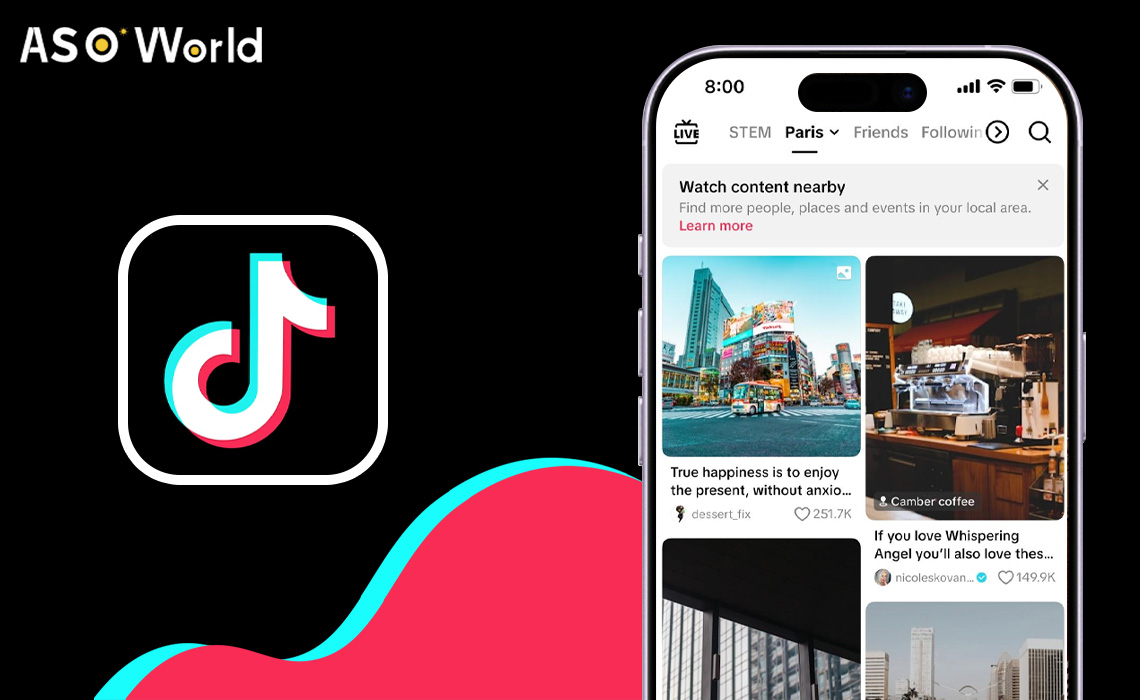

TikTok has launched a new feature called Nearby Feed, enabling users to explore videos from their immediate surroundings.
This update focuses on real-time local content, such as restaurants, events, and attractions, marking a shift toward practical, location-based discovery on the platform.
Feature Mechanics and User Experience
The Nearby Feed appears as a dedicated tab on the app's home screen, labeled with the user's current location, like "Nearby in London."
It curates public videos based on location, topic relevance, and recency to ensure fresh recommendations.
Key Factors in Content Selection
Videos are prioritized using geo-tags, user interests in areas like travel or food, and recent postings.
Users can opt to share more precise location data for better personalization, though this remains voluntary.
Restrictions and Safeguards
The feed excludes content from users under 18, private accounts, or posts limited to friends.
This helps maintain appropriate visibility while promoting hyper-local experiences, such as spotting a viral cafe or festival nearby.
Initial Rollout and Geographic Focus
The feature debuted on December 4, 2025, starting in four European countries: the United Kingdom, France, Germany, and Italy.
It targets major cities like London, Paris, Berlin, and Rome, with progressive availability via app updates for users aged 18 and older.
Historical Development
TikTok tested similar location-based tools in Southeast Asia since 2022, including integrations with e-commerce.
The European launch builds on these trials, adapting to strict data regulations like GDPR for broader appeal.
Business and Community Impacts
This feed boosts visibility for small businesses and local creators by surfacing organic content without ads.
Studies show nearly half of UK TikTok users visit spots seen on the app, potentially increasing foot traffic and economic activity in post-pandemic recovery.
Strategic Advantages
It aligns with trends where young users prefer social platforms for local searches over traditional engines.
By enhancing discovery commerce, TikTok positions itself against rivals like Instagram and Snapchat, fostering deeper engagement and retention.
Privacy Considerations and Challenges
While innovative, the feature relies on location services, raising concerns about data exposure.
TikTok offers opt-in controls and exclusions to mitigate risks, but critics highlight potential issues like unintended location sharing in privacy-focused regions.
Public Reactions
Feedback on platforms like X varies, with some praising the real-time utility for travelers and food enthusiasts, while others question its impact on personal privacy amid ongoing debates about data handling.
Editor's Comments
This launch strengthens TikTok's role in blending entertainment with everyday utility, echoing broader industry moves toward localized digital ecosystems.
Given competition from features like Snapchat's Snap Map, it could accelerate TikTok's growth in e-commerce and search.
However, success depends on building user trust amid regulatory scrutiny, with a potential U.S. expansion in 2026 facing hurdles from data privacy laws and geopolitical tensions.

 Follow Us on Facebook