
HYROX is everywhere right now: sold-out arenas, finish-line videos, bib photos, and social feeds full of sled pushes, wall balls, and exhausted athletes celebrating at the end.
It is easy to see why the sport has gone viral. The format is simple, the event looks intense, and the content is highly shareable. But behind the growth story, one number stands out: 43%.
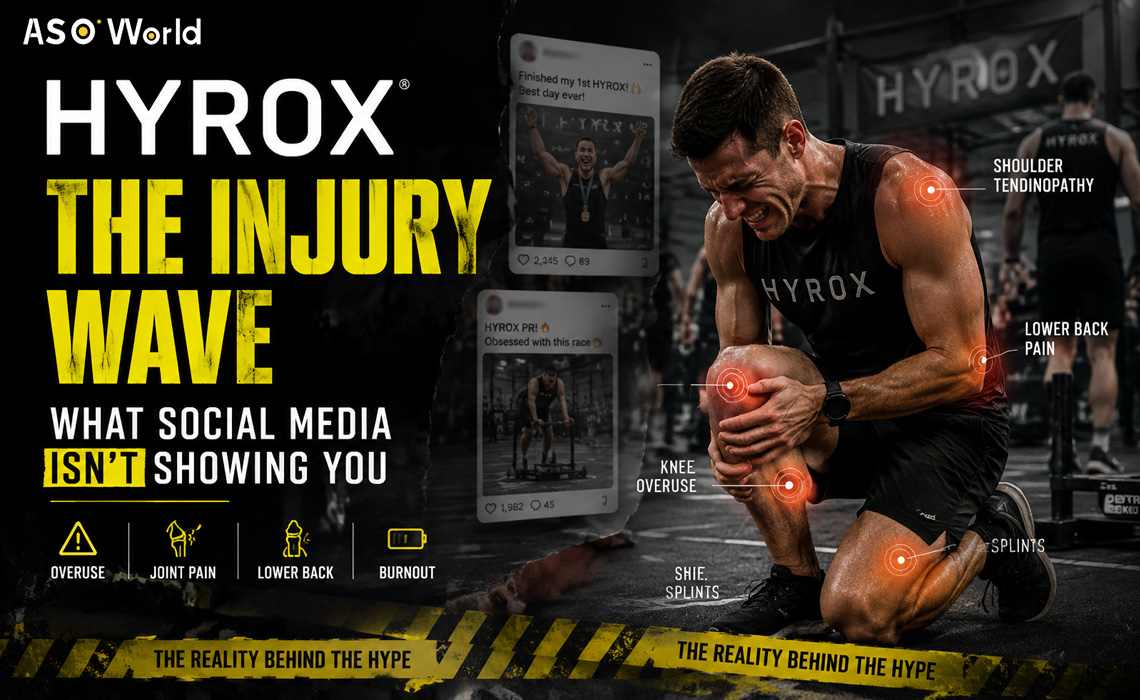
According to a 2025 peer-reviewed study published in Applied Sciences, 43% of active HYROX athletes surveyed reported sustaining an injury during training or competition. Most were overuse injuries, including tendon pain, joint irritation, and soft tissue problems.
A Sport Growing Faster Than Many Bodies Are Ready For
HYROX launched in Hamburg in 2017 with just 650 participants. By 2024, participation had grown to more than 650,000 athletes globally. For the 2025/26 season, estimated participation has reached around 1.3 to 1.5 million athletes.
Events are now held in more than 30 countries, with major cities selling out quickly. London uses a ballot system, New York sold out in minutes, and Shanghai has drawn more than 10,000 athletes for a single event.
The commercial side has expanded just as quickly. HYROX now has thousands of affiliated gyms, major brand partnerships, and a growing ecosystem of coaching, footwear, apparel, travel, and race-day media packages.
But one issue keeps coming up: many participants are new. Around 70% of HYROX racers are first-timers, and many are over 30, often returning to structured competition after years away from sport.
The Race Looks Accessible, But It Is Not Easy
HYROX is marketed as accessible, and in some ways it is. The format is standardized: 8 kilometers of running, broken up by functional fitness stations such as sled push, sled pull, rowing, farmer’s carry, lunges, SkiErg, burpee broad jumps, and wall balls.
But accessible does not mean low stress on the body.
A 2025 study in Frontiers in Physiology found that athletes in a simulated HYROX event sustained an average heart rate of about 171 bpm, with blood lactate levels reaching 8.5 mmol/L during the functional stations.
In plain terms: this is not just a fun fitness challenge. It is a long, high-intensity effort performed under fatigue.
Where Injuries Tend to Show Up
The most common problem is not usually a dramatic race-day accident. It is load building up over time.
- Knees: repeated running, lunges, and wall balls can increase tendon and joint stress.
- Lower back: sled push, sled pull, and farmer’s carry place heavy demand on spinal stability.
- Shoulders: SkiErg and wall balls can expose poor overhead mechanics under fatigue.
- Feet and ankles: rapid increases in running volume may lead to shin splints or plantar fasciitis.
The Real Problem May Be Preparation
The concern is not that HYROX is inherently too dangerous. The bigger issue is that social media often makes the event look more straightforward than it really is.
A common pattern is easy to imagine: someone sees a finish-line video, signs up, starts training hard, treats every session like race day, and then gets injured a few weeks before the event.
Researchers have also noted that recovery strategies among HYROX athletes are often inconsistent or insufficient. That matters because most overuse injuries come from the same basic equation: too much volume, too much intensity, and not enough recovery.
HYROX Is Starting to Respond
To its credit, HYROX appears to be taking athlete welfare more seriously. The organization has launched a Sports Science Council, increased race-day medical support, and supported more systematic injury data collection.
There has also been discussion around judging standards and movement quality, including testing AI tools for wall-ball judging. These changes suggest the sport is trying to professionalize as quickly as it is growing.
Final Thought
HYROX can absolutely be a positive fitness goal. It can build endurance, strength, confidence, and community. But the benefits come from the training process, not from simply buying a race ticket.
The finish-line photo is real. The sense of achievement is real. But so is the injury data.
For first-time athletes especially, the message is simple: build slowly, follow a structured plan, respect recovery, and do not let social media set your training pace.

 Follow Us on Facebook