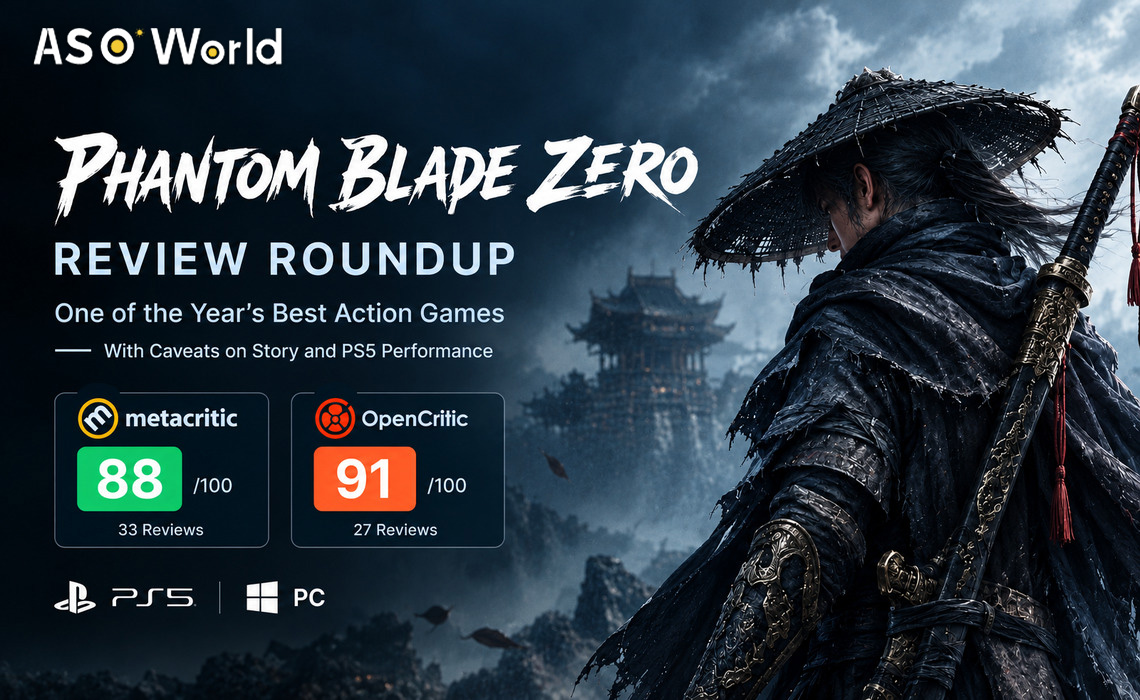

Chinese studio S-Game's Phantom Blade Zero has arrived in the review cycle as one of 2026's strongest action releases. With reviews going live on October 26, 2026, the game holds an 88 on Metacritic and a 91 on OpenCritic, with almost every early review positive. It launches on PC and PlayStation 5 on October 29 (unlocking from 10 p.m. ET on October 28) at $59.99.
Below is a clear summary of what critics are praising, where opinion splits, how the game performs on each platform, and who should buy it at launch. Scores are early and may shift slightly as more reviews arrive.
Key Takeaways
- Scores: 88 on Metacritic from 33 reviews and 91 on OpenCritic from 27 reviews at the time of writing. Of 31 Metacritic reviews checked, 30 are positive, one is mixed and none are negative.
- Biggest strengths: The parry-and-counter combat, multi-phase boss fights and a wide weapon arsenal.
- Common criticisms: Repetitive regular enemies, a divisive story and uneven console performance.
- Platform advice: PC runs well, PS5 has some frame drops, and Steam Deck is not recommended.
- Not a Soulslike: There is no stamina bar, deaths carry no penalty, and difficulty can be changed at any time.
The Scoreboard
| Aggregator | Score | Reviews counted |
|---|---|---|
| Metacritic | 88 | 33 |
| OpenCritic | 91 | 27 |
The score opened higher, around 91, before settling at 88 within hours as more reviews came in. Big launches commonly drift by a point or two during the first week. Several outlets scored the game 9 or 10 out of 10, and only a small number landed at 8 out of 10.
Game Snapshot
| Detail | Info |
|---|---|
| Developer | S-Game (China) |
| Platforms | PC and PlayStation 5 |
| Release date | October 29, 2026 (unlocks 10 p.m. ET, October 28) |
| Price | $59.99 |
| Length | About 25 to 30 hours for the main story; 40 to 50 hours with most side content |
| Difficulty | Wayfarer, Pathbreaker and Hellwalker, switchable at any time |
| Genre | Wuxia-inspired "kungfupunk" action game |
What Critics Agree On
Combat is the star
Reviewers are close to unanimous that the fighting is the game's strongest feature. It is built around parrying, countering and chaining attacks without a stamina bar, and the camera and animation make fights look like martial arts cinema. Players direct the action through each weapon's specific inputs, so careful play looks and feels far better than button mashing.
The arsenal is large. The game offers around 30 main weapon types and roughly 25 special Phantom Edges, which are powerful limited-use tools. Upgrades unlock new abilities, and weapons can be refunded, so players are encouraged to experiment. Builds range from drunken-style fighters whose range and damage change with their state, to bleed builds, elemental storms and fist-focused play.
Bosses and exploration
Boss fights are the second most praised element. They are multi-phase, each phase introduces new tricks, and the game places a checkpoint between phases, so dying in a later phase does not send players back to the start of the fight. Critics say this makes tough encounters feel fair without reducing the challenge.
The interconnected world earns similar praise. Open regions, shortcuts, hidden bosses and gated paths reward players who leave the main route, and optional paths consistently lead to useful rewards.
Presentation
- Visuals: Detailed environments, lifelike faces and motion-captured martial arts drew praise.
- Audio: The soundtrack mixes traditional Chinese instruments with rock, metal and electronic tracks, some synchronised to boss fights.
- Voice acting: Chinese performances are widely preferred. Several reviews call the English dub stiff and suggest playing in Chinese with subtitles.
Where Reviews Split
| Area | What some critics liked | What others criticised |
|---|---|---|
| Story and pacing | An engaging revenge plot with a strong ending | Confusing, thin, or the weakest part of the game |
| Regular enemies | Fast, spectacular fights even against basic foes | Mob fights repeat late in the game, and shielded or armoured enemies slow the pace |
| Enemies stay dead | Cleared areas make progress feel earned | Empties the world and limits practice or farming |
| Performance | Strong results on PC | Frame drops on PS5; major problems on Steam Deck |
Performance by Platform
| Platform | Verdict | Details |
|---|---|---|
| PC | Runs well | Shaders compile on first launch. One test measured around 100 fps at 4K on high settings with DLSS Quality on an RTX 4080. Traversal stutter is rare, and ray tracing is costly. |
| PS5 | Some issues | Performance mode mostly holds 60 fps but drops in the rainy Pangzhen region and during some boss fights. Graphics mode struggles on the base console, while PS5 Pro gets three modes. |
| Steam Deck | Avoid for now | Testing found it under 30 fps at the lowest settings, with dips near 10 fps and a battery life of about two to two and a half hours. |
Is It a Soulslike?
Not really. The game borrows ideas such as challenging bosses, interconnected levels and Phantom Bell checkpoints that work like bonfires. But there is no stamina bar, death carries no penalty, bosses resume from the phase where the player died, accessories can widen the parry window, and difficulty can be changed at any time. A post-game mode, 66 Days, adds a cap of 66 deaths for players who want the opposite experience.
Who Should Buy It?
| Player type | Recommendation |
|---|---|
| Fans of parry-heavy boss fights and flexible builds, on PS5 or a mid-range or better PC | Buy at launch |
| Base PS5 players sensitive to frame drops, or anyone who needs a story that lands | Consider waiting for patches or more reviews |
| Steam Deck owners, or players wanting a true open world or deep narrative | Skip for now |
Why It Matters Beyond the Score
This section is ASOWorld's editorial analysis, not a statement from S-Game.
Phantom Blade Zero is the first console and PC release in a franchise that began on mobile, where earlier Phantom Blade games reportedly reached more than 20 million players in China. Its reception adds to a growing wave of ambitious Chinese action titles following Black Myth: Wukong, and it enters the awards conversation weeks before Grand Theft Auto VI arrives on November 19.
For the games industry, the lesson is that mobile-born studios can build high-end, premium experiences and win critical acclaim, and that a successful console launch can bring renewed attention to a franchise's mobile titles.
For more coverage of game launches and industry trends, browse the Gaming section on Marketing Trending.
📱 App Marketing Angle
Big console and PC releases often lift interest in a franchise's mobile games and in similar action titles on phones. Mobile publishers can prepare for launch-week search spikes by refreshing store listings, screenshots and keywords around genre terms such as martial arts, action RPG and wuxia. See how ASOWorld's gaming app marketing solutions help games turn launch-week attention into rankings, installs and revenue.
What to Watch Next
- Final scores. More reviews, including from outlets still finishing the game, could move the averages.
- Day-one and early patches. PS5 frame rates and Steam Deck performance are the main areas to watch.
- Player reception. User scores will show whether repetitive enemies and the story matter as much to players as they do to some critics.
- Awards season. The game's strong start puts it in early Game of the Year conversations, with a crowded release calendar still ahead.
Quick Answers: Phantom Blade Zero
When does Phantom Blade Zero come out?
October 29, 2026 on PC and PlayStation 5, unlocking from 10 p.m. ET on October 28.
How much does it cost?
$59.99 on both PC and PS5.
What are the review scores?
Around 88 on Metacritic and 91 on OpenCritic at the time of writing, with almost all reviews positive.
How long is it?
About 25 to 30 hours for the main story and 40 to 50 hours with most side content.
Is Phantom Blade Zero a Soulslike?
Not really. It has no stamina bar, no penalty for dying, and difficulty can be changed at any time.
Does it run on Steam Deck?
Not well. Testing found it stuck under 30 fps even at the lowest settings.

 Follow Us on VK