
On December 11, 2025, OpenAI officially released GPT-5.2, a major upgrade focused on professional reasoning, coding, long-context handling, and multimodal inputs.
The launch follows an internal "code red" initiative to accelerate development amid strong competition from Google's Gemini 3.
GPT-5.2 delivers higher benchmark performance and deeper integration across tools and workflows.
What is ChatGPT-5.2
GPT-5.2 is the latest large language model series from OpenAI, integrated into ChatGPT and available via API.
It builds on GPT-5 and GPT-5.1 with three variants: Instant for fast responses, Thinking for complex reasoning and structured work, and Pro for maximum accuracy on research and professional tasks. Rollout began December 11 for paid subscribers and developers.
Key enhancements include improved reasoning and generalization, stronger support for images and long documents, better tool execution, and reduced factual errors.
(Source: OpenAI)
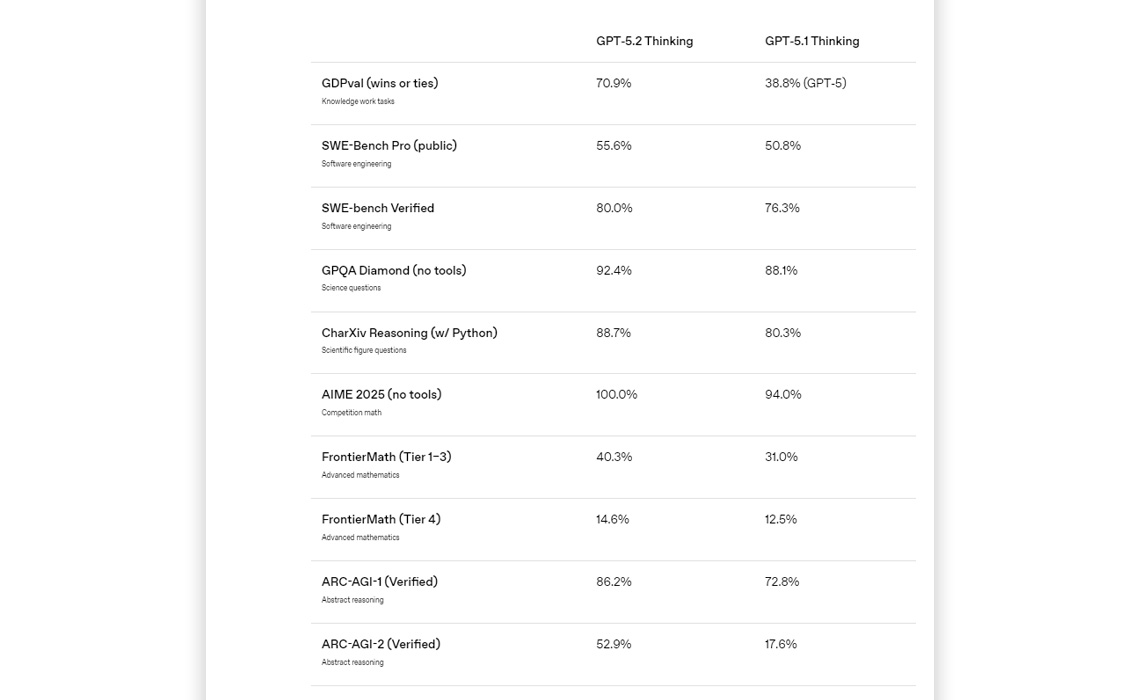
GPT-5.2 sets new state-of-the-art scores on benchmarks such as GDPval, where it matches or exceeds human professional performance on many tasks across 44 occupations.
OpenAI also announced a major partnership with The Walt Disney Company: a $1 billion investment and a three-year licensing deal for over 200 Disney, Pixar, Marvel, and Star Wars characters and worlds to be used in Sora, OpenAI's AI video platform.
Disney will deploy OpenAI tools across its workforce and creative workflows.
Performance Highlights
GPT-5.2 excels in professional benchmarks. The Thinking variant achieved top marks on GDPval, outperforming human experts across many well-specified knowledge work tasks.
It demonstrates strong gains in software engineering benchmarks (SWE-Bench Pro) and improved scores on reasoning evaluations like GPQA and ARC-AGI.
Internal testing also highlights sharper outputs in specialized domains, such as scientific reasoning and complex planning.
Compared with GPT-5.1, GPT-5.2 shows reductions in hallucination rates and stronger structured responses for workflows like coding, data analysis, and multi-step project management.
Safety improvements include more accurate handling of sensitive content, improved de-escalation in mental health scenarios, and ongoing age prediction testing with plans for a dedicated "adult mode" in early 2026.
Cost & Accessibility
GPT-5.2 is available to ChatGPT paid users and developers via API. Users on subscription plans can access different model levels, with higher tiers gaining expanded usage and capabilities.
API pricing is set per million input and output tokens, with discounts for cached prompts.
Comparison to Other AI Models
| Model | Context Window | Intelligence | Price (USD/1M Tokens) | Output tokens/s | Latency |
| ChatGPT-5.2 |
400k
|
73
|
$1.75
|
119 | 33.84 |
| ChatGPT-5.1 |
400k
|
70
|
$3.44
|
103
|
29.12
|
| Gemini 3 Pro |
1m
|
73
|
$4.50
|
112
|
36.57
|
| Claude Opus 4.5 |
200k
|
70
|
$10.00
|
67
|
2.16
|
(Source: Artificial Analysis - LLM Leaderboard)
GPT-5.2 positions itself against competitors such as Google's Gemini 3 and Anthropic's Claude.
OpenAI claims leading performance in reasoning, coding, and long-context handling, though competitors remain strong in vision tasks and ecosystem integration.
Gemini 3's rapid adoption and integration across Google products emphasize the competitive landscape driving the GPT-5.2 release.
Industry and Market Context
The GPT-5.2 release fits into a phase of rapid model acceleration across the sector. OpenAI is tightening its focus on core model quality, long-context performance, and strategic alliances while competitors scale aggressively through ecosystem integrations and free access models.
Enterprises are broadening AI adoption for day-to-day workflows, shifting from experimentation to deployment.
Surveys indicate rising executive confidence in AI-driven productivity gains, even as organizations continue to weigh automation risks and workforce impact.
Editor's Comments
OpenAI's swift GPT-5.2 rollout signals a defensive pivot in the AI arms race, blending technical refinements with strategic alliances like the Disney deal to fuel content innovation and revenue.
While benchmarks show promise for workplace efficiency, sustained user retention will hinge on addressing slowdowns and over-refusals highlighted in community discussions.
By mid-2026, expect deeper multimodal leaps via Sora integrations and personalized agents, potentially stabilizing OpenAI's lead as competitors like Google scale infrastructure investments.

 Follow Us on Facebook