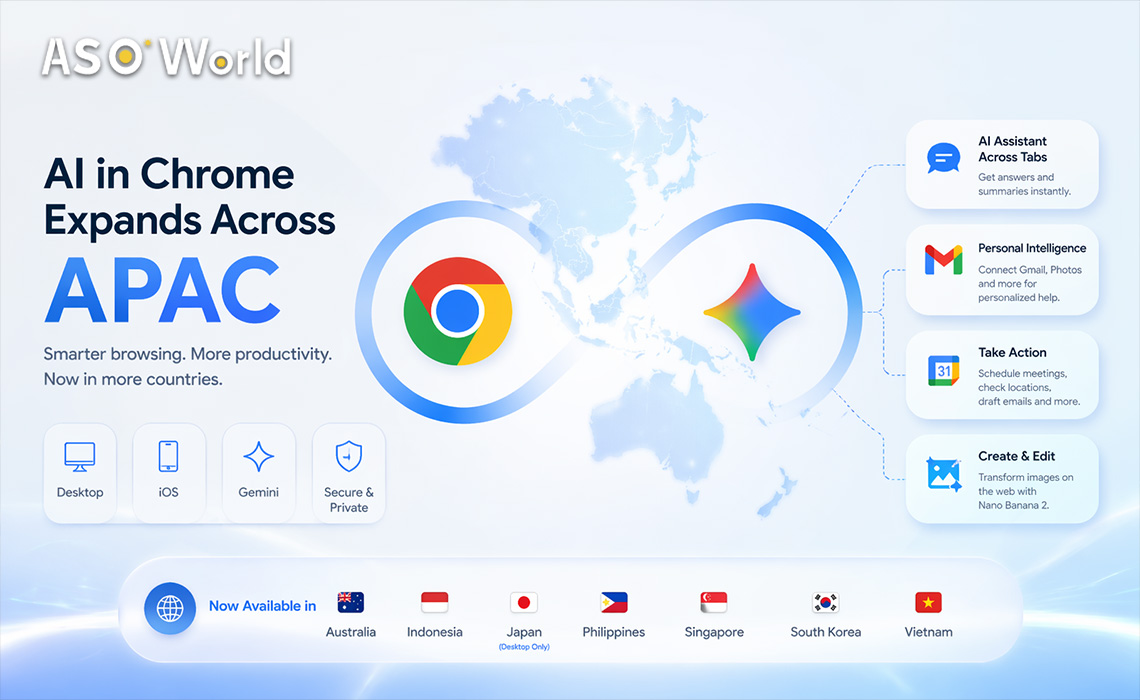

Google has officially launched its Gemini AI integration in Chrome across key Asia-Pacific (APAC) countries, including Australia, Indonesia, Japan, the Philippines, Singapore, South Korea, and Vietnam. The rollout is available on desktop and iOS platforms—except for Japan, where iOS access is still pending. This expansion follows previous launches in the U.S., India, Canada, and New Zealand, marking a significant step in Google’s global AI strategy. By embedding AI directly in the browser, Google is changing the way users interact with productivity tools and digital content, with direct implications for app discovery, downloads, and market trends.
Gemini in Chrome Launch
The Gemini rollout introduces a set of integrated AI features that allow users to:
- Access a sidebar-based assistant across multiple tabs
- Draft emails via Gmail and schedule meetings in Google Calendar
- Retrieve location details using Google Maps
- Manage personal content in Google Photos
- Edit images on web pages through Nano Banana 2
These features mean users can perform tasks traditionally handled by standalone apps directly in Chrome, potentially affecting search volume and app store visibility for similar AI and productivity apps.
Regional Significance
APAC is a fast-growing digital market. Mobile app adoption is rising, with Southeast Asia in particular showing strong growth in productivity and AI-driven tools. Early adoption of Gemini in Chrome signals shifting user behavior: users may increasingly rely on integrated browser AI for routine tasks, reducing engagement with standalone apps.
Why This Matters
This is more than a product release; it signals a shift in user behavior. Users in APAC are now able to access AI functionality directly in Chrome, reducing reliance on separate apps for routine productivity tasks.
Market Implications and Data Trends
Even without precise download numbers, industry signals suggest:
- Keyword competition will increase for generic AI assistant terms in app stores
- User acquisition patterns may shift from apps to browser-integrated tools
- Emerging markets present opportunities for apps that localize features and leverage high-growth regions
Productivity Apps Under Pressure
Features like scheduling, email drafting, and image editing within Chrome reduce the need for lightweight productivity apps. Developers of these apps may experience slower growth unless they adapt with:
- Niche-specific or vertical functionality
- Workflow-specific enhancements
- Integration with other platforms to complement browser AI
Early Data Signals
Past regional rollouts (U.S., India, Canada, New Zealand) suggest early adoption in APAC could boost engagement with AI tools while slightly depressing downloads for standalone competitors in overlapping categories. Monitoring trends in user engagement, retention, and search visibility will be crucial for developers.
Comments
Google’s APAC rollout of Gemini in Chrome represents a key milestone for browser-integrated AI. While it may disrupt some standalone apps, it also opens opportunities for developers to innovate, localize, and optimize for emerging markets. Success will depend on understanding shifts in user behavior and proactively adapting app strategies.
FAQs
What is Gemini in Chrome?
An AI-powered browser assistant that enables cross-tab queries, email drafting, scheduling, and image editing.
Which APAC countries are included in the rollout?
Australia, Indonesia, Japan, the Philippines, Singapore, South Korea, and Vietnam.
How does this affect AI productivity apps?
Standalone apps may face increased competition; differentiation through vertical or workflow-specific features is key.
What should developers focus on to adapt?
Optimize keywords, localize content, innovate features, and monitor adoption trends for growth opportunities.

 Follow Us on Facebook