
Live-service games are no longer competing on content volume alone. For years, many gacha and mobile titles relied heavily on power progression, limited banners, and event cadence to sustain engagement. But increasingly, the strongest retention systems are being built around emotional continuity — recurring characters, serialized storytelling, and community attachment that extends beyond gameplay mechanics.
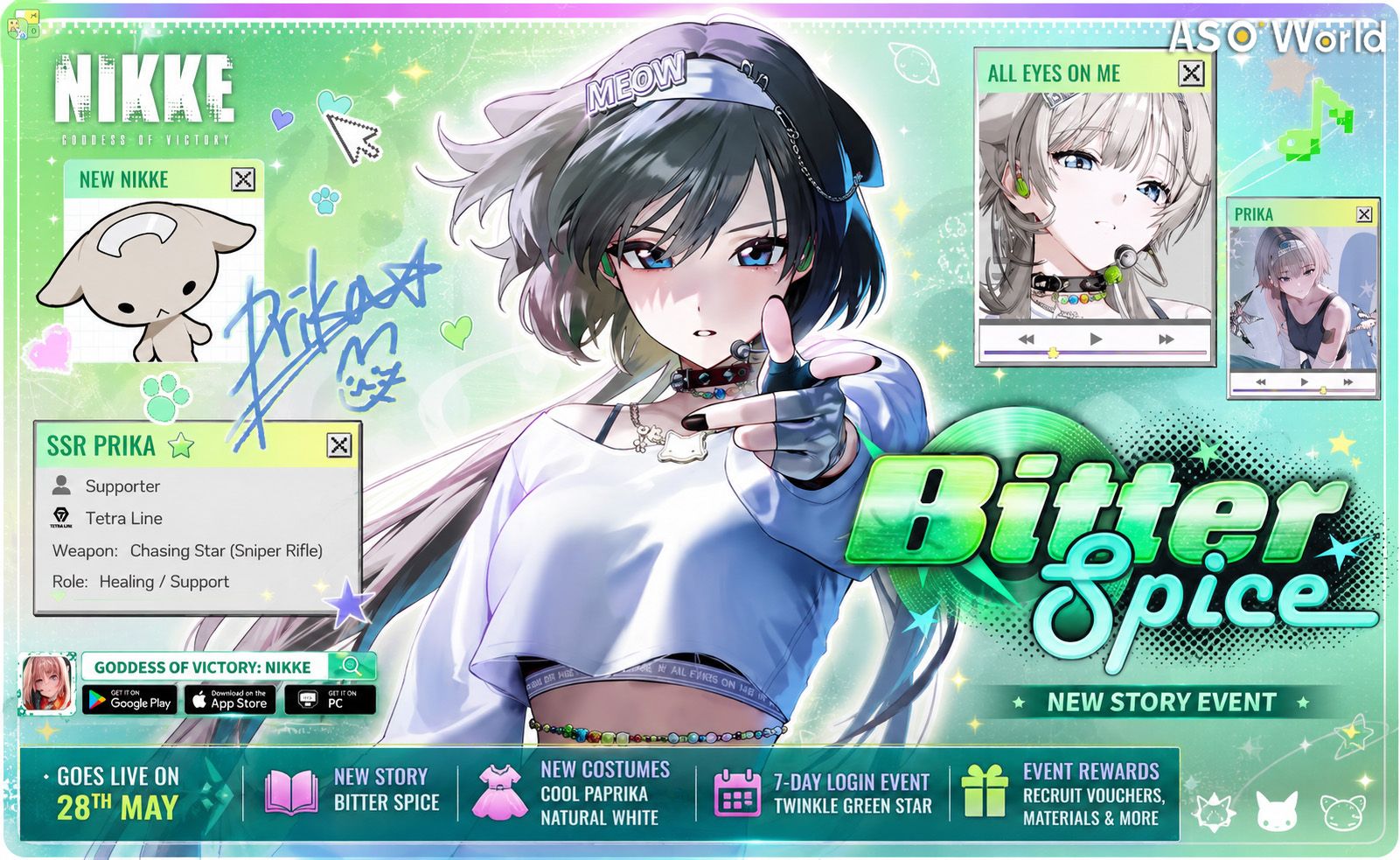
SHIFT UP’s latest Goddess of Victory: NIKKE update, “Bitter Spice,” is a strong example of that evolution in action. On the surface, the update introduces SSR Prika, a new event storyline, costumes, login rewards, and additional progression content. But from a game design and live-service strategy perspective, the more interesting story is how NIKKE continues turning character arcs into long-term engagement infrastructure.
The“Bitter Spice” Update Continues NIKKE’s Idol Narrative Expansion
The headline addition in the update is SSR Prika, a Supporter-class Nikke affiliated with Tetra Line and the idol group T.T. STAR. She uses the sniper rifle “Chasing Star” and specializes in healing and sustain-focused support mechanics.
The update’s central content, however, is the new BITTER SPICE story event. Following Anis’ departure from T.T. STAR, Mint and Prika attempt to continue idol promotions while dealing with mounting pressure, internal conflict, and creative disagreements.
Mechanically, the event follows a familiar NIKKE structure:
- Story stages
- Challenge stages
- Event currency exchange
- Login campaigns
- Costume monetization
- Limited-time recruitment banners
But the emotional framing around the content is what stands out. Rather than presenting the update as an isolated event, SHIFT UP continues building a serialized narrative ecosystem around T.T. STAR. Previous storylines involving Star Anis, Mint, and Prika are now functioning as interconnected engagement loops rather than standalone character releases. That distinction matters for live-service retention.
NIKKE Is Converting Narrative Investment Into Retention Infrastructure
One of the most noticeable trends across modern gacha games is that emotional continuity increasingly drives player retention more effectively than pure gameplay expansion.
NIKKE originally built its audience through visual presentation, combat systems, and character collection mechanics. However, recent updates suggest SHIFT UP is leaning more heavily into long-term narrative attachment as a core engagement strategy. The T.T. STAR storyline is a strong example.
Instead of treating characters as banner rotation assets, the game continuously evolves relationships, conflicts, and emotional stakes across multiple updates. This creates ongoing community discussion cycles that persist even outside active gameplay sessions. From a developer perspective, this approach has several important advantages:
1. Narrative Extends Event Lifecycles
Traditional live-service events often lose momentum shortly after launch. Serialized storytelling extends engagement windows because players remain invested in unresolved character arcs between patches.
The discussion surrounding Prika’s release began long before the actual update launched, largely because the storyline had already built emotional anticipation across previous events.
2. Character Continuity Strengthens Community Retention
Games with strong narrative continuity generate more fan discussion, theory crafting, social sharing, and creator content. This creates additional retention layers outside the game client itself.
In NIKKE’s case, T.T. STAR story developments have consistently generated discussion across Reddit, X, YouTube, and community forums.
3. Emotional Investment Improves Monetization Efficiency
Players are generally more willing to spend on characters they feel emotionally connected to rather than purely meta-relevant units.
Costumes, passes, and premium cosmetics become significantly more effective monetization layers when attached to ongoing character arcs players actively follow. The “Cool Paprika” costume strategy inside Bitter Spice reflects this model clearly.
The Update Also Reflects a Larger Shift in Gacha Design
NIKKE’s current direction mirrors a broader industry-wide evolution happening across live-service games. Earlier generations of mobile gacha titles often relied on aggressive content velocity, rapid power escalation, and banner frequency to sustain revenue. While those systems still exist, many successful games are now prioritizing emotional persistence over pure content density.
This shift can also be seen across titles like:
- Honkai: Star Rail
- Blue Archive
- Uma Musume Pretty Derby
- Zenless Zone Zero
These games increasingly structure updates around:
- long-term character arcs
- emotional progression
- social attachment
- fandom participation
- creator ecosystem engagement
For developers, this changes how live-service content should be evaluated. The most valuable update is no longer necessarily the one with the largest feature set. In many cases, the most effective content is the update that advances emotional continuity and keeps community conversation active between major patches. That is a fundamentally different retention philosophy from earlier mobile live-service design models.
Why This Matters for Game Developers
For developers building live-service games, NIKKE’s Bitter Spice update offers a useful case study in modern retention design.
The update itself is not mechanically revolutionary. Most of its systems — banners, challenge stages, event shops, seasonal passes — already exist across the genre.
What differentiates it is how effectively those systems are connected to ongoing emotional narratives. SHIFT UP is not simply shipping isolated character events. It is building persistent audience attachment through serialized storytelling that extends across multiple update cycles.
That approach creates several strategic advantages:
- stronger long-term retention
- higher social engagement
- more efficient cosmetic monetization
- better creator ecosystem activity
- sustained community discussion between patches
As competition inside the mobile and gacha market continues intensifying, emotional continuity may become one of the most important retention systems available to developers. In that environment, narrative design is no longer just worldbuilding. It is part of live-service infrastructure itself.
Final Thoughts
The Bitter Spice update may look like a standard character event on the surface, but its larger significance lies in how it reflects the changing priorities of modern live-service game design.
NIKKE continues demonstrating that long-term player retention increasingly depends on emotional persistence, recurring character investment, and narrative continuity rather than content quantity alone. For game developers, that may be the most important takeaway from the update.

 Follow Us on Facebook