
Key Points Summary
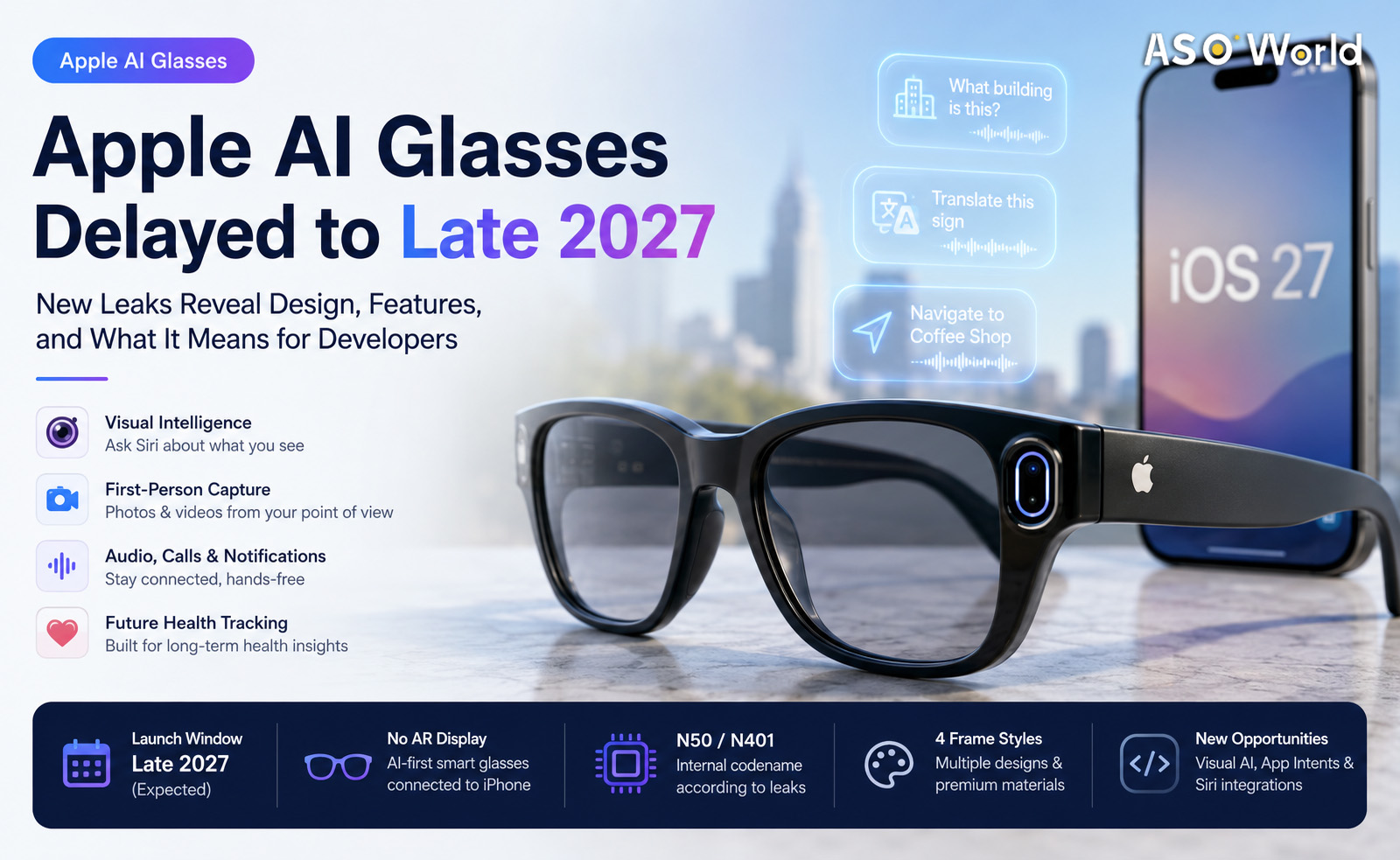
- Apple's first AI smart glasses are reportedly launching in late 2027, featuring Visual Intelligence, first-person photo/video capture, voice interactions, and deep integration with Apple Intelligence and the iPhone ecosystem.
- The device is expected to prioritize AI over AR, with no built-in display, premium acetate frames, multiple fashion-focused designs, and a distinctive camera system aimed at making smart glasses a mainstream wearable.
- For developers and growth teams, the bigger opportunity lies in AI-driven discovery, as Visual Intelligence and Siri could introduce new pathways for app discovery, service integrations, and intent-based user interactions beyond traditional search and ASO.
Apple's First AI Glasses Are Taking Shape
Apple's long-rumored smart glasses are reportedly still in development, but new details are giving the industry a clearer picture of what the company's first AI wearable may look like.
According to recent reporting from Bloomberg's Mark Gurman and multiple supply-chain sources, Apple's first AI smart glasses—internally known as N50 or N401—are now expected to launch in late 2027.
Unlike earlier expectations surrounding augmented reality, Apple's first-generation glasses are reportedly being designed as a lightweight AI companion focused on visual intelligence, voice interaction, and seamless integration with the iPhone ecosystem.
The reported timeline comes alongside claims that Apple's lower-cost Vision headset project, often referred to as Vision Air, may also be pushed back to a later release window.
No AR Display, Just AI
One of the biggest surprises from recent leaks is what Apple reportedly isn't including.
The first-generation glasses are not expected to feature any augmented reality display or visual overlays inside the lenses. Instead, the device will rely on cameras, microphones, speakers, and Apple Intelligence to create what sources describe as a "visual AI" experience.
Most processing is expected to be handled through a connected iPhone, allowing Apple to keep the glasses lightweight enough for everyday use.
This would make Apple's first smart glasses significantly different from the company's long-term AR ambitions and much closer to an AI-first wearable designed for daily life.
Visual Intelligence Could Become the Core Experience
At the center of the device is Apple's growing Visual Intelligence platform. The glasses are rumored to include dual cameras, including a dedicated computer-vision sensor that effectively acts as Siri's eyes.
Combined with future versions of Apple Intelligence, users could ask questions about what they're currently seeing, such as:
- "What building is this?"
- "Translate this sign."
- "What product am I looking at?"
- "What's the history of this landmark?"
Rather than searching manually, users would interact with their surroundings through natural language conversations with Siri. The goal appears to be creating an AI assistant that understands context in real time.
Built for First-Person Content Creation
The glasses are also expected to support first-person photo and video capture. Integrated cameras would allow users to record moments from their own perspective and instantly sync content with the Apple ecosystem for editing, storage, and sharing.
While Apple has yet to confirm these features, the functionality would align with the growing popularity of wearable cameras and creator-focused smart glasses.
Calls, Music, Navigation, and Notifications
Beyond AI features, the device is expected to function as an extension of the iPhone. Built-in microphones and speakers inside the temples would reportedly support:
- Hands-free phone calls
- Music playback
- Siri voice interactions
- Real-time notifications
- Walking navigation
- Voice-based controls
This approach allows Apple to deliver useful everyday functionality without the power and weight requirements of a full AR headset.
Future Versions May Add Health Features
Sources also suggest Apple sees smart glasses as a long-term health platform. While the first generation is expected to focus on AI and communication, future versions could incorporate:
- Activity tracking
- Motion sensing
- Head-position monitoring
- Additional wellness-related features
This would extend Apple's broader strategy of integrating health technologies across its hardware ecosystem.
Apple Is Reportedly Taking a Fashion-First Approach
Beyond the technology, Apple appears to be paying unusual attention to eyewear design. Instead of partnering with established eyewear brands, the company is reportedly developing the product entirely in-house and positioning it as a premium fashion accessory. The goal is simple: make smart glasses feel like normal glasses.
Premium Acetate Frames
According to supply-chain leaks, Apple is moving away from traditional plastic frames and testing premium acetate materials commonly used in high-end eyewear. Acetate offers a more refined finish, improved durability, and better comfort for all-day wear.
Four Frame Styles Under Testing
Reports suggest Apple is evaluating multiple frame designs rather than a single universal model. Current prototypes reportedly include: Large Rectangular Frame、Slim Rectangular Frame、Large Oval Frame、Small Oval Frame. The variety suggests Apple is treating eyewear more like fashion than traditional consumer electronics.
A Signature Apple Camera Design
Another interesting detail is Apple's reported camera design. Rather than using the circular camera cutouts commonly seen in competing smart glasses, Apple is reportedly testing a vertical oval-shaped camera module with a surrounding indicator light.
The indicator would alert nearby people whenever photo or video recording is active, helping address privacy concerns while creating a recognizable Apple design language.
Expected Colors
Additional neutral finishes may also be under consideration ahead of launch. Prototype colors reportedly include:
- Black
- Ocean Blue
- Light Brown
Why This Matters for Developers and Growth Teams
The most important takeaway from these leaks isn't the frame design or hardware specifications. It's Apple's apparent strategy. The company appears to be positioning Apple Intelligence as a new computing layer that sits between users and apps.
If iPhone was built around touch and Vision Pro around spatial computing, Apple's AI glasses may become the company's first truly context-aware device. The device understands what users are looking at, where they are, and what they're trying to accomplish in that moment. That shift could have significant implications for developers.
Visual Intelligence Could Become a New Discovery Channel
If Apple eventually opens Visual Intelligence capabilities to third-party developers, real-world objects and environments could become a new source of app discovery.
Imagine users saying:
- "Book a table at this restaurant."
- "Download this store's app."
- "Show me reviews for this product."
- "Open a bike-sharing service nearby."
Instead of searching through app stores, users could reach services directly through contextual AI interactions. For ASO and growth teams, this represents a potential new discovery surface that extends beyond traditional keyword-based search.
App Discovery May Shift Toward Intent Discovery
For more than a decade, app growth has largely revolved around search visibility. Users type keywords. Apps compete for rankings. AI changes that model. As conversational interfaces become more capable, users increasingly express goals rather than keywords.
Instead of searching for an app, they simply ask for an outcome. That shift creates a new optimization challenge. Developers may eventually need to focus not only on App Store visibility, but also on:
- App Intents
- Siri integrations
- Apple Intelligence compatibility
- Context-aware actions
- AI-driven service discovery
In other words, the future of app discovery may depend as much on understanding user intent as ranking for search terms.
Apple's Roadmap Signals a Bigger Industry Shift
Perhaps the clearest message from these reports is that Apple appears to be prioritizing AI wearables before true AR glasses. Rather than waiting for display technology to mature, Apple is reportedly focusing on a simpler combination of:
AI + Camera + Voice. That strategy mirrors broader industry trends. Across the technology sector, companies are increasingly exploring lightweight AI wearables as a more practical path toward next-generation computing. The race may no longer be about building the best AR headset. It may be about building the most useful AI assistant users are willing to wear every day.
What Developers Should Watch Next
Apple AI Glasses remain at least a year away from launch, and many details could still change. However, several questions are becoming increasingly important:
- Will Apple open Visual Intelligence APIs to developers?
- How deeply will Siri integrate with third-party apps?
- Can Apple Intelligence become a new app discovery layer?
- Will AI wearables create new opportunities for user acquisition and engagement?
The answers may ultimately matter more than the glasses themselves. Because if Apple succeeds, its first AI glasses won't simply introduce a new hardware category—they could reshape how users discover, access, and interact with apps across the Apple ecosystem.

 Follow Us on Facebook