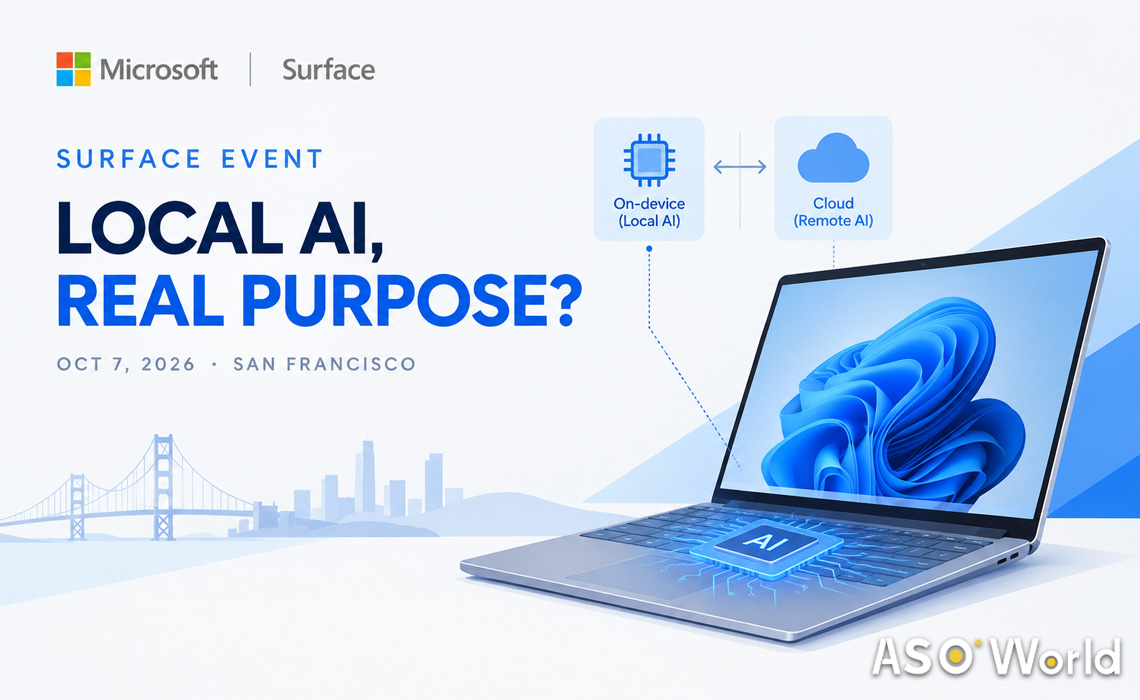

Microsoft’s October Surface event arrives with a large claim: local AI will shape the next chapter of the personal computer. It is an appealing idea. If more AI work can happen directly on a laptop or desktop, features could respond faster, protect more information and work even when an internet connection is unreliable.
But the phrase “AI PC” has become easy to say and hard to explain. Most people do not buy a computer because it contains a new kind of processor. They buy one because it starts quickly, lasts through a day, handles their work and does not create new problems. Microsoft’s task is to show that AI can improve those fundamentals rather than merely decorate them.
Local AI is about where the work happens
Cloud AI sends a request to remote data centres and returns an answer. Local AI uses specialised hardware in the device itself for some tasks. In theory, that can reduce delays and keep sensitive material closer to the person using the computer. It can also enable features that would be impractical if every action needed a round trip to the cloud.
The promise is meaningful, but it needs practical examples. A good event will show specific uses in writing, meetings, media editing, accessibility, search and creative work. A weak event will show a generic assistant doing familiar tasks with a new label. The difference is whether a person can recognise a saved minute, a clearer workflow or a capability they did not have before.
Windows and Surface need to tell one story
Surface has often acted as Microsoft’s statement of intent: a device designed to show how Windows should feel on modern hardware. New Surface products will still be judged on price, display, keyboard, battery life and performance. AI features will only matter if they fit into that whole experience.
Microsoft also operates in a fiercely competitive field. Apple has made on-device intelligence central to its hardware strategy, while Qualcomm, NVIDIA and major PC manufacturers are pursuing their own versions of AI-enabled computing. The race is not simply about who has the fastest silicon. It is about whose software makes the hardware feel valuable.
What to watch when the keynote begins
Look for confirmed device availability and price, not just concept hardware. Watch for which Copilot features run locally, which require the cloud and which are available in different markets. Ask whether privacy controls are understandable. And pay attention to whether Microsoft explains how existing Windows users benefit, rather than speaking only to people buying an expensive new machine.
The event is scheduled for 10 a.m. Pacific Time, early on October 8 in Beijing. This article is designed as a preview for European and North American readers; update it after the keynote with confirmed launches and remove any expectation that is not addressed.

 Follow Us on Facebook