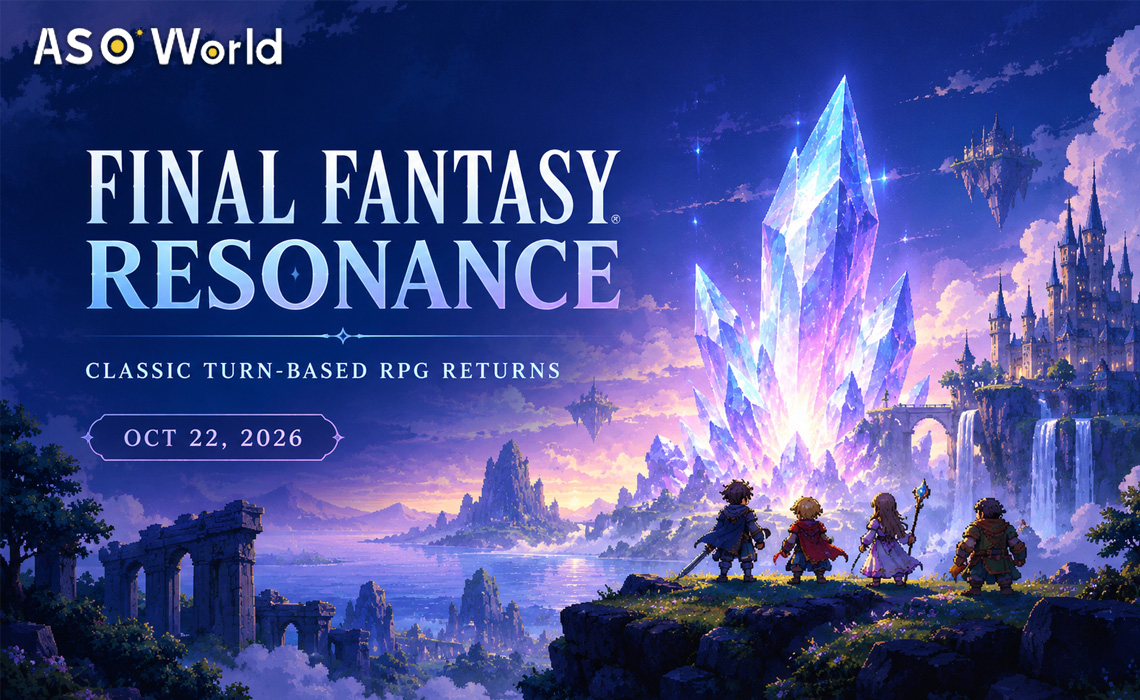

Final Fantasy Resonance brings the long-running RPG franchise back to traditional turn-based combat, combining retro-inspired pixel art, modern 3D environments, and a system that lets players draw on the abilities of familiar Final Fantasy heroes. Launching on October 22, 2026, for Nintendo Switch, Nintendo Switch 2, PlayStation 5, and Xbox Series X|S, with the PC version arriving on Steam on October 23, the game is shaping up to be one of the year's notable releases for classic JRPG fans.
Early reviews have highlighted its tactical combat, attractive HD-2D presentation, and affectionate references to the franchise's history. However, the response is not entirely one-sided. Some critics have pointed to familiar storytelling, uneven pacing, and exploration that does not always match the quality of the battle system.
Based on the first story arc of the discontinued mobile game Final Fantasy Brave Exvius, Resonance is more than a straightforward port. It reworks the original material into a premium, single-player RPG, removing the free-to-play structure and building a more traditional console-style adventure around its characters, combat, and world.
The central question is whether this combination of nostalgia and modernization creates an RPG that stands on its own. The early critical response suggests that its strongest argument is not originality in every department, but how effectively it brings several classic Final Fantasy ideas together.
Final Fantasy Resonance at a Glance
- Title: Final Fantasy Resonance
- Developer: Square Enix and Lancarse
- Publisher: Square Enix
- Genre: Turn-based Japanese role-playing game (JRPG)
- Release date: October 22, 2026; Steam release scheduled for October 23
- Platforms: Nintendo Switch, Nintendo Switch 2, PlayStation 5, Xbox Series X|S, and PC
- Player mode: Single-player
- Visual style: HD-2D, combining pixel-art characters with modern 3D environments and lighting
- Original inspiration: The first story arc of Final Fantasy Brave Exvius
1. HD-2D Graphics Give Classic Final Fantasy a New Visual Identity
One of Final Fantasy Resonance's most immediately recognizable features is its visual direction. The game uses HD-2D techniques to preserve the charm of pixel-art characters while placing them in environments enhanced by three-dimensional geometry, atmospheric lighting, depth effects, and cinematic camera movement.
The result occupies a middle ground between classic 16-bit RPGs and contemporary 3D adventures. Character sprites retain their distinctive silhouettes and expressive animation, while towns, dungeons, and the wider world gain a greater sense of scale and visual depth.
This approach is particularly relevant to Final Fantasy. The franchise has spent decades experimenting with presentation, from its early pixel-art adventures to increasingly cinematic, real-time experiences. Resonance explores what a modern Final Fantasy might look like if it continued developing the visual language of its older games rather than abandoning it.
Its retro aesthetic is therefore more than a nostalgia filter. The contrast between small, stylized characters and expansive environments helps preserve the readability of traditional RPG exploration while giving familiar settings a contemporary presentation.
However, visual polish cannot compensate for every design limitation. If environments offer limited interaction or exploration lacks meaningful discoveries, attractive scenery can eventually become a backdrop rather than a reason to keep exploring. The game's visual presentation is a major strength, but its long-term appeal still depends on what players can do within that world.
2. Turn-Based Combat Is the Game's Biggest Strength
The return to fully turn-based combat is one of the defining features of Final Fantasy Resonance. Rather than blending commands with real-time action, the game gives players time to consider their options, evaluate enemy weaknesses, and plan the order of their moves.
For players who prefer the strategic rhythm of classic JRPGs, this design offers a clear alternative to the action-oriented combat that has featured prominently in recent mainline Final Fantasy releases.
Combat emphasizes party composition, elemental affinities, character-specific abilities, and the timing of powerful attacks. Understanding an enemy's vulnerabilities and selecting the right combination of actions can matter more than simply choosing the strongest available move.
The interface also makes turn order and enemy condition easier to read, helping players understand how their decisions affect the flow of a battle. Quality-of-life options, including adjustable combat speed and convenient travel systems, reduce some of the friction associated with older RPG conventions.
Why the Battle System Works
The most successful turn-based systems make players feel that their decisions matter. Resonance benefits from giving characters distinct combat identities, encouraging players to think about how individual abilities complement one another rather than treating the party as a collection of interchangeable damage dealers.
Its battles are also supported by the Vision system, which adds another layer to character customization and combat planning. This creates opportunities for experimentation and gives encounters a connection to the broader Final Fantasy universe.
Critical responses have frequently singled out the combat as one of the game's strongest elements. For players who have missed traditional command-based battles, Resonance offers a substantial reason to pay attention.
Where Traditional Combat Can Become Repetitive
Turn-based combat is not automatically engaging simply because it is familiar. Random encounters, repeated enemy patterns, and unnecessary backtracking can interrupt the rhythm of exploration if the game does not provide enough variation.
Resonance includes conveniences intended to make progression more manageable, but its overall pacing still depends on how frequently battles introduce new tactical problems. Players who prefer continuous action or rapid mechanical execution may find its deliberate combat less appealing.
The distinction is important: Resonance is not trying to compete directly with action RPGs on speed. Its challenge is to keep a traditional combat loop interesting over the course of a full-length adventure.
3. The Vision System Connects New Characters With Final Fantasy History
One of Resonance's most distinctive mechanics is its Vision system, which allows characters to draw on the powers of heroes from across the Final Fantasy franchise.
Characters such as Cloud, Tidus, and the Warrior of Light appear as part of this broader celebration of the series. Their presence is not limited to visual references or dialogue. The Vision system connects familiar characters to the game's battle mechanics, giving players additional abilities and opportunities to customize their strategies.
This creates a useful bridge between Resonance's own cast and the wider franchise. Longtime fans have an opportunity to recognize familiar heroes and abilities, while newer players can engage with the system as another layer of combat customization.
The appeal, however, depends on more than recognizing famous names. Nostalgic appearances are most effective when they contribute to meaningful gameplay rather than functioning only as references for existing fans.
In Resonance, the Vision system helps give the battle system a distinct identity. It also reflects a wider trend in established game franchises: older characters and recognizable mechanics can be reused in ways that introduce new players to a series while rewarding longtime followers.
4. Story and Characters: Familiar Fantasy With Uneven Pacing
The story follows Rain, a young knight whose journey begins with disturbances surrounding a crystal shrine. Alongside companions including Lasswell and Fina, he becomes involved in a conflict threatening the world's elemental crystals.
The premise draws on familiar JRPG traditions: a young hero, an expanding party, mysterious enemies, powerful crystals, and a journey that gradually reveals a larger threat. Airships, chocobos, summons, and other recognizable elements reinforce the game's connection to the franchise's older adventures.
That familiarity can be an advantage. The narrative establishes its fantasy setting quickly and gives players a recognizable framework for exploring new locations, meeting companions, and confronting increasingly powerful enemies.
Yet familiarity also creates expectations. A story built around well-established genre conventions needs compelling characters, meaningful developments, or strong thematic ideas to distinguish itself from previous adventures.
Character Moments Offer More Than the Main Plot
One recurring point in the early reviews is that the supporting cast can be more engaging than the central narrative initially suggests. Optional quests and character-focused episodes create room for personalities and motivations to emerge beyond the main storyline.
These smaller stories can be especially valuable in a party-based RPG. They give players reasons to care about individual companions and help make the group feel like more than a set of combat roles.
However, the main story's familiar structure and slower opening have also attracted criticism. Players looking for an immediately gripping narrative may need patience before the adventure develops more of its personality.
The broader takeaway is that Resonance's storytelling works best when it focuses on its cast and their relationships. Its conventional fantasy framework provides a reliable foundation, but character development is what can make that framework memorable.
5. Exploration and Dungeons: Convenient, but Not Always Ambitious
Resonance retains several familiar elements of traditional Final Fantasy exploration. Players travel between towns, investigate dungeons, encounter enemies, collect items, and gradually gain access to a larger world.
Airships and fast travel support the sense of a connected adventure while making it easier to revisit earlier locations. Other convenience features help prevent dungeons from becoming excessively frustrating, particularly for players who prefer steady narrative progress over extended periods of navigation.
These adjustments reflect a sensible modernization of older RPG structures. Classic design does not need to preserve every inconvenience simply because it appeared in earlier games.
However, convenience and depth are not the same thing. Some critical assessments have found the world less compelling than the combat system, with limited environmental variety and dungeons that do not always offer enough distinctive challenges.
This creates a noticeable contrast. Battles encourage tactical thinking, while some stretches of exploration provide fewer opportunities for experimentation or discovery.
For players who value a focused adventure with manageable dungeons and straightforward progression, that structure may be welcome. Those expecting a vast world filled with complex environmental puzzles, hidden systems, and substantial exploration rewards may find the experience more limited.
6. From Mobile Game to Premium RPG: What Has Changed?
Final Fantasy Resonance is based on the first story arc of Final Fantasy Brave Exvius, a mobile RPG that originally launched in 2015 and was discontinued in 2025.
That background is important because adapting a mobile game into a premium single-player RPG requires more than updating the graphics. The progression structure, encounter pacing, narrative presentation, and overall relationship between gameplay systems must work without relying on the expectations of a free-to-play mobile experience.
Resonance removes the original game's gacha-driven framework and rebuilds its material into a more conventional RPG format. It also uses HD-2D presentation and redesigned mechanics to establish a different identity from the mobile title.
This approach has two clear benefits. First, it gives existing material another opportunity to reach players who may never have played the original. Second, it allows the developers to build a more cohesive premium experience around characters and systems that already have an established foundation.
However, the adaptation also carries risks. Familiar narrative structures and uneven exploration can make the game feel less ambitious than a completely new mainline entry. The challenge is to make repurposed material feel like a complete experience rather than a collection of elements inherited from an older game.
Resonance's strongest response to that challenge is its combat system and visual overhaul. These elements give the game a recognizable identity, even when other aspects remain more conventional.
7. Platform Availability and Release Date
Final Fantasy Resonance launches on October 22, 2026, across Nintendo Switch, Nintendo Switch 2, PlayStation 5, and Xbox Series X|S. The PC version on Steam is scheduled for October 23, 2026. The game is also listed for PC through the Microsoft Store on Windows.
Its broad platform availability makes the release relevant to players across console and PC ecosystems. The HD-2D visual style also appears well suited to handheld play, where clear character silhouettes and readable environments can be especially valuable.
Players should check their regional storefronts for exact release times, pricing, language availability, and edition details, as these may vary by platform and region.
8. Who Should Play Final Fantasy Resonance?
Based on its design and early critical reception, Final Fantasy Resonance is likely to appeal most strongly to players who value traditional turn-based combat, party customization, and a retro-inspired presentation.
Recommended for
- Classic Final Fantasy fans: Players who miss command-based battles and the structure of earlier entries may find the game particularly appealing.
- Turn-based RPG enthusiasts: The tactical battle system and character-specific abilities provide reasons to experiment with party composition.
- HD-2D fans: Players who enjoy the combination of pixel art, three-dimensional environments, and modern lighting may appreciate its visual direction.
- Players interested in the franchise's history: The Vision system and familiar characters provide connections to earlier Final Fantasy adventures.
- Players who prefer focused RPGs: Convenient travel and manageable dungeon progression may suit those who want a structured adventure without excessive backtracking.
Who May Want to Wait?
- Players seeking a highly original story: Familiar fantasy tropes and a conventional central plot may not provide enough narrative surprise.
- Fans of action-heavy combat: The deliberate, command-based system is fundamentally different from real-time action RPGs.
- Exploration-focused players: Those who expect every dungeon and region to offer substantial environmental challenges may find some areas less ambitious.
- Players unfamiliar with older JRPG conventions: Random encounters and traditional progression may take some adjustment, even with modern convenience features.
Final Verdict: A Strong Return to Classic Combat, With Familiar Limitations
Final Fantasy Resonance makes a persuasive case for the continued appeal of traditional turn-based RPGs. Its HD-2D presentation gives the series' familiar visual language a modern treatment, while the Vision system and tactical combat provide a clear mechanical foundation.
Its greatest strength is the way these systems work together. Rather than relying entirely on nostalgia, Resonance gives players a combat-focused reason to revisit the structure of classic Final Fantasy adventures.
Its limitations are equally important to recognize. The familiar storyline, uneven pacing, and less ambitious exploration mean that the experience does not necessarily reach the same heights in every area. Players who prioritize narrative originality or richly interactive worlds may find the game less compelling than those who primarily value combat and presentation.
Ultimately, Resonance is best understood as a deliberate return to a particular style of RPG rather than an attempt to redefine the entire franchise. For players who have been waiting for a new Final Fantasy experience built around traditional turn-based battles, it is a release worth watching as it arrives on consoles and PC.
FAQ
When does Final Fantasy Resonance release?
Final Fantasy Resonance launches on October 22, 2026, for Nintendo Switch, Nintendo Switch 2, PlayStation 5, and Xbox Series X|S. The Steam version is scheduled for October 23, 2026.
What platforms is Final Fantasy Resonance available on?
The game is scheduled for Nintendo Switch, Nintendo Switch 2, PlayStation 5, Xbox Series X|S, and PC. PC availability includes Steam and the Microsoft Store on Windows.
Is Final Fantasy Resonance turn-based?
Yes. The game uses a traditional turn-based battle system, with tactical decisions built around party composition, character abilities, enemy weaknesses, and the Vision system.
Is Final Fantasy Resonance a remake of Final Fantasy Brave Exvius?
It is based on the first story arc of Final Fantasy Brave Exvius, but it has been reworked into a premium single-player RPG with revised gameplay, HD-2D visuals, and changes to the original mobile game's structure.
Do players need to know previous Final Fantasy games?
Previous series knowledge can make the references and returning characters more meaningful, but Resonance follows its own central cast and story. Newcomers can approach it as a standalone fantasy RPG.
What is the biggest strength of Final Fantasy Resonance?
Early reviews most frequently highlight its tactical turn-based combat and HD-2D presentation. The Vision system also adds a layer of customization connected to the wider Final Fantasy franchise.

 Follow Us on VK