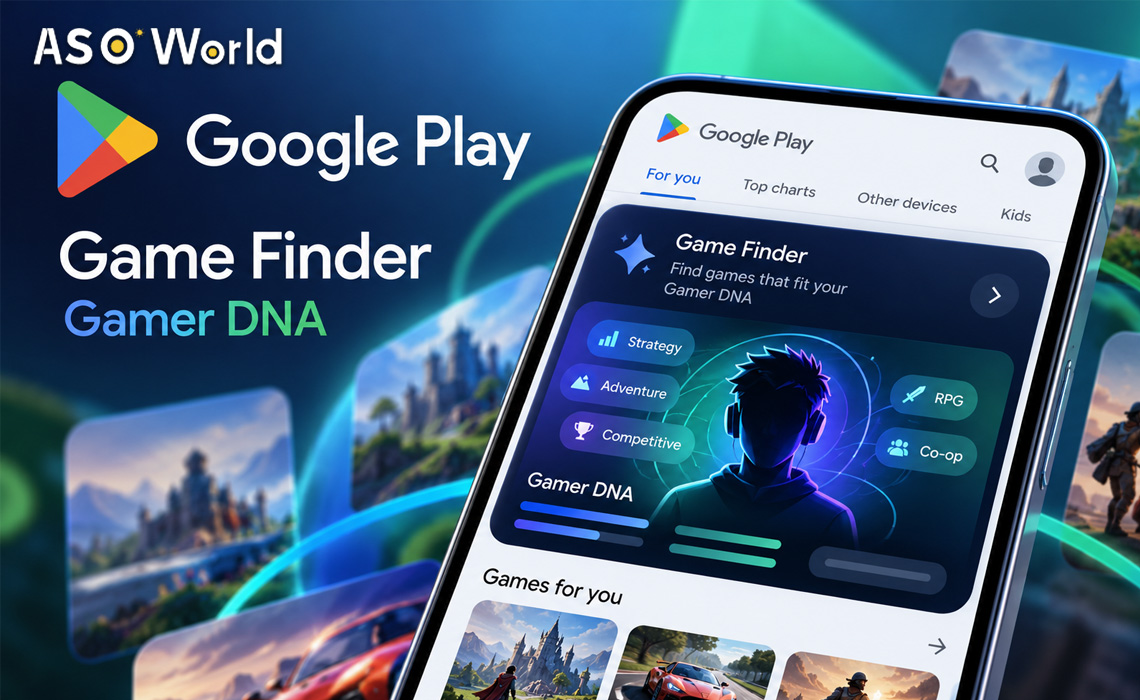

For years, one of the biggest questions in the app economy has been deceptively simple: how does someone actually find the right app? Google's answer, rolled out this month for Google Play, is to stop showing everyone the same store. Announced as part of Google's October 2026 Play Store update, Game Finder is a new AI-powered discovery tool that builds a personal "Gamer DNA" profile and uses it — alongside Gemini — to surface games a player is genuinely likely to love. Initially live for English-language users in the United States, with more markets to follow, the feature is one of the clearest signals yet that app store discovery is shifting from popularity rankings toward personal relevance.
And while Game Finder is a gaming feature, the machinery behind it speaks to anyone shipping an app: search, recommendations and even editorial-style placements are increasingly generated per user, not for the crowd.
What Google Actually Announced
Game Finder lives inside the Games tab of the Play Store as a feed chip. When a player opens a title from that feed, a details panel explains why the game suits them, summarizes player reviews with AI, and shows real people playing it — including accounts they follow and "similar players." Google has kept the feature opt-in: personalization and Play history must be enabled before a Gamer DNA profile is generated. The launch arrived alongside a wider cluster of Play updates aimed at discovery and engagement.
| Feature | What it does | Status |
|---|---|---|
| Game Finder | AI game recommendations matched to a personal "Gamer DNA," with explainable "why you might like this" reasoning | Rolling out to English-language users in the US |
| Gamer DNA | A Gemini-generated gaming profile spanning motivations, pace, vibe and mechanics — user-tunable | Tied to Game Finder opt-in |
| Ask Play comparisons | Conversational AI now compares apps side by side on subscriptions, features and reviews | Expanding |
| Gemini app discovery | AI-driven discovery credited with 6M+ installs in its first two months; now reaching Gemini Live for voice | Live / expanding |
| Game Playlists | User-built game collections organized by genre, mood or activity | Rolling out; sharing to follow |
| Sprints & Playbacks | 48-hour skill-matched challenges for 2–5 players; 30-second shareable clips via Sidekick | Rolling out |
| Community Posts | Discussion threads attached directly to game listings | Rolling out |
| Game Trials on PC | Try premium PC titles before purchasing | Expanding |
What Exactly Is "Gamer DNA"?
Google's own help documentation describes Gamer DNA as "your unique gaming profile" — and stresses that it deliberately goes beyond genre labels. Rather than sorting players into a handful of categories, it tries to decode motivations and specific game characteristics. The profile has three parts: an AI-generated persona (avatar, title and short description), a list of games a user has played and can rate, and a "fine-tune" area for adding or removing preferences.
Under the hood, the system blends gameplay history, post-install surveys, ratings and followed genres, then scores each candidate game against a set of behavioral signals:
| Signal | What Gamer DNA reads |
|---|---|
| Session length | How long a player tends to play in one sitting |
| Vibe & setting | Mood, theme and art style |
| Pace | How fast, action-packed or relaxing a game feels |
| Core gameplay | The actual loop — driving, matching, building and so on |
| Upgrades & customization | Progression, rewards and character personalization |
| Strategy & difficulty | How much planning is required and how hard it is to learn |
| Social & competition | Offline play, teaming up, or competing against others |
Two design choices stand out. First, explainability: the panel tells a user why a given title fits their profile — an unusually transparent move for a recommendation engine. Second, control: players can push preferences toward "More of this" or "Less of this," or avoid traits such as heavy in-app purchases. That last detail is one app marketers should read very closely.
The Bigger Story: Discovery Is Going Personalized Everywhere
Game Finder is not happening in a vacuum. Across both major stores, the one-size-fits-all storefront is fading. Apple has been threading AI through the App Store via AI review summaries, natural-language search and App Intents, while Custom Product Pages let developers serve different store experiences to different audiences. Google has mirrored the idea with Custom Store Listings. The shared trajectory is identical: ranking position for a fixed keyword matters less than relevance to a specific user in a specific moment.
Google's own disclosure is the tell. The company says AI-driven discovery through Gemini generated more than six million installations in the first two months after launch — evidence that assistants, not just store search bars, are becoming front doors to apps. As AI assistants such as Gemini, ChatGPT and Siri recommend apps conversationally, discovery is migrating upstream of the store entirely.
📱 App Marketing Angle: What This Means for Developers
Game Finder adds a fresh discovery surface — and a fresh unknown. Google has not disclosed how Game Finder recommendations interact with existing search rankings or whether they lift download conversion, so the safer strategy is to optimize for relevance, not just keywords: keep your listing language aligned with the motivations Gamer DNA rewards (pace, vibe, core mechanics), and treat personalized store pages as a core growth lever rather than a nice-to-have. For a deeper playbook, see our guide to ASO best practices and strategies for 2026.
The Open Questions for Developers
Three unknowns will shape how much Game Finder really changes the game. The first is rankings: Google has been explicit that relevance is rising, but silent on whether Game Finder placements feed back into traditional search ranking — a detail that could quietly reprice the value of ASO. The second is conversion: a recommendation that fits a player's DNA should, in theory, convert better and retain longer, but Google has published no lift figures. The third is privacy and trust: because the system is opt-in and feeds on gameplay history, surveys and ratings, the quality of recommendations — and of the "explainability" claim — will be tested by users who can now see exactly why an app was chosen for them.
What Comes Next
For now, Game Finder is a US-only, English-language rollout, and Google has said expansion to additional markets is planned. Developers should expect the surface to evolve quickly: the same Gemini backbone already powers Ask Play comparisons and voice-based recommendations through Gemini Live, and Google has signaled it intends to keep folding conversational AI into how people browse. The practical takeaway is not a single feature launch, but a direction of travel — store metadata that describes what an app feels like, not just what it is, is about to matter more than ever.
Frequently Asked Questions
What is Google Play's Game Finder?
Game Finder is an AI-powered discovery feed inside the Google Play Games tab. It recommends games based on a player's "Gamer DNA" profile and can explain why a title matches their tastes.
What is Gamer DNA?
Gamer DNA is a Gemini-generated profile of a player's gaming preferences. It goes beyond genres, weighing signals such as session length, pace, vibe, core gameplay, upgrades, difficulty and social play — and users can tune it toward or away from specific traits.
Is Game Finder available everywhere?
Not yet. The feature initially rolled out to English-language users in the United States, with Google indicating broader market availability to follow.
The Bottom Line
The headline is a gaming feature, but the story is far bigger. Google Play's Game Finder and Gamer DNA are the clearest statement yet that app store discovery is being rebuilt around the individual user — and that AI assistants are becoming a primary path to installs. For developers and marketers, the winners will be the teams that stop chasing a single ranking and start designing for relevance at scale.

 Follow Us on Facebook