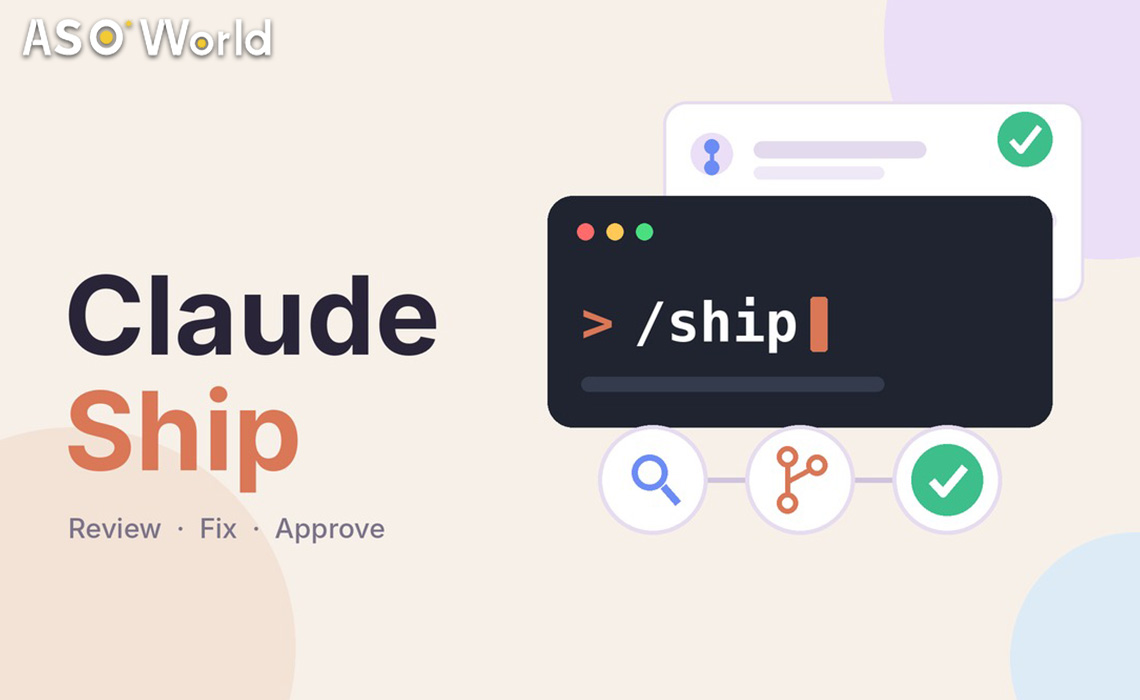

Code Review is already generally available; PR Steward and Claude Approvals arrive in beta for Team and Enterprise GitHub repositories, with a natural-language policy file deciding what ships without a human.
Anthropic on Monday launched Claude Ship, a set of agents that review, fix and approve routine code changes — moving the company from generating code to deciding when that code is ready to merge. The suite is in beta for Claude Team and Enterprise customers on GitHub, and it is invoked from Claude Code with a new /ship command.
Two of the three components are the actual news. Code Review, which runs Quick, Standard or Deep passes on a pull request, was already generally available. PR Steward and Claude Approvals are new, and both are in beta.
Three agents, one command
| Agent | Status | What it does | Where it stops |
|---|---|---|---|
| Code Review | Generally available | Runs Quick, Standard or Deep review passes on a pull request | Produces findings; does not approve |
| PR Steward | Beta | Fixes failing CI checks, merge conflicts and review feedback; comments after every push with what changed and how to roll back | Cannot approve or merge; developers can steer or halt it with @claude and @claude stop |
| Claude Approvals | Beta | Reads a team-written policy file on the default branch and approves changes that qualify as routine | Escalates anything outside policy to a human |
The division of labor is deliberate. PR Steward does the maintenance work that slows a pull request down — red builds, conflicts, review comments — but it is explicitly barred from approving or merging. Claude Approvals holds the decision, and only the decision.
The policy file is the interesting part
Claude Approvals does not decide from a fixed rubric. It reads an approval policy that the team writes into the repository's default branch, in natural language, and applies it to incoming changes. That policy can draw on Code Review findings, the company's own classifiers, or other signals the team defines.
The practical effect is that review authority becomes a versioned artifact. A rule like "approve dependency bumps that pass CI and touch no more than two files" can be written down, reviewed, diffed and rolled back like any other code. Anthropic's blog frames the motivation plainly: most teams want a person to approve every change, and that is manageable when people write every line — but a growing share of code is now written by agents, and the review queue becomes the bottleneck.
That is the shift worth watching. Claude Ship does not make code generation faster; it moves the constraint from writing to approving, then automates part of the approval. Whether that is safe depends entirely on how well a team can express its own standards as rules — and how often the rules are wrong.
What the numbers show, and what they do not
Anthropic says its own Claude Code team more than doubled merged pull requests between June and September, while the share of reverted PRs fell by more than 40%. The figures are specific and directionally impressive, but they come from the vendor, describe a single internal team, and were produced on the company's own codebase with its own tooling.
There is no control group and no external audit. The numbers are best read as a proof of concept rather than a benchmark: they show that the workflow can produce more merged changes with fewer reversions inside Anthropic, not that it will do the same in a codebase with different review norms, test coverage or compliance requirements.
Running it without handing over the keys
Anthropic's own rollout guidance is cautious, which is telling for a product whose selling point is autonomy. Teams are advised to run the approval agent in observe-only mode first, so its decisions can be compared against human ones before it is allowed to act. Starting with a single repository limits the blast radius. Monthly spending limits cap what the agents can consume.
Teams also keep control of where Claude Ship runs, which review depth it uses, and which categories of change must escalate to a person. Those settings are the real policy surface: the difference between a useful filter and an incident is usually a rule about what the agent is not allowed to touch.
Where it fits
The launch lands in a busy stretch for Anthropic. The company went public this month in a record $81 billion IPO, and public-market pressure to show revenue puts a premium on products that can be sold per seat to engineering organizations. Claude Ship's availability on Team and Enterprise plans, rather than individual accounts, points in that direction.
It also arrives as rival platforms push agents deeper into the development stack. Google's Gemini 4 Neon release is competing on model access and price, while Apple is reportedly building a Mac AI agent that can operate a Mac the way a person would. Claude Ship is narrower and more concrete: it owns one step of the pipeline, and it owns the one with the sign-off.
For more on the companies and models behind these launches, the AI Tech section tracks the rollout as it develops.
Availability
Claude Ship is rolling out to Claude Team and Enterprise plans for repositories on GitHub. Code Review is generally available; PR Steward and Claude Approvals are in beta. As with any beta, behavior and interfaces can change before general availability.
What to Watch Next
Policy files as repository artifacts.
If teams start reviewing their approval rules the way they review code, the file becomes a new kind of engineering document — and a new source of outages when it is wrong.
Audit trails.
Regulated teams will want to know which change was approved by which rule, at which version. Anthropic has not detailed how that record is exposed.
Hosting beyond GitHub.
The beta is GitHub-only. GitLab and Bitbucket support would decide whether this becomes a general workflow or a GitHub-shop feature.
The first high-profile misapproval.
One bad automated approval in a public repository will shape how the category is regulated and how cautious the next set of policies becomes.
Quick answers
What is Claude Ship?
A suite of three agents from Anthropic that review pull requests, fix routine problems and approve changes that match a team's written policy. It runs on GitHub for Claude Team and Enterprise customers.
Can Claude approve code without a human?
Yes, within the limits of a policy file the team writes. Claude Approvals can auto-approve routine changes and is designed to escalate anything outside those rules.
Is Claude Ship generally available?
Only Code Review is. PR Steward and Claude Approvals are in beta, and Anthropic recommends starting in observe-only mode on a single repository.
Does PR Steward merge code?
No. PR Steward fixes failing checks, conflicts and review feedback, but it cannot approve or merge. That decision belongs to Claude Approvals or a human.

 Follow Us on Facebook